
Category: Debates

  • New attitude to work: or a return to an old one?

    New attitude to work: or a return to an old one?

    Motion: the UK needs a new attitude to work

    Debated: 6 July 2026, Ye Olde Cock Tavern, Fleet Street

    Format: main debate, proposer and opposer, 13 floor speeches

    ‘The UK needs a new attitude to work.’ The chair read the motion to a room of about twenty, framing it against the productivity crisis and the million young people not in education, employment or training. A show of hands before the speeches gave the proposition an early lead of 10 to 3. What followed was less an argument about whether British working life is in trouble than about what kind of trouble it is, and whether a new attitude to work is the cure or the misdiagnosis.

    The proposer’s case for a new attitude to work

    Ross Hunter proposed the motion and Helena Wardle opposed it.

    The comparison that framed a new attitude to work

    The proposer opened with two decades of numbers. Real wages in this country, they claimed, have risen by about 4.5 per cent since 2008, while American incomes over the same eighteen years rose roughly three times as fast from an already higher base. They set that beside the count of young people not in education, employment or training, now above a million.

    Having arrived from the United States twenty-one years ago, the proposer ruled the American model out. Losing a job there means losing health cover, which hands employers a power over staff they called bonkers. The NHS removes that fear. The point of the comparison was narrower: some American habits, particularly the spread of technology through ordinary firms, could be adopted without giving up anything Britain values.

    Culture, investment and class

    Three arguments followed. On culture, they noted that a national sporting fixture can flatten a working week here in a way it would not elsewhere, and that a disdain for technical work and for talking about money carries a cost. On investment, they cited Britain’s standing in international comparisons, putting British investment at roughly half the level of other G7 countries and the country as having coasted too long on Victorian infrastructure.

    The third was offered as a taboo. Where a marginalised group was exploited a century ago, the proposer argued, resistance made sense, but a hangover of that attitude now persists in a workforce that no longer needs it. Cynicism about who has the connections, they said, is a reason for action rather than a reason to disengage. The motion asked only for a change of attitude, not a change of hours.

    The opposer on a new attitude to work: recover the old one

    Not a new attitude to work but an older one

    The opposer took the motion in the other direction and argued the country needs to recover an attitude it has lost. She began by heckling the proposer on purpose, then explained why: conformity is the thing under defence, and a debate is a poor place to practise it. Nobody knows what the future of work looks like, and humans have thrived without knowing before.

    Her case rested on childhood. She questioned one member from the floor about cycling long distances as a young man, unsupervised play and the absence of any fear of failure, then asked whether a modern childhood looks the same. She took the answer to be the root of the problem. Independence, curiosity, adventure, making your own decisions and challenging authority are learned young or not at all.

    Work as adult school

    Work, on her account, has become adult school: standardised tests, tick-box recruitment and a reluctance to say that a boss is wrong. Childhood jobs, the paper rounds and the waitressing, taught transferable skills that recruitment systems no longer look for. She described arriving from South Africa with a handful of CVs, walking into every shop on a high street and being offered work by a florist on the strength of willingness alone, and traced her own career to a chance conversation behind a counter.

    Remote working removes the thing that made this possible, she argued: watching people who know what they are doing, and overhearing them. Her firm recently hired someone into a developer role who cannot yet code, on the basis that she understood the problem and had held nine or ten jobs already. The ask she left with the room was not policy but obligation. Mentor the young, because they are no longer learning at work the way the room did.

    Voices from the floor on a new attitude to work

    Blame, and where a new attitude to work should be aimed

    The first floor speaker objected to what they heard as blame directed at working people, and challenged the idea that this is a British problem at all. Quiet quitting, they noted, appears across the West and most intensely in Japan. American growth, they claimed, looks less exceptional once capital flows and the tech sector are stripped out, and the investment gap is a choice about austerity rather than a national temperament.

    A later speaker made the same move from a different angle. Attitudes are rational and incentive-driven, they argued, so what has changed is circumstance, not character. Working from home leaves juniors unwatched and unmentored, and they offered the example of a graduate who sat for forty-five minutes watching a query that should have taken three, simply because nobody was sitting beside them.

    The sceptics: what would a new attitude to work actually change?

    Two speakers declined to be moved. One, who had worked in management development at a corporation employing thirty thousand people, pointed out that the motion proposes nothing: it says only that things ought to be different. They added that they had once asked the Treasury and major consultancies what causes economic growth and received no answer, and that the research on the 1930s depression suggests you do not get out of one. They intended to abstain.

    Another abstainer attacked the class argument directly. Class is not a British peculiarity, they argued, being present across Europe and Asia without producing the same results. They also disputed the account of hiring: graduate recruitment now runs to four or five anonymised stages, so networking gets a young person little more than the address of an application portal.

    Money, mobility and comparisons abroad

    A speaker who had spent thirty years in the United States and fifteen here, having grown up in a Chinese household, agreed that Britain treats money as slightly dirty and wealth as suspect. They asked which areas the country should invest in, and warned that hard work without direction produces nothing.

    A speaker who works in a church took a different view. Of 6.9 million people aged 16 to 24 in England, they noted, 5.9 million are doing something, and the remaining million includes carers and others with reasons. Vacancies exist in hospitality and social care. What the country needs, they argued, is not a new attitude to work but a new attitude to meeting people’s needs, and a redistribution of wealth to match. Asked what would then motivate the people creating that wealth, they replied that they would rely on human goodness instead.

    Government policy as the real obstacle

    Several speakers moved the blame to Westminster. One argued that employers’ national insurance, the minimum wage, business rates and expanded employment rights have together made hiring a young person too risky, and traced the anxiety they see in that age group to school closures during the pandemic and to a failure to prepare for a coronavirus rather than an influenza.

    Another asked why a country that taxes alcohol and tobacco to reduce consumption also taxes work, and turned to artificial intelligence: Britain is not winning that race, and the abundance it might create will be housed elsewhere. A third offered the closure of Hammersmith Bridge as the whole argument in miniature. Approved in 1824 and finished in 1827 for £82,000, about £7.6 million today; shut since 2019, and now quoted at seven years and £300 million to repair.

    A new attitude to work, or a model breaking down?

    One speaker agreed with the opposer about childhood and observation while rejecting the idea that government caused it. What is breaking down, they argued, is a technological and social model barely two centuries old. Before the industrial revolution most people were born into a trade and worked to the rhythm of the seasons. The factory system created the clock, the interview and the freedom to leave one employer for another, and artificial intelligence is now unsettling all three.

    Another speaker tried to reconcile the two openers, arguing they had more in common than either admitted. Jobs became about ticking boxes and avoiding risk, they said, and the productivity problem sits in the long tail of small firms with poor incentives and poor management rather than at the top. Young people see wider opportunity through their phones, and the gap between that and a box-ticking job keeps widening.

    What a new attitude to work asks of the young

    A speaker in the age group under discussion pushed back on the charge of fragility. Graduate schemes are two-year fixed contracts, they argued, and companies take on more graduates than they have permanent roles for, so the disloyalty runs in both directions. Offices reward showing your face, speaking first and booking the meeting rather than its output. Quiet quitting, on this account, is a response to being used for groundwork and dropped, and cutting entry-level roles to artificial intelligence removes the middle managers of five years’ time.

    The chair closed the floor on schooling and confidence: homework in private schools long before state schools, classes of twelve against classes of thirty-five, and the difference that makes to whether a child speaks up. They objected to the rhetoric around welfare and mental health, and traced the rest to manufacturing decline, to Brexit and to a Saturday job that now requires an application, an interview and a four-hour contract at Christmas.

    Closing arguments: the opposer

    The opposer revealed that she had been due to propose the motion until earlier that day, and had planned the opposite case on the train. Productivity is not efficiency, she argued, and a £300 million bridge is not a problem money will solve.

    She agreed that artificial intelligence will destroy jobs, and predicted that anyone who does not embrace it within five years will be unemployable, but insisted the more important question is transferable skills. Junior roles are dying, and a chief executive who refuses to hire junior engineers has forgotten where senior ones come from. We have forgotten how to fail, she said, and children have not.

    Closing arguments on a new attitude to work: the proposer

    The proposer conceded that neither opener had mentioned artificial intelligence, which he called bonkers given that both work in it. He took the graduate-scheme argument from the floor as the strongest thing said all evening, and turned it into his own: those schemes are the best jobs available to people of that age, and if managers are not mentoring or stretching them, that is the work culture in miniature.

    He rejected the idea that he was blaming working people, noting that those at the top can afford their own idleness, and argued that a century of bailing the country out has left it in a funk it needs to shake off.

    The final vote on a new attitude to work

    The motion carried, 11 votes to 7, with 2 abstentions. The room had gone in 10 to 3 in favour, so the margin narrowed even as the proposition’s raw total rose. Both abstentions were declared in advance by speakers who said the motion proposed nothing concrete to change. The room agreed that something in British working life has gone wrong; it did not agree on whether the fault lies with attitudes, with government or with a model of work that is simply running out.

    Why the new attitude to work motion carried

    A motion this broad usually loses, because a room can always find a reason to say that the words commit nobody to anything. This one won because the proposition did not have to hold its opening ground. By the second half of the floor the question had quietly changed from whether British workers try hard enough into whether British institutions still work, and almost every speaker who answered that second question answered no. In his closing the proposer adopted the strongest version of that reframing, and the motion proved wide enough to accommodate it.

    The proposition’s case: comparison, investment and class

    The opening speech was built on three legs of unequal strength. The economic comparison was the sturdiest, partly because it pre-empted the obvious objection by ruling out the American model on its own terms. Conceding the NHS point early cost nothing and bought a hearing for everything after it.

    The investment argument went almost unchallenged all evening, which is worth noting because it was the most concrete thing said. Nobody disputed that British investment lags the G7. What speakers disputed was the cause, and the answer they preferred was austerity rather than temperament.

    The class argument was the gamble, and it drew the sharpest replies. Two speakers pointed out that class exists across Europe and Asia without the same consequences, which is a hard rebuttal to answer. The proposer had invited exactly that response, and inviting it took some of the sting out, but the leg did not hold weight.

    What the numbers did, more than persuade, was set the terms. Once the chair had framed the motion against the productivity crisis and the NEET figure, every speaker who followed had to say something about young people and something about output. Anyone wanting to argue that British working life is fine had no obvious ground left to stand on.

    The opposition’s case: childhood, observation and obligation

    The opposition’s strongest move was structural rather than rhetorical. Refusing to defend the status quo and arguing instead for recovering an older attitude meant she never had to claim that British working life is fine. It also created her one real vulnerability, which the floor spotted within the hour: a motion asking for a new attitude is satisfied by any change of attitude, and recovering a lost one qualifies.

    Two speakers said so explicitly, and one of them voted with the proposition on that ground alone. The opposition case was strongest where it was least like a rebuttal. The observation about remote work removing the chance to watch competent people at close range was picked up and extended by two later speakers, and nobody argued against it.

    Her second difficulty was that the case was addressed to the room rather than to the motion. Asking twenty people to go away and mentor somebody is a call to action, and it landed. It is also, on any reading, a change of attitude, which is exactly what the motion asked for.

    The ebb and flow of the floor debate

    Thirteen speakers took the floor and the centre of gravity moved twice. It began close to the opposition, drifted through a long middle passage about government and technology in which the motion itself was barely mentioned, and settled at the end on employers and the young. Two speakers announced abstentions along the way and neither was talked out of it.

    Battleground one: was a new attitude to work an accusation?

    The first two floor speeches treated the motion as a charge against working people and defended them. This was the opposition’s best stretch of the evening, and the proposer’s decision to answer it explicitly in his closing suggests he thought so too. What blunted it was that the defence conceded the premise. Once a speaker argues that quiet quitting is a rational response to bad incentives, they have agreed that something needs to change, and the motion does not specify who has to change it.

    Battleground two: government, technology, or something older

    The middle of the evening belonged to speakers who located the problem outside the workforce entirely: in tax and employment law, in the handling of the pandemic, in the cost and speed of building anything, and in the arrival of artificial intelligence. The bridge example did a lot of work here. It converted an abstract complaint about attitudes into a number, a date and a piece of infrastructure that people in the room drive past.

    These speeches read as opposition to the government rather than opposition to the motion, and several of them ended in the proposition lobby. The speaker who argued that an entire model of work is breaking down offered the deepest version of the same thought, and reached the same destination by a longer road.

    It is worth noticing what nobody said. No speaker defended British management as it stands, and no speaker argued that productivity here is fine. A motion that needs only agreement that something must change collects those speakers by default, whatever they believe the something to be.

    Battleground three: what a new attitude to work asks of the young

    Late in the evening the floor produced the decisive speeches. The account of graduate schemes as two-year contracts that end in a drop reframed the evening’s central complaint as a description of employers rather than employees, and it came from someone speaking about their own position. The chair’s speech on class sizes, confidence and welfare rhetoric extended it downwards into schooling.

    Neither speech was a rebuttal of the opposition. Both were compatible with everything she had said about childhood and mentoring, which is why the opposition could not convert them. They were, however, precise about what ought to change, and the motion only ever asked for that.

    Closing arguments on a new attitude to work, and what drove the result

    The two closings pulled in the same direction more than either intended. The opposer spent hers on junior roles disappearing, on the need to embrace artificial intelligence and on mentoring; the proposer spent his on graduate schemes, on managers who do not stretch the people they hire, and on artificial intelligence. A listener arriving at that moment would have struggled to say which was proposing.

    That convergence explains the numbers better than any single speech. Seven people voted against a motion whose opponent had just agreed that work must change; they were voting against the word ‘new’, or against blaming attitudes, or against a motion that named no remedy. The two abstentions came from the two speakers who had said from the floor that the motion proposed nothing, and they held that line to the end.

    The proposer also did something the opposition did not, which was to take an argument from the floor and make it the centre of his reply. Adopting the graduate-scheme case put the strongest thing said that evening on the proposition’s side of the ledger, and it left the opposition’s own best material, about mentoring and about watching competent people work, sounding like agreement.

    Conclusion

    The pre-vote margin was wider than the final one, which is the reverse of what the raw totals suggest and the more interesting figure. Late arrivals and a break account for some of it, and in a house of twenty a few votes are noise.

    What is not noise is the direction of the argument: the room grew less willing to talk about attitudes and more willing to talk about institutions as the evening went on, and voted for the motion anyway. A country can decide it needs to work differently long before it can agree on who is working wrongly.

    Full transcript of the new attitude to work debate

    Read the full transcript

    The motion, and the show of hands before the speeches

    Good evening, everyone. The motion is: the UK needs a new attitude to work. It is more in reference to NEETs and the productivity crisis. What I would like to know is how people feel about the motion. How many are for the motion? Ten. And who is against the motion? Three. Thank you. Would the proposer like to start, please.

    The proposer opens: two lost decades

    Good evening, everyone. It is a very important topic and I am sure we will have a wide-ranging debate. I am interested that all of you have come out tonight, because it was a big night last night. How many of you were watching the football? Three. I think there are some other Sylvans who probably did watch the football and may not have made it out tonight. Far be it from me to take anything away from the national sport, but let us get into the subject and think about what our attitude to work is in this country.

    I came to the UK almost twenty-one years ago, and the scary thing that has happened is this. Since 2008, a couple of years after I arrived, real wages in this country have gone up by 4.5 per cent. Everyone on average can buy 4.5 per cent more than they could in 2008. I am not saying that buying things is the most important thing in life. People in the UK increasingly value earning a lot of money less, and I think that is a good thing. Trying to earn stupid amounts of money leads to people like Elon Musk.

    At the same time, we are struggling. The United States over that period went up three times as fast. Their incomes went up by 14 per cent over the same eighteen years, and at that time they were already far wealthier than we were. When I came to the UK in 2005 the salaries in dollar terms were the same. The pound was two dollars, then in the crisis it went to 1.3, and it reverted to roughly what it was before. The UK has always been not as wealthy as the US in recent times, which is fine.

    I am American. Tonight is about the UK, not about America. I am going to use the US as a contrast and draw comparisons between the two. I am not trying to say the American model is the right model. It is not the right model for the UK. But we have to look outside and ask whether we have the right model here, and what the best model for us is. If we sit in our own echo chamber that is not necessarily the right thing to do, and the Sylvans is all about busting up echo chambers.

    The other sobering statistic, as the chair alluded to, is that we have over a million NEETs, not in education, employment or training. Those are young people. A million people. We have had two lost decades for the economy, and we have a million people who could be lost for themselves, lost for the economy and lost for everyone. Imagine being one of those people. People who come out of school or out of university and do not start working have their whole lives affected by it. It changes their entire life prospects. So we have won the football, fantastic. But are we winning? We have some real challenges here.

    I had a choice. If I had stayed in the US, over those twenty years I would have worked quite a bit harder, probably 20 or 30 per cent harder, more hours, harder driving, and I would have earned a shitload more money. I am glad I am here. I could not work in the US any more. It is too insane. It is bonkers. Bosses have huge amounts of power over their staff. You lose your job, you lose your health care, and that gives them excess power. Imagine that. You do not want to get sacked because you could lose your health care. We would never face that here, and it is a much better way of running an economy.

    At the same time, the productivity they have there is far higher. They work harder. They use technology much more, and technology use is much more widely spread across US companies than it is here. Some of those things we could adopt here without changing the culture. We can keep the NHS and adopt some of them, and we would all be better off. We could possibly even work the same amount and still be a lot better off. It is not about working more hours.

    The context, and how other countries organise work

    So that is the context. Sorry to start with a downer, but it is tough out there. People feel it. I know so many people who are struggling. Then I look at my children, and they have a different attitude to work from the one I would have had at their age. I am a foreigner and I cannot fully understand British culture, but I observe a lot. Some things I can see clear as day. Others are more subtle and harder for me to understand. When I hear my children say “I can’t be bothered”, that is an attitude you would not get in the US. That phrase does not exist there. You have people who might say something similar, but the idea that you could possibly say that, nobody would.

    Even in France or Germany it is different. Germans do not necessarily work long hours, but they have a totally different attitude to work. In Germany the lower-paid staff work shorter hours and the highest-paid people work the longest hours by far. When I was working in Germany, the partners in consulting firms and law firms worked twenty-four hours a day. They are paid the most and they feel it is only fair that they do the most work. Their mid-level and base-level staff have the shortest hours and the full benefits.

    I am not saying that is the right model for us either. The point is that different countries set work up differently, and the question is whether we have the right one for us. France shuts down in August. Their productivity is not especially high, but they probably work fairly efficiently because they do not work that much, and they are about as rich as we are. There might be something we could learn from the French as well, and the food culture is excellent.

    Culture, and the cost of a national shrug

    I want to talk about three areas, and the third is a massive taboo. I am already breaking taboos here and I am going to break another one.

    Culture. I have touched on it already. In a lot of countries, take the Super Bowl in the US, it is on a Sunday evening and there are plenty of people who get drunk and are probably hungover at work the next day. I will tell you, they at least pretend that they are twice as efficient on the Monday morning. They are not turning up late. They get in early and double the amount of work they do that morning just to prove that they are still working.

    Shutting down work, taking a bank holiday for sport, would never happen here. I am not saying we should not keep football culture, but there is a cost to it, and the question is whether we have the balance right. I am sure people are going to hate that argument, but I am putting it out there because we need to kick it around. Pun intended.

    In the UK there can be a disdain for technical things, for technology, for money, for talking about money. Not valuing high earnings, I like that. But if we disdain all of it we are going to fall behind, and we will not be focusing on the things that could help everyone. So there is part of the culture that we need to think about.

    My second point is investment. We have the lowest investment of any G7 country by miles. Our investment levels are something like half of the other G7 countries. Italy is a G7 country and our investment is way below Italy’s, and the Italian economy is really weak. We have infrastructure from Victorian times. It was amazing infrastructure then and it is still all right now. If we get the wrong kind of leaves or the wrong kind of snow we have a problem, but most of the time it works, and that is actually good. Leveraging old infrastructure is a high-return thing. The problem is that it is not quite good enough. We have coasted on it too long.

    It is not just infrastructure. Investment applies inside work too. I have a small team of ten people, and we have a new tool we could use. In order to start using it we have to do work. We have to set ourselves back a little to get to the point where everything we do afterwards is much easier. It is very difficult to convince people to do that.

    To get ahead you have to invest. Everyone who comes out of school or university builds skills, builds networks, pounds the pavement, spends ten thousand hours on some skill. Everyone does it to an extent, but there is an aversion to it here and people struggle to get there. In the US you would say: this is a better solution, we have to do this much work to get there, let us do it tomorrow. It is a can-do attitude. We have it in some places here, but it is not pervasive.

    The class system, and a taboo

    Now I am going to turn everyone off. Please, we are in the Sylvans, keep an open mind. It is a taboo subject and I have almost never heard it mentioned here, which I cannot believe. The class system. Railing against the establishment, fine, but the class system is slightly different. One member talks about it all the time. Nobody else ever does.

    I do not fully understand it. There is a book called Watching the English, by an anthropologist called Kate Fox, which is brilliant for foreigners. It is a how-to guide for English people, written by an anthropologist who studies the English, and it is a fun read. She talks about class throughout. I cannot understand it, but I do feel something, and people should come up and shoot this down. I am very happy to be proved wrong.

    If I were part of a marginalised group that was completely exploited by capitalists or upper-class people a hundred years ago, would I have wanted to rebel? Would I have wanted to work less, and damn the man, or whatever the phrase is here? Yes, I can completely understand that. I think there is a hangover still. I think part of that attitude is still pervading the workforce, and that is a waste. There is no need for it any more. Jettison it. Get rid of it. If I am wrong, shoot me down, and I look forward to hearing it.

    Then there is the cynicism. These people all have connections, I do not have the same opportunities. People have differing levels of opportunity. It would be amazing to have equality of opportunity. That is not a reason for cynicism. It is a reason for action. Do more, invest more in your own career, work harder, study more, whatever it is, get on with it.

    I have been making the argument that the attitude to work needs to change. We need to work smarter. In some cases we need to work harder, not necessarily overall, and at certain times. That is really working smarter. We work harder for a bit and we can actually work less afterwards. We also need to invest, and that takes a different attitude, a different view of what the future is. You may disagree with 95 per cent of what I said. The motion says we need a new attitude. If any of these points make you think a bit of a change of attitude would make a difference, vote for the motion. Thank you.

    The opposer replies: recover the old attitude

    Hopefully my argument will help make sense of this. So you have a choice: popcorn or audience.

    I do not think we need a new attitude to work. I think we need to recover an old attitude to work, and I am serious about that. I am going to be extremely poorly behaved deliberately, and that is going to annoy the President greatly, and I am sorry that you bear the consequence of my misbehaviour. I am going to continue.

    I want to talk about what we are actually debating. We are talking about changing the way we work, changing our attitudes to work. I think that is wrong. Why are we continuously trying to put human nature in one box and say everyone looks the same, everyone thinks the same, everyone conforms to rule, everyone listens to presidents? Obviously I will not. That is my point, and I want to tell you why.

    We have absolutely no idea what is going to happen in the future. We never did. We never have. We have always thrived as humans. The problem with how we try to control things is that we get some data, we are told things are changing, we are told we need a different attitude, and then we are unwilling to reverse when we have stuffed it up. Some things just never change and we are not prepared to admit it. I love change. Anyone who knows me knows I am the first to encourage anything new. In this case I am going to argue that we do not need something new. We need to go back to the old, and I am going to paint the picture with some audience participation.

    I would like you to imagine the person next to you, the person in front of you, as a child. Let us look at one of our members. He is my prime example. Imagine him as a child. Let me tell you a story a lot of you may not have heard. This man got on a bicycle and travelled a very long way when he was young. He told us the story in a debate and it is funny. So please tell me, what did you learn on your travels that you could translate into work? Am I allowed to ask the audience questions? I am. Were you scared of failing while you were doing that? Did you worry about any of that?

    “No. I had no fear. No fear of failure. It never entered my mind.”

    What do you think drove you?

    “I was determined to get where I wanted to get to.”

    Tell me about your childhood. Did your parents supervise you all the time while you played?

    “No.”

    Did you have free time when you could explore and cause mischief without your parents ever finding out, and you knowing that?

    “Yes.”

    So, modern childhood. Do you think that looks the same?

    “Probably not. No.”

    No. We kill people’s human nature, which is detrimental for their work, because we are trying to box people into behaving. I am deliberately misbehaving because I think it is important. I am not talking about crime and that kind of nonsense. I am talking about learning independence, following your curiosity, having a sense of adventure, learning to make your own decisions, learning to challenge authority. Would anyone challenge their boss right now? No, because you would probably get sacked. I would. I do not have a boss, by the way. But how many people have the comfort to go to their boss and say you are wrong, and here is why? Look at our politicians. Do we actually revolt against them?

    Work as adult school

    The key point is that we forget we have boxed the whole system into one neat, tiny thing of conformity, which is damaging for us as adults in work. I see work as adult school. Let me tell you why. You all have to do a standardised test. We have a tick-box recruitment system, and if you do not tick the boxes and do not have all the skill sets, you will not get the job.

    Has anyone thought about how many of us had jobs as children? What kind of jobs? Paper rounds. Lawnmowing. Waitressing. All of those little jobs we did, sharing homework, all of those are transferable skills that we use in the adult world, in adult school, in work. But we box children in. I have seen it, and I am not blaming parents. Please understand that. We are all adults with influence. The news has an influence, because parents are terrified their children are going to get killed. Teachers, anyone who touches a child’s life, has an influence on it.

    This is shaping the young humans coming into employment today, because they do not learn independence, they do not learn that they have their own voice, they do not learn that they can challenge the people they think are in charge, because we do not allow them to. The problem that creates in society is massive, because now we put them into work and say, well done, guess what, we are a remote world.

    So how did you learn, and how did you fall into your career? Think about it. I can tell you my story. I came over from South Africa completely clueless, thinking it was stupidly easy to get a job in the UK. I walked up and down a high street with twenty CVs in my hand, went into every single shop and asked them, do you have a job for me? The florist asked me, can you do flower arranging? I said no, you can teach me. That was because I climbed trees, I was outside, I was allowed to be totally independent as a child.

    I also grew up in a world where I saw people in authority treat people like total shit, and I was told that is the way it is. I got kicked out of Sunday school because the man who tried to teach us to listen was really cruel to a black person, and I said to him, sorry, but you are trying to teach us about kindness, and I saw what you did. I grew up in that country and it taught me a lot. I do not trust authority, I never will, and I think it is the best thing I learned.

    We do not allow children to learn things like that, because we cage them into little boxes to control them. That is the worst thing we can do to young people. And now we have a remote world where we do not get to observe other people at work. That is damaging.

    I fell into my career because I worked in a building society, and the financial adviser wanted me to refer clients to him from the counter. He told me about his job. I turned round and said, how do I get to do what you do? This is not about me. One of you did the same. You walked into a shop, saw an advert, and asked if you could do the job. That is my point.

    Transferable skills, connections and mentoring

    We are saying this is AI, this is that. Yes, and, to the proposer’s credit, there is a non-profit that exists precisely because if you do not have connections you do not move up. Let me tell you now, if I had not networked my backside off in the last five years I would not be where I am. That is natural in some circles, because you get people who have a friend of a friend who has this and that. Imagine you come from nothing and you have no connections. That class system is a real issue, and I am very happy to say that an organisation exists to solve it.

    But we do not allow children and young people to learn these skills any more, because we box them in. Mischief or naughtiness is bad, obviously not. I do not think we should teach people to conform in the way that we do. I think it is damaging for society, because ultimately we need people to learn that failure is okay. We need to show them failure is okay, because we stuffed up. We created all these systems of education that are utter rubbish, and then modelled work on that. I am not saying cause chaos at work. Please understand what I am saying. We do not help young people understand that they have transferable skills.

    Let me give you an example. We have just hired someone in my business into a developer role and she cannot code. What she does have is an exceptional understanding of the problem, and she had nine or ten jobs before this one. She is not that old. That is the kind of person I look for, because I know they are flexible, adaptable, willing to learn and curious. We beat that out of young people, and I think that is the biggest mistake we have made.

    We can blame whatever we like, but we have a million young people who are going to struggle, and all I can ask of you today is to be their mentor, because they are not learning at work the way we did. They cannot watch the leaders walk around and have conversations, and eavesdrop. I did. I bet you did too. Mentor the young people who need you, because we have seriously undervalued how valuable experience is, and they have almost no chance of getting it now. That is all I need.

    The floor: is the motion a charge against working people?

    Good evening, everyone. I am going to vote for the opposition, and I will reflect on some of the points the proposer made. My main objection is blaming working people for the lack of productivity, and the proposer also brought class into it, so blaming working-class people. Our lack of productivity is a very complex issue, and I think it is unbalanced to put it on working people.

    “Do you really think that is what was said?”

    I am just reflecting. I made some notes. I am not attacking anyone. He made a lot of points and I am going to try to address them. It is also not a UK phenomenon. We have quiet quitting, which we see across the West, and allegedly it is most intense in Japan. We see it in the US as well. There was a survey of Gen X in the US, and their expectation is that by thirty they will all be earning seven hundred thousand or more, and at the same time they want balance. My point is that this is not a UK attitude. It is an attitude across the West.

    The USA is not a good example, because it has the benefit of the dollar being the world’s reserve currency, and that results in capital flows into the US that inflate the economy. Risk anywhere in the world means capital flight into the US, and that goes into buying treasuries and the stock market. The Financial Times ran some numbers last year, and they said that if you strip out capital flows and things like the tech industry, their growth rates are similar to European growth rates. With tech it is more complex, because it is pulling in capital, but is it actually making any money? The data tells us it will be decades before we see revenue.

    There is also a difference between Wall Street and Main Street, between what the stock market says and what people feel. If you are in the US, people are also feeling impoverished. Compare with Europe: Germany is in a mess, France is in a mess, and the German car industry is being taken over by the Chinese. If we look at productivity overall it started to decline around 1971, and you can use that as a marker, because that is when the US came off the gold standard. China is the most productive country in the world. That relates to what productivity is: we are not selling enough, and we import more than we sell.

    The proposer said we do not like to talk about money, but in Holland, for example, it is the same thing. It is not a UK thing. He also said we have insufficient investment levels, which is true, but that is because of the Conservatives pushing austerity, as opposed to Labour, which wants to invest. It comes down to political decision making. Those are the reasons I am tending towards the opposition. I refuse to blame working people, because it is much bigger than that.

    What would a new attitude actually change?

    Madam Chairman, I have come on this side but I do not really know where we are going at all. It is very difficult to see what you are going to change in the management and development of people and their jobs, because that has not actually been proposed. All we are saying is that it ought to be different. I doubt we can make a decision on this unless we know what you want to aim for. The topic is also so large that we have covered virtually none of it.

    I have mentioned in these rooms that I had a job not very far from here, working in the largest corporation in its business, employing thirty thousand people. I worked in a management development department where we were looking at exactly these issues. How do you manage people? How do you motivate them? Hygiene factors. It is a topic you could take a degree in, and I do not think we have covered any of it here tonight.

    The proposer has reeled off a list of the statistics. I have been looking at them recently as well, and they are more or less right. As always, the United States is leaps and bounds ahead. It is interesting that he has worked over there and does not want to stay there. I have heard other people say the same thing. Maybe the pressure is just too much.

    The other problem with this motion is how you relate our poor economic performance to how you create and manage people in their jobs. That has not been touched on. The same corporation I worked for went out and talked to the senior people in the country about longer-term economics, and I asked people in the Treasury and even major consultants what causes economic growth. I got no answer. They did not know. So we have not got the economic growth going, but we have no idea what causes it.

    I have taken an interest in this subject over many years and I have published what I consider are the factors, and none of them has been mentioned here tonight. So along with everybody else, we as a group have no idea how you get economic growth going. We are getting some growth. It is not that we have not got any, but from 2006 to 2026 that is twenty years of poor growth, and I have said in these rooms several times that I believe we are in a depression.

    The people still studying the 1930s depression conclude that once you get into a depression you cannot get out of it. It is partly the investment problem. If you are a firm and you see no growth, there is no sense investing whatever resources you have in enlarging your capacity to produce more goods and services. You are just not going to do it. That is why, once you get into that state, you cannot get out of it.

    The answer from the people studying the 1930s is that it was the Second World War. Britain declaring war on Germany caused America to arm us. America did not come in and fight for a long time, but they armed us straight away, and building up the United States armaments industry was enough to push the United States out of depression. I cannot see any war of that kind on the horizon, only conflicts, so we are stuck with that one as well. I do not know where we are, ladies and gentlemen, and I will probably abstain. We will see what other people say.

    Money, culture and comparisons abroad

    I still do not know where I am in terms of the final vote, but I think I am leaning towards the proposition. This is a very complex issue and it is difficult to debate it out within an hour, so I will focus on a couple of things. First, the attitude of UK people towards money, and then culture.

    Some background, because that is how I make my observations. I have been living in this country for fifteen years now, and this is the second time I have lived in London. The first time was two years, about twenty years ago. I spent more than thirty years in the US, but I was not born there. I came from a Chinese background, so I had Chinese culture. My parents worked under Chinese work conditions. So you see where I am coming from: an Asian background, then living, studying and working in America for thirty years, and then coming to the UK for fifteen.

    I am glad the proposer said America is not the model to follow, and he did not say he was against the working class, so I did not get that at all. What I see in this country is that people do not like money a lot. They do not like to talk about it. It is like a dirty thing. This is just my personal opinion and I could be wrong. In America we could invest, and at one point I was a retail investor. Here, being a retail investor was seen as, what are you doing, this does not sound good. If you are rich there could be something wrong with you, and your money probably came from a dirty way. That is just my impression.

    On investment, I wish the proposer would tell me which areas we should invest in. He did not mention that. Education? Military? Technology? I would like to hear that at the end.

    On culture, I came from an Asian background, and when I first moved to America I thought Americans were very lazy. You have heard of the tiger mother. You have heard how they want their children to be one of three professions: doctors, lawyers and engineers. I studied engineering, following my parents’ advice. We worked so much harder. Things have changed, definitely. When I worked in the US I pretty much worked from seven in the morning until eleven at night, and I was only a senior project manager, not at C level. At that time a mobile phone was a rare thing, but I was given one so they could text me and call me any time they wanted until eleven at night.

    I agree with the proposer that we need to work smarter, but also harder when you are working smarter. Working hard is not enough. You can work hard and go through the motions without producing anything. I also do not like to hear productivity gains conflated with cash flow. Let me finish with the opposition. The opposition said we need to go back to the old attitude, but what she described was not the old attitude. It is a different attitude. It sounds new to me.

    Class, globalisation and the hiring process

    Good evening. I abstained at the beginning because I felt the question was quite broad, and I will abstain again, for various reasons.

    First, for the proposition. One of the things mentioned was class. However, class is not just a UK thing. I would argue that class is really related to money, and it is present throughout Europe and in Asia. In India it is probably one of the best-known cases, and yet we are not seeing the same productivity or growth issues we are seeing in the UK. So I do not feel that is significant enough a factor to explain it. In France, anybody who has been there or been raised there will know that class is a massive issue, to the point where people describe themselves as proletariat. If we are talking about class in the more traditional sense of a monarchy or an aristocracy, again, that is a very common European concept. It is not special to the UK.

    The second reason is that I feel neither side really addressed the issue of NEETs, which was part of the opening statement, and neither addressed globalisation. The workforce today is not the same workforce as it was thirty years ago. People today are competing for the same jobs and there are a lot more of them.

    On the lack of uptake of technology, one place we can see that is not true is in hiring. Most people today who apply for a job, especially young graduates, will not get one through networking. You have to go through a three, four or sometimes five-stage process, especially at a top company. I changed jobs recently. I joined a big company three years ago and it was a full-stage process that took six months. I have applied for jobs pretty constantly over the last fifteen years and the hiring process has got more and more complex and more and more anonymised. So who you are does not really matter, especially at the beginning of a career.

    Being a NEET today, the best networking will get you is here is the website to apply to, and hopefully you get through the HR hurdle. So the comments on hiring and networking, to me as somebody who has gone through that process consistently for fifteen years, seem to come from people who have not, and they do not reflect today’s reality.

    The third point, and part of the reason I am not voting for the opposition, is that we are in a new world. A lot of things that were true when our parents were young are not the same today. People are competing with other nationalities and other education systems for the same jobs. Because it is a lot more competitive, a lot more people will get left behind. In a previous time, when the world was more insular, you might get by without having to push yourself the way people have to now. So overall I feel that neither proposition nor opposition really answered what to me was the key question.

    Hiring risk, the pandemic and government

    Mr Chairman. A million young people not in education, employment or training. That is the result of government policies over the last twenty-five years. This government has raised employers’ national insurance, has raised the minimum wage, has raised business rates and has given new employees more rights. That makes it more expensive to employ anybody, which is going to feed through into limitation of growth.

    When you hire a young person you are taking a risk. They have come out of university or whatever. They have had some sort of theoretical training, but it is their first job. Maybe they are nothing more than a pair of hands for months. They are not going to be worth what you are paying them until they learn the job properly. And nowadays you are taking a risk. That young person could phone in on the second day with a sickie for anxiety or depression. So firms are not going to employ young people. It is too risky.

    The second reason is the way the pandemic was handled. Back in 2005 the World Health Organisation issued two warnings about pandemics. One was for an influenza pandemic and the other was for a SARS pandemic, severe acute respiratory syndrome. The government got the message for the first one. But for some reason the message about the SARS pandemic, despite the fact that it had happened twice, once in Guangdong province in China and once in the Middle East, dropped down the risk register and disappeared off it in 2017. That register is what the government maintains of the risks they should prepare for.

    So when we got a SARS pandemic, the regional health authorities had been dismantled during the Brown and Cameron eras. We had some bureaucratic organisation called Public Health England. The way you tackle a SARS pandemic is to test for infection, trace any contacts and isolate. Test, trace, isolate. We had no mechanism to do that. It had all been dismantled. So the government said stay at home, lock down, close the schools. Schoolchildren had no interaction. I can see you shaking your head, but you needn’t. No interaction, at home on their phones and their PCs for two or three years. Of course you get an element of young people nowadays with neuroses, anxiety and depression, and that is entirely down to government policy, or the failure of government to prepare properly for a pandemic that was warned about in 2005.

    Also, not a single person in this cabinet has ever run a business. None of them has had to worry about whether we are operating at a loss or just making a profit, whether we have enough staff, too many, the right staff. They have all been employed by the public sector, where the money just flows from the taxpayer. That is the sort of government we have. So frankly the problem we have is self-inflicted, because of who we elect.

    Taxing work, and the arrival of artificial intelligence

    An interesting and difficult debate, which has swung either side as it has gone. I think the opposer makes a great point about not trusting authority, and why should we here in the UK wait for our government to bring us a solution when they are in fact the problem? Much like the previous speaker said, the government is the root cause of what is going on in the UK at the moment. We tax alcohol, we tax tobacco. Why? Because we want to reduce consumption. Why are we increasing our taxes on work? What is that going to lead to? It is going to lead to less work. That is some of the lower-hanging fruit.

    But there is a more philosophical question that lingers that nobody has touched on yet, and that is AI and what is coming. The UK, along with the rest of the world, is going to have to fundamentally have a new attitude to work, because work is going to change. It is coming. It is here. A lot of people in this room will have fear about what is coming with AI, and as a British resident you should have that fear, because we are not winning the AI race. We are going to be on the side where we do not have data centres. Our electricity is too expensive. The best leaders in AI, the models, are offshore. They are in the US. So the abundance that gets created from AI is going to be housed in the US.

    But then there is the other side of this philosophical argument. How can you embrace a utopia, an AI-driven society where you do not actually have to do the work you do not want to do, where some machine does it for you, if you cannot divorce your identity from your work and allow a machine to do it on your behalf? You cannot enter that phase of abundance, which potentially is waiting for us. I think it is maybe a couple of years away, and I am not sure the UK will win this race. But it is a question we need to think about. If we do not change our attitude to work, can we ever fully embrace the benefits of what AI can bring us?

    Needs, redistribution and human goodness

    Fellow Sylvans. I seem to remember a few years ago there was a vacancy, but it was not advertised in the job centre. It was for head of state, and I think that in a crystal shows the conflict in our society. I think it is erroneous to make comparisons between the United States and the UK, because my understanding is that the economies of each individual state matter rather more than the federal level. I remember a politician from California saying we have got a bigger economy than France.

    Let me refocus on the NEET business. I bothered to look up the demographic for sixteen to twenty-four year olds for England, and there are 6.9 million young people between those ages. So the majority, 5.9 million, are doing something. Then you have to break down that million people, because each one is an individual with their own life. A high percentage of them are caring for parents who are disabled. Then there is geographical location, the mining areas that were decimated. Dagenham used to employ thousands. There is a change in the technology, but there are vacancies available. They are in hospitality and in social care.

    We are full of status. Footballers. I kick a ball, I do not get ten thousand pounds for it. My position was left back in the changing room. But some children do. And it is true that some of the working class do get through. Look at David Hockney. He was working class from Bradford, and when he came to get his diploma at the Royal College he told them to stick it, because he did not take the exam. They gave it to him in the end. He said, look at my work. So there is social mobility, but I am not likely to get the top job. Probably something to do with my religion, I do not know.

    I am a worker. I was born in Birmingham. I work one day a week, and I come here, and this is even harder work than running a church, trying to get people to interact and believe what you say and come to some honest conclusion. I do not think we generally need a new attitude to work as such. I think we need a new attitude to providing what people want and need. We need a redistribution of wealth. We need people to have their needs met, whether that is housing or anything else.

    “Given your idea about redistribution of wealth, what do you think would motivate the people who are creating most of that wealth to continue to create it?”

    I would not rely on them, because I think within humankind there is enough oomph if people are given the opportunities. Self-build, for example, has gone out of fashion, and that could be new. I believe in the essence of human goodness, and I think that will overcome all, even inequality, if given the chance.

    Work before and after the industrial revolution

    My fellow Sylvans. I have points I agree with the opposer on. Children today do not have the opportunity to experiment when they are playing, to be creative, to learn the skills that ground them for adult life. In particular, all their online activity does not give them the chance to observe people’s behaviour, which we do not realise is such a fundamental skill in almost every job until we lose it.

    I have to disagree with one point made earlier about children’s deprivation being caused by government policy. It is much worse than that. What we have here is the breakdown of a very old technological and social model which has shaped our work at least since the nineteenth century. For that reason I am going to say that yes, we do need a new attitude to work, because the very attitudes we take for granted towards work today are historically only recent.

    Before the industrial revolution you did not have a factory system. Peasant workers did not look at their watch and say, I have to be at the field at a certain time or the boss will discipline me. They were not doing things in an assembly-line way. Most of us were peasant farmers. We had to work to the rhythm of nature, whether that was growing the crops, tending the animals or waiting for the rainfall. There were other workers we might call knights, who had to wait for their lord and master to tell them who to go out and kill on the battlefield, and there were far more depraved workers we call actors, travelling storytellers, people who had a calling. Acting was not a respectable profession. It was something people travelled round doing. It was a family calling.

    Work before the industrial revolution was not something you handed in a CV for. It was not something you turned up at an office for and had a nice interview for, only to get an email saying you had not got the job. Most people were born into their profession. They probably did not like it, but that is the way work happened, because of the technology and the way things worked.

    The industrial revolution upset that. It upset our assumptions, and it did create phenomenal amounts of wealth, with assembly-line pins, motor cars, the ability to make modern medicine, and the fact that if you fell out with one factory boss you could stick your middle finger up at him and go and work for another one, whereas they could not do that back when people were tied to their land.

    That is a model that has served us from Queen Victoria’s day pretty much until the present, and it is breaking down. New technology is coming. An earlier speaker said AI is coming, which is a new technology we do not know how to incorporate into the workplace. We will probably have to rethink the way we work with AI. It will probably turn out for the better, because we will actually have to put the old human intelligence to the test.

    I am prepared to say that NEETs have the right idea in the modern world, because young people do not have the opportunities their parents and grandparents had. A lot of them feel the system hates them. The property market is messed up because they cannot get a property. It is expensive to start a family. If you can afford to have children they are a blessing, but so many people in relationships cannot afford to. And when you have the labyrinth that is modern HR policy and workplace politics, and workplaces that make it look like they are doing something and take you to training where you do not learn anything, why would you not want to be a NEET and drop out of the system?

    I am not going to say what I do for a living, but I would like to say that I am, for all intents and purposes, a NEET, except for the fact that I have a job in London’s art scene. I love my job. I have done it for nearly two decades and growth has not been great. But it is not so much a job as a craft. My craft, my calling, my way of life. It is not something I have had to turn up to an interview for in nearly twenty years. The future of work is not going to be like that, and we do need to rethink our attitudes to work. Work is changing, but the future is bright.

    Working from home, and pointless jobs

    I am in the opposition camp. Two strands run through my argument: working from home, and bullshit jobs. Let us start from the premise. What attitude do we want people to have? To stimulate the economy, more growth, to pay the state’s liabilities somehow, and also moral, I suppose. Sanity is the ability to love and the ability to work. It is good to work. I am not going to challenge you on those things.

    On working from home. My argument is that we do not need a new attitude to work. The attitude is not wrong. It is not as if in a generation we were all hardy work clubs and we have all started to hate it. Our circumstances have changed over recent years, and the big one is working from home. Everyone’s attitude to work is rational and incentive driven, and everyone starts out maybe taking the piss and being a bit lazy, like young people. I was like that. People I mentored in jobs were like that as well. They simply need to be watched. They need to be in offices with managers, with people they respect, and in teams, being held accountable for how long their team breaks are. They need to be helped.

    I had a situation once, ten years ago, with a junior member of staff. He was new. He was well intentioned. He was nice. He was clever. He was a physics graduate. But he was just looking at an SQL query running for forty-five minutes, doing nothing, and because I was sitting next to him and knew that should not take forty-five minutes, I said, how long have you been watching that? Forty-five minutes. How long does that normally take? Three minutes. Right, let us do something about this. If he had been on his own he would just have watched it. It is not laziness or lack of application. Some young people are just shy. They gain confidence around other people.

    I think working from home has been the most pernicious and unchallenged natural development over the past ten years. I am glad companies are slowly reversing out of it, because it makes companies far more badly managed, and it makes it easier for people to fall through the cracks and feel unmotivated and unseen by their managers. That feeds into the bullshit jobs argument. Our economy, especially our service laptop-class economy, has become in many cases absurd and pointless, with so many jobs being pointless, or jobs advertised as theoretically useful not becoming what they should be.

    Bullshit jobs comes from David Graeber, a social anthropologist who wrote a book called Bullshit Jobs. There are five of them: the goon, the flunky, the duct taper, the box ticker and the taskmaster. I am a mixture of a duct taper and a flunky. A duct taper is someone who does shadow IT work when they are a data analyst. A flunky constructs a job out of whole departments’ worth of mismanagement, so far from what the job purports to be that it is papering over cracks, and is hired for the vanity of a senior manager who is evaluated on how many direct reports he has. Data analysts often fall into that camp.

    I think I have a great attitude to work and a great attitude to life. I got up at a quarter to seven, did the gym, did my day’s work, came to this. Tomorrow I am going to do more gym, do my day of work, and go and do something else. I want to live life to the full. But sometimes even I can feel cynical about doing work that is fundamentally absurd, and I consider myself to have a good attitude.

    We have known this throughout the twentieth century. Solzhenitsyn wrote about the gulags, and that the worst form of punishment for an inmate was to make convicts move buckets from one side of the camp to the other all day long, because the pointlessness of the work would demoralise them more than the physical deprivations in the camp. Pointless work is fundamentally demoralising for people, and we essentially need to redynamise our economy through better taxes, so that real jobs and real businesses can grow and there can be creative destruction to get people doing meaningful work again. That is circumstance, not fundamental attitude.

    The cost of building anything

    I am going to stand with the proposition. The UK does need a new attitude to work. It was quite interesting that the opposer opened by saying we do not need a new attitude to work because we just need the old attitude to work, which in fact would be a new attitude to work. So, if I am being difficult.

    There has been a lot of discussion about where we are, where we have been and where we might be going. I think the story I am about to tell you epitomises what has happened to this country over the last two hundred years. Does anyone live near Hammersmith Bridge? Hammersmith Bridge has been shut since 2019, for safety concerns. Now they are saying to us, seven years later, that it is going to cost three hundred million pounds to repair it so that cars and buses can go back over it. It has taken them seven years to tell us that.

    So I had a look back. In 1824 work was approved for the building of Hammersmith Bridge, and it cost eighty-two thousand pounds, which in today’s money is 7.6 million. They approved it in 1824, the work began in 1825, and it was completed in 1827. In three years they built the bridge and it cost 7.6 million pounds. We spring forward two hundred years and we have now decided that it is going to take us seven years to repair something that should really have been done five years ago, and it is going to cost us three hundred million.

    “Is the three hundred million pounds mostly materials?”

    It is absolutely not materials, and that is my point. It is people sitting in a room saying, what is the environmental impact of this, for three years. When you look at infrastructure projects in this country, and you look at things like HS2 and the money that we waste, make a decision, build the thing, and stop having meetings about it. Unless we have a different attitude to work, we are finished.

    An earlier speaker made a great point about attitude. Her parents wanted the best for her. They forced her to do things. She probably did not like it when she was a child, but they said this is the best thing for you to do. Today we have a society which says, listen, you just sit there and you do not want to come out of your bedroom. What has happened to grit and determination in this world? Unless we do something about it quickly, we are screwed.

    Boxes, incentives and badly managed firms

    Good evening. I will continue on the previous speakers, in an attempt to reconcile opposition and proposition a little, on the topic of responsibility. I think both openers have much more in common than they are trying to present today.

    The opposition talked a lot about how we stop teaching our children curiosity and independence, and how work became like a school for adults where you just tick boxes. I think this is part of the problem of responsibility, and of all these people just sitting in rooms. Jobs became about ticking boxes, pushing papers, not taking risk, not experimenting with the job. If you do your job well and follow the rules and do what you are expected to do, you are going to do great and get promoted. That is not how an ambitious country and ambitious companies should run, and there is evidence about this.

    One of the underrated parts of the productivity issue in the UK is how badly mismanaged the tail of smaller companies is, while the top companies have good productivity. If you look at how an additional worker influences those companies, for small companies there is a really bad correlation, as the Office for National Statistics would say, and a McKinsey report highlighted the areas: bad incentives, bad promotions and bad management, in the sense that you are told what to do.

    That is what the opposer is talking about, and the proposer is talking about symptoms of it when he talks about the disdain, or the unwillingness to try new tools and new tactics. If something works, if something is doing fine, I am not going to risk it to experiment. I am just going to stay and do my thing and that is going to work and I am going to be fine. The same goes for investment. People are just not taking risks in this country as much as they should if we want it to succeed.

    I think this whole culture of putting our jobs in little boxes is what partially drives the NEET crisis, because the new generation see the world through their phones, they see the opportunities through the phone, and they have a higher bar for what interests them and what makes them feel fulfilled.

    There can be a discussion about whether some of that is overblown, but when we create little boxes which are boring and just push paper, and we have young people with very different expectations from the previous generation, this divergence becomes bigger and bigger. As long as we do not accept this, and do not understand that these boxes, this culture, this attitude is what is wrong, we are not going to solve this issue. It starts in school and goes into our work, and it is about attitude. Both of the speakers are talking to the same point, and I hope we will be able to fix it.

    Graduate schemes and what employers offer the young

    I wanted to build on the idea about young people’s attitudes to work. It was mentioned earlier that you would not hire a young person because on day two they are going to call in sick with anxiety or depression. I think that in itself sums up that companies nowadays are not investing in young people.

    Generally, when people come out of university or out of their A levels they are offered graduate jobs. Those are fixed-term two-year contracts, after which the company can drop the graduate. They generally take on too many graduates and do not have enough permanent roles for them at the end. You have the same thing outside the graduate world, where people are given fixed internships at lower rates of pay lasting six months to a year, and the company drops them at the end.

    The problem is that young people, as a result, do not have loyalty or any incentive to commit to these companies. When they go to work for them, they know the company is already one foot out of the door. So they are not willing to work the extra hours. If they are paid from nine to five and there is extra work on their desk, and they know the likelihood is that they are going to be cut within the next year, why would they stay until nine at night when there is no incentive, because the company does not value them?

    This is emphasised by the fact that after COVID people have become less connected to the office. On one hand that is a good thing. Globalisation has kicked in, we are able to work from anywhere, and arguably that should increase productivity, but it has not had that impact. Instead people feel they are able to get away with more, that they are detached from their colleagues and that they are not being held to account. That is particularly true with young people, who need to be managed and taught, and that is not happening when they feel they are not being fully invested in.

    On top of this, at work you are valued for showing face, not for the inherent value and productivity you bring. You are valued for speaking first in the meeting. You are valued for putting a meeting in the diary. You are not valued for what comes out of that meeting. You are not valued for thinking, should we even be having a meeting in the first place, or should this be an email? That does not connect to productivity and it does not connect to getting the job done. Working practices are broken, what large companies value is at fault, and we are teaching young people the wrong practices.

    Most young people nowadays have two or three career changes. That is very different from my parents or my grandparents, who would stay at the same company. My granny worked for Unilever for twenty years. She is obsessed with that company. Nobody can say a bad word about it at my family dinners. The same will not apply when I am her age. I will probably have had two or three career changes, and I will probably reflect by bad-mouthing the companies I have worked for, by saying they have not given me the promotions I deserve or the valuable work I was capable of doing. I think that means we are engaging in a society where people are not valued and they are not loyal to the work that they do.

    We have a problem in my generation with quiet quitting. That is not because my generation is lazy. It is because my generation is not being incentivised, nor are we being given the work we were promised, nor the career development we were promised. We are being used to do the groundwork and then dropped at the end of two years. That is problematic when you are trying to develop people.

    Further to that, AI means my generation are being cut. We do not need ground workers any more at my level, because we will get AI to do it, and that fundamentally means that in five years’ time you do not have your middle managers, and then you have fewer options above. That will damage productivity not only now but in the future, because we are not hiring the young people who are going to be able to do that decision-making job.

    Schooling, confidence and the rhetoric around welfare

    I will go over quickly and try to do it in three minutes. First, to the previous speaker, I think that was the best speech all night. I had semi-written a speech and then deleted it, so technology and AI is not very good. I used to run a comedy club, and one of the things about promoting it these days is that I used AI for it, but a friend said you cannot just use AI, you have to change all the wording, because the algorithm picks it up.

    Let me list the things that lead to this subject. Public schools and class do come into this. When you start primary school, at least when I started, we did not get any homework. Now, in the last ten years, they get homework. Private schools have always had homework. And wait for it: you also play with sand at state schools. Private schools do not play with sand. So there is a difference in how children are brought up and in their expectations.

    If you go to a school where you are told not to speak up, or you are made to feel that you may not do a good job, you always put yourself in that position. At private schools there are twelve people in a class, and thirty-five in state schools. You get more individual attention. I have done work in private schools, and the confidence of twelve year olds is such that you think, better watch how I say that, because that is not how you would say it in a state school. I am not trying to say that all privately educated children grow up with confidence.

    The next thing we have to talk about, and a few people have mentioned it, is mental health. Mental health affects a lot of people, but for young people they do not want to talk about it, because under eighteen they do not want to diagnose you as having mental health problems. Since lockdown it has been a major problem. I really do not like the rhetoric around it, and because it is based around welfare it does get my back up, because I have gone through mental health problems and I have gone through being on welfare, and I have been in positions where people do not think I might be good enough.

    There was a job going at a fashion label for a receptionist, and I asked what time it started. It started at one in the afternoon, and I thought that is perfect. I have insomnia, so I do not need to worry. If it were ten o’clock I might not have been able to use my freedom pass. Then I looked at all the other things about why I might not get it. I thought, fashion company, I can come in as an older intern. But I used the fact that I am not really a sustainable person, and I thought even if I got the job I might lose it in two days, because I am bound to let it out that I am not really into sustainable clothing.

    There are other things as well. Manufacturing. I think we have to blame governments for this. Margaret Thatcher started it: me, me, me. She wanted to break the unions. We are not a manufacturing country. We are a service and hospitality country. Then we had Brexit, which got rid of half the people who work in hospitality. You go into the big supermarkets and there is no staff there.

    If you have a me-me-me society, and NEETs have always been around, sometimes it is just a media thing to make us feel we have to talk about it. Oh, it is the foreigners taking our jobs. Oh, it is these people. That is why we are in this state. We are not in that state. It is a mixture of everything everyone has said. I can remember going to the park and playing hide and seek and feeling free and able to do that, and walking along the high street and asking, have you got a Saturday job, and getting the job.

    You go for a Saturday job now and you have to fill in a form, sit down, come back for an interview, and wait for it: if you go to a high street retailer at Christmas to get part-time work, in two weeks they will give you four hours, and they think they have got you on their books. So do you expect a young person to feel obligated to want to work when they think, I want to earn some extra money? I am going to end it there.

    The opposer’s closing

    I only picked one person, with permission. One of you said something very interesting to me downstairs. I am extremely disruptive today, and let me explain why. Someone said my points were quite similar to the proposer’s. I was supposed to propose this debate until earlier today. So I planned this in forty minutes on the train, knowing full well I might completely stuff it up. Looks like I did, because I think I won two votes.

    I am going to stick to my notes for this, because I care enough about this issue to argue both sides. I have no problem with that. I think that is a healthy debate. But I think we are conflating something really important. Productivity does not equal efficiency. Look at the three hundred million example. Do we really think being more productive is the problem we need to solve? I say no. I also do not believe that throwing money at this and talking about economics is the main problem. We always try to fix problems with money. It is not going to work. What I am arguing is that we have fundamental human natures that we have suppressed, and it is damaging.

    The reason I think this is important is that I agree with the earlier speaker on AI. AI will absolutely kill jobs, and we will be bored to tears if that happens. The purpose of humans is not to sit on our backsides and do nothing. It has never been the case. We would not exist. The apes would rule the world. Look at what happened to software developers. For anyone who knows AI, you will agree with me: you do not need to know how to write code to develop an app. However, do we see software developers having no jobs?

    Anyone who does not embrace AI in the next five years will be unemployable. I am making a strong statement, because I have done multiple things that a lawyer should be able to do, that a CFA should be able to do, that a developer should be able to do, and I had no clue what I was doing. I learned it by using AI extremely well, because I am building an AI business.

    The opposer on transferable skills and mentoring

    However, I do not think that is the point, which is why I did not take a heavy line on AI today. What is more important is transferable skills. I genuinely believe we need to kill the stupid recruitment tick boxes, because if we carry on like adult school we are all going to be screwed. There is a very good researcher who has done enormous amounts of work on this. The three main things that motivate people are autonomy, mastery and purpose. Eighty per cent of people are not motivated by money. I am not interested in the economic argument. However, I agree strongly with the earlier speaker who runs a business that it does not help that we are taxed so stupidly to employ people. It should not be that expensive to give people opportunities.

    The biggest challenge is that junior roles are dying. I have heard a chief executive say they will not hire junior engineers. I said, you are an idiot, because where do you think senior engineers come from? Younger people aged sixteen to twenty are totally screwed, because working life has not adapted. So I want us to go back to understanding that we have a hell of a lot of transferable skills. We have forgotten how to fail. I am quite happy to fail, as you can see.

    Look at children learning to walk. Look at children singing in a school play. They are terrible. I do not know how parents tolerate it. Not many of them can sing, but they do not care. They are quite happy to have a go and see what happens. We kill that the minute we become adults, and I think that is stupid. We need to embrace adaptability, flexibility and open-mindedness. If I did this job, what can I learn from it to apply to the next one? Our jobs are not going to look the same. Whatever we had before, this is twenty times faster, if not more.

    I am not going to make any predictions. That is why I said we do not know what the future looks like. But one thing I can tell you: I do not hire people in my business unless they use AI, and I test for that. I do not take them through four or five case studies. I am sorry your experience was that, because you can tell whether someone is open-minded much faster than that. We had three hundred applicants for one role, and we are a small start-up. We got through those applicants down to ten with AI, met the right people, and did not waste their time.

    I will give you an example of a business we should look at. A large retailer sacked all of its customer service agents and replaced them with AI. Guess what they did? They put all eight and a half thousand people on the shop floor. Stop being scared of this. Help younger people. This is not a money problem. This is a help-young-people problem. Mentor young people. Help them learn from you. Support them. Give them opportunities. That is what I am arguing for.

    We are really lucky to have experience, and I feel a strong obligation to help younger people find opportunities, because they do not get them. They listen to social media, and millions of people follow total idiots because they have not been taught to challenge what they hear. That is why I think we should go back to thinking about what we learned as children, when we were not constrained the way modern society constrains us. That is not new thinking to me. That is old thinking. Thank you.

    The proposer’s closing

    Thank you, Madam Chair, and thank you to the opposer for opposing this. She was warned days ago that she might have to close this. Neither of us had any time to prepare today, but I have been thinking about this topic for a while, so I will say that to be fair.

    Amazing debate. It is a big, wide topic. Part of it is woolly and part of it is concrete. The floor speeches, as always, have helped define it. The two of us not mentioning AI is absolutely bonkers. We are both doing AI. The opposer’s job is one hundred per cent AI. Mine, I am doing AI every single day, putting AI in and getting other people to use AI, so the point is very well taken.

    One floor speaker hit the nail on the head in a number of ways, and a couple of the speakers right at the end brought it home for me. I want to dig into that example of graduate jobs. Graduate jobs are the best jobs for people in the NEET age group, so we are not talking about all jobs when we talk about graduate programmes, but they are a useful insight into the management and work culture in the UK. Listen to what was described: they came in, they were not given challenging work, they were not mentored very well, the company was not actually invested in them. It was probably a directive. Somebody said we need a graduate programme and we need bright young things walking around.

    I have worked with people in UK graduate schemes before. I was at a large bank for a while, and the graduate scheme people there either became the bank, and they were programmed to be bank bots and would never leave, or they got spat out at the very beginning. That bank did look after them, but a lot of firms will not look after them that well. What is happening there? The managers of those graduate schemes are not putting any effort in. If they put effort in and trained them a little and challenged them and gave them a bit of real work, or just gave them an opportunity to do something, some of those graduates would have the incentive to go for it.

    In the US you will have some companies where this problem happens too. If you have ever worked in the US, the culture is totally different. Out of a graduate class of ten, you will have eight who are gunning to be the chief executive. If they do not become the chief executive of that company, they will move to a different company and try to be the chief executive of that one. Not all of them will succeed, but some of those people will, through drive and sheer work ethic. Three out of them will work seven in the morning to eleven at night every single day. I am not saying that is going to work here, or that that is how it should be here, but the gulf is vast.

    AI is going to completely change everything around work. I agree with some of what the opposer says on that. AI has the potential, if we have this abundance state, for so many people to have the opportunity to do things they wanted to do. Some people will say, I have got my basic needs, I can use AI to build my dreams, and they will take that opportunity. For other people who are succeeding in the rat race it could go the other way. I was an amazing lawyer and I could charge six hundred an hour to write these contracts, and AI is taking my job, and I have completely lost all motivation. So it can have all kinds of different effects.

    Do you want to fall into that trap? If you are doing well today, do you want that? If you are struggling now, do you want to embrace a new attitude and new technology and a new tool, and have a better life? You need a new attitude.

    The proposer on class, paternalism and the safety net

    I also want to touch on paternalism. In the UK, and in Europe in general, the UK is somewhere in between Europe and America on different measures. One speaker said the government has screwed this up, the government has done this and that, governments of different political stripes. I am not saying that taxing work is a good idea. The tax burden is very high. It is too high. Those policies are not helping.

    But look farther back, and I will come back to the class point. I am absolutely not blaming working-class people. Upper-class people are being lazy. They can get away with being lazy. Things just come to them. They do not have to do anything. So it is definitely their fault as well. Everyone needs to be in this. Think of what happened. You had the class system getting destroyed by the First World War and the entire economy being wrecked, then you had the Labour Party coming into place, with good reason, and they put in place benefits, they put in place the NHS, amazing things. That is the government righting a wrong, one way of looking at it. It is also the government saving everything.

    We heard from one speaker on the right of the political spectrum. We heard from others. All of them saying the government. We need more benefits. Government policies are bad. We need to give people all their needs. That is bailing people out. It is paternalism. Should the government have a safety net? Should the NHS be there? I explained in my opening why having the NHS is really important for work, and that is one of the drivers of the work culture in this country and in Europe relative to the US, which I think is positive. So I am not saying we should not have a safety net, and I am not saying we should not have the NHS.

    But I think the history of where we come from has partly put us into a funk, and we need to shake ourselves out of it. Many of you will not agree with a lot of the things I said. If you agree with anything, that we can change our attitude and that it will have a positive impact on our life, on our jobs and on how the country is doing, then we need to change it now. Vote for the motion.

    The vote

    Thank you to the main speakers, and thank you to everyone for your contributions. Now we are going to find out what your thoughts are. Shall I read the motion again? The UK needs a new attitude to work. Who is for the proposition? Eleven. Who is against? Seven. And who is abstaining? Two. So the motion has won, 11 votes to 7, with 2 abstentions.

    Further reading

    Download this debate as a PDF: Sylvan detailed debate summary, new attitude to work, July 2026.

    Browse our archive of past Sylvan debates, or read about how Sylvan debates work.

    Related: the British state and growth debate, the home ownership obsession debate and the individual rights debate.
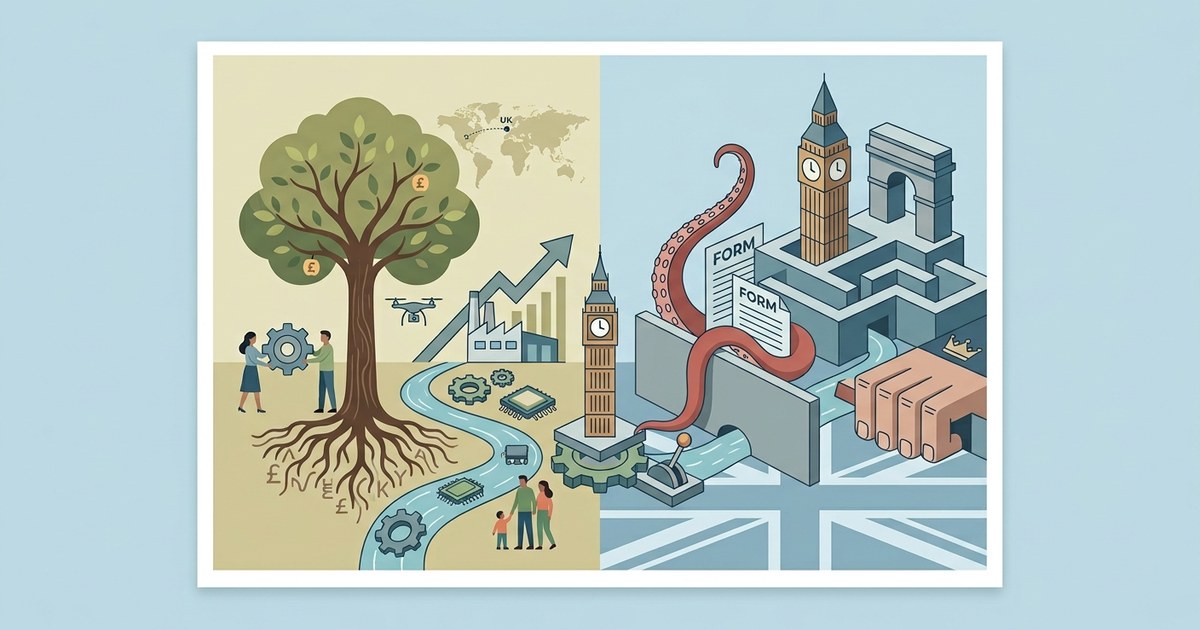
  • British state and growth: what is holding Britain back?

    British state and growth: what is holding Britain back?

    Motion in the British state and growth debate: the British state impedes economic growth

    Debated: 15 June 2026, Ye Olde Cock Tavern, Fleet Street

    Format: rapid debate, proposer and opposer, floor speeches

    The evening’s first motion put the British state and growth in the dock together: the British state impedes economic growth. A show of hands before the speeches gave the proposition 12 votes to 3, with one abstention. The interest was not the result but the range of incompatible reasons found for it.

    The proposer on the British state and growth: what the state fails to do

    An unusual case from an unusual proposer

    The proposer opened by naming the oddity of their own position: a leftist who believes the state should be active in economic development, arguing that this one impedes growth. Then came an offer. If you think taxes are too high, vote for the motion, though Britain’s burden sits below the OECD average. If you think regulation stifles enterprise, vote for the motion, though on the anniversary of Grenfell it is worth saying Britain is among the least regulated countries in several industries.

    The British state and growth: housing first

    Their own case was about what the state does not do, and housing came first. In the mid-1990s the average London home cost roughly four times the average annual wage. By just after the pandemic that figure had reached nine, and they assumed it is higher now.

    Productivity has been flat since the financial crisis, they argued, partly through overdependence on finance and partly through housing. Money paid to a landlord is money not spent elsewhere. Cities generate productivity, and people priced out of them cannot contribute to it.

    Ten per cent of new homes

    The claim they treated as decisive concerned who buys new housing. Only about 10 per cent of new British homes reach the open market, they said, and in London about 2 per cent. The rest go to institutional investors and overseas buyers. Sales could be restricted to owner-occupiers, and are not.

    What Italy does that Britain does not

    Infrastructure closed the speech. Rail costs three or four times as much per kilometre here as in Italy, they claimed, and Italy has a national engineering agency that standardises the work whenever a city needs a metro. Britain starts each scheme from nothing and buys in the expertise.

    The opposer on the British state and growth: a global system

    Everybody has this problem

    The opposer’s case was comparative. Every country wants growth and few are getting much: Europe is not growing, the United States less than the headlines suggest, and China is the outlier. On which government was meant, they took both. The Conservative answer was austerity, which cut costs and investment together, and many economists date the weakness to the absence of investment after 2008.

    Capital moves and ownership follows

    Their central argument was the free movement of capital. It buys the housing stock and it buys the businesses. Numbers of British firms are owned by American private equity, and when a British company approaches viability, global capital arrives and takes it. What results is shareholder capitalism rather than stakeholder capitalism, with the shareholders abroad.

    Their remedy looked like the proposer’s: restrictions on who may buy British companies and housing, since the Americans would never let a foreign buyer take a firm they considered a national interest.

    The wounds that were self-inflicted

    Two concessions closed the speech. Britain has damaged itself, and the 2016 vote to leave the European Union did more of that damage than 2008 did. The country also depends on the United States for energy, defence and finance, so every card transaction runs through an American system. Any government would meet the same constraints.

    Voices from the floor on the British state and growth

    The entrepreneur’s warning

    The first floor speaker had advice for anyone starting a business: do not do it in the formal economy. The state tells you what to pay people and takes a share of it, and small firms can afford neither accountants nor the time to contest a bad assessment. They believe the country is in a depression deeper than that of the 1930s, and that the last one ended in a war they cannot see coming.

    The arithmetic of borrowing and net zero

    A second speaker read out numbers. Employers’ national insurance and the minimum wage both rose, so hiring costs more and over a million young people are out of work. Borrowing heads towards £3 trillion at 4.7 per cent, the highest rate in the G7, and this year’s interest bill of £111.2 billion is 8.3 per cent of all public spending. Against a welfare bill of £345 billion they set £42 billion of net zero commitments, and called it a failure of priorities.

    Whether growth is the point

    One speaker questioned the premise. Growth may not be what life is for, and spending on climate now may save money later. A younger generation declining to work until ten at night is choosing a better life rather than failing at the old one. An ageing population presses on the health service, and artificial intelligence is removing the entry-level jobs the young once started in.

    Energy, ownership and borders

    Another speaker took three positions at once. Britain should use the North Sea, since restricting supply raises the cost of everything that moves. Railways and utilities should return to public ownership, because private priorities are profit rather than service. And open borders are not a left-wing policy: they hold wages down and press on housing.

    The net zero exchange

    That drew the sharpest exchange of the night. A speaker who works in energy countered that net zero lowers prices, citing hours of free and negative-priced power in Spain and an Italian supplier giving electricity away between noon and four. A speaker working in oil and gas replied that the British version includes an end to North Sea exploration licences, and asked whether that had no effect. The first held their ground: demand does not require those reserves.

    The British state and growth: the cost of complying

    A further speaker put a figure on regulation from the other side. The state makes decisions and outsources the cost of implementing them. Brexit has probably cost between 2.5 and 4 per cent of GDP, they said, and compliance between 4 and 6 per cent. The tax authority closed its helplines for months, and Britain has the most expensive electricity in the G20, an awkward foundation for an economy said to be saved by artificial intelligence.

    A dissent on growth itself

    One contributor dismissed the frame. Economics is a work of fiction, they said, and there had been enough hot air in the room to heat several houses. Growth has limits on a planet with finite resources, and the distribution of wealth is a world government question.

    They also corrected the unemployment figure. The population aged 16 to 24 is 6.9 million, so a million out of work is a minority, and many of the rest work in charity shops and cafés.

    The household and the Ritz

    Another speaker reached for the family budget. Essentials first, then whatever is left, and they had never chosen a fortnight at the Ritz because they could not afford it. The country has been doing the equivalent for years, and income tax now covers little more than the welfare bill. Asked to accept that 70 per cent of that bill is pensions, they did, and named the triple lock as part of what everybody will have to pull back on.

    The case for doing less

    A speaker almost won over by the proposer’s argument that the state should do more said the opposite: it should do far less. Policy here is built on ideology rather than economics, and stamp duty slows movement into housing. Rather than tackle the debt the state will inflate it away, and top marginal rates, council tax and licence fees remove the money that would otherwise reach producers as demand.

    Tuvalu and Papua New Guinea

    The most direct challenge came late. One speaker took the motion to be about the existence of a state rather than the conduct of this one, and cited the literature holding that institutions drive long-run growth: rule of law, property rights, elections, and a government able to enforce them.

    Then they set two Pacific countries against each other. Tuvalu has 10,000 people, a highest point five metres above sea level and no resources. Papua New Guinea has 11 million people, oil, gas, fisheries and vast neighbours. Tuvalu has the higher income per head, and the difference is a credible government.

    The state is more than the government

    The club’s president took that up. There had been complaint about both recent governments, but the motion says the state, and the courts are the state too. A business dispute here can be settled at law in a semi-reasonable time, which is a condition of doing business at all. They quoted Hobbes on life without government being solitary, poor, nasty, brutish and short, and drew a line at solar generation in a country where it rains while defending wind in Scotland.

    The British state and growth: how far should the state reach

    The last floor speaker reframed the question as one of degree. South Korea took the other path, betting on a few industries and letting them run, and China is copying it. What results is a handful of families with enough economic weight to hold political sway. At issue is not whether a state should exist but how far into the economy it should reach.

    Closing arguments: the opposer on the British state and growth

    The opposer replied first and led with comparison. Japan carries debt worth 230 per cent of its output, the United States 120 per cent, and France and Canada more than Britain does. On foreign direct investment, offered as the world’s verdict on an economy, Britain remains a focal point.

    History did some work too. British growth was built on empire, on raw materials taken cheaply and goods sold back, and competing fairly is harder. Austerity cut the debt and killed the investment. Our labour market is more flexible than Europe’s, and taxation funds the roads and the legal system without which no business could trade.

    Closing arguments: the proposer on the British state and growth

    The proposer went straight at the opposition’s central claim. Dependency on global capital is not weather. It is the residue of decisions taken under Thatcher, under Blair and under every government since, to run down industry and build on finance. France, Germany and Sweden made different choices, and Poland is the fastest-growing economy in Europe while being just as integrated.

    On the distinction between state and government they conceded the point and turned it: governments make the choices that shape the state, and this one has a large majority and has used it cautiously. Britain has the worst insulated homes in Europe, housing starts have fallen since the pandemic, and management fees can be raised from £2,000 to £6,000 at will. All of it could be legislated against.

    Their close was an invitation. Whether you think the state does too much or too little, the motion holds, because the question is not what the state could do but what it has done.

    The final vote on the British state and growth

    The room voted 13 in favour, 4 against and 2 abstentions, and the motion was carried. Before the speeches the show of hands had been 12, 3 and 1, so every column grew by one and the balance held almost exactly.

    The chair noted that the counts did not quite reconcile, most likely because latecomers were present for the second. What the evening produced was not a shift but broad agreement reached from irreconcilable directions.

    Why the room linked the British state and growth

    The motion was carried 13 to 4, and it was always going to be. Four to one before a word was spoken is not a debate to be won so much as a majority to be kept, and the more useful question is why a room this varied agreed so readily. The answer is that the motion is broad enough to hold two opposite complaints, and the proposer spotted that in his first minute.

    The proposition’s case: housing, productivity, procurement

    The opening speech did something unusual and effective. It began by handing the audience arguments the speaker did not believe, on tax and on regulation, and inviting them to vote on those instead. That converts every free-market objection in the room into a vote for the motion while conceding nothing.

    The case they did make was about omission rather than interference: housing left to institutional buyers, productivity flat since the crisis, infrastructure bought from consultancies rather than built by a standing public capability. Framing the charge as a failure to act made it hard to answer, because the opposition’s best material was all about what the state cannot control.

    It was also the only speech of the night that treated the British state and growth as a question of capability rather than of attitude. The Italian engineering agency is a small, concrete example of a thing a state can build and Britain has not, and nobody from the floor engaged with it.

    The opposition’s case: capital, dependency, comparison

    The opposition’s argument was the more sophisticated of the two and it was structurally doomed. Their claim was that global capital flows explain what looks like British failure, and that any government would meet the same forces.

    Two problems followed. Conceding that the remedy is restriction on foreign purchases of housing and firms hands the proposition its case, since a state that could restrict and does not is a state that impedes by omission. And the comparative material, that Japan and France carry more debt and that Britain still attracts investment, argues only that Britain is not unusually bad. The motion never said unusually.

    What the opposition needed, and never quite reached, was the claim that the state is not the binding constraint. They gestured at it with the point about global capital, then undercut it by naming Brexit, which is a decision of the British state, as the deeper wound.

    The ebb and flow of the floor debate

    Twelve floor speakers followed, and they agreed on the verdict while disagreeing about almost everything else. Three battlegrounds opened, and none of them was about the motion. Housing surfaced in five separate contributions, which is a continuation of the evening the club spent on whether an obsession with home ownership leads to poor decisions, and the party-political material picked up where the Greens and Reform debate left off.

    First battleground: energy and the price of net zero

    The one genuine exchange of the evening was about energy. Two speakers argued that net zero raises costs and that the end of North Sea exploration is an economic decision dressed as an environmental one. Two others, both of whom work in the sector, argued the opposite from operating experience, citing negative wholesale prices in Spain and suppliers giving power away in the middle of the day.

    That is the argument this room does well: specific, drawn from work rather than from newspapers, and conducted between people who disagreed without either retreating. It changed no votes, because both sides of it were compatible with the motion. A state that spends £42 billion on the wrong things impedes growth, and so does a state that ends exploration licences without replacing the supply, and so does a state that fails to build the cheap generation its neighbours have. Every version of the energy argument was a version of the motion.

    Second battleground: what the state costs to comply with

    The most original contribution of the night put a figure on something usually left vague. Compliance may cost British businesses more than leaving the European Union did, on the argument that the state sets rules and outsources the cost of obeying them, and that the growth in employment is in the departments that do the obeying.

    It is a contested figure and it went unchallenged, which is worth recording. It also cut across the proposition’s own case, since that speaker wanted less state where the proposer wanted more, and both were voting the same way.

    Third battleground: problem or precondition

    The only line of attack that could have moved the vote arrived from the floor, late, and from an unexpected direction: that the question is whether a state helps or hinders in general, answered by the institutions literature and by two Pacific countries with opposite endowments and opposite results.

    The president reinforced it from the other side, pointing out that the courts, the rule of law and the roads are the state, and that Britain without them would have no economy to slow down. Both speeches were well received and neither dented the result, for a simple reason. The motion does not say the British state prevents growth. It says it impedes growth, and a state can be necessary and obstructive at once.

    The argument nobody made

    Worth recording is what went missing. Nobody defended the state’s record on its own terms, and nobody argued that current policy is working. Even the opposition’s case was that the failure is not Britain’s fault rather than that there is no failure.

    Nor did anyone test the proposer’s central statistic, that only a tenth of new British homes reach the open market. It is a striking figure, it did most of the work in the opening speech, and it passed without a question in a room containing an accountant, two energy professionals and an economist. A motion phrased as blame carries a room that agrees about the diagnosis, and agreement of that kind discourages the checking that a contested claim would attract.

    What drove the result in the British state and growth debate

    The pre-vote did most of the work, and honesty requires saying so. A room that starts 12 to 3 has decided, and the speeches were arguing about reasons rather than about the verdict. Only one column moved by more than a single vote, and the room was larger at the close than at the opening, so even that movement is more plausibly a matter of arrivals than of persuasion.

    What the evening added was range. A self-described leftist proposing, a speaker who wants the railways nationalised, a speaker who wants austerity deepened, a speaker who doubts growth is worth pursuing, and a speaker who thinks the state is the reason there is anything to measure: all but the last voted the same way. The motion is broad enough that doing too much and doing too little both count as agreement, and the proposer’s closing said so out loud rather than hiding it.

    Conclusion

    The most striking thing about the evening was not the margin. It was the president’s observation that a motion about the economy would not have reached a Sylvans agenda a few years ago, which says more about the mood of the room than the vote does. A club that cannot agree on what the state should be doing can still agree, and did, that it is not doing it.

    Full transcript of the British state and growth debate

    Read the full transcript

    The motion and the opening show of hands

    The chair read the motion: the British state impedes economic growth. Plenty to say here, for and against. Could it be the current government? Could it be elements of the British state, the deep state, as they say on X? Is it even the responsibility of the state to engender economic growth, if it is not impeding it? But it is not my opinion and pontifications that count.

    The chair then asked the room for an opening position. Twelve declared for the motion, three against, and one abstained.

    The opening speech: the British state and growth

    My fellow Sylvans, those of you who know me might be shocked that I am arguing for a proposal against the British state, or any state in general. After all, I am a dirty leftist. I should be in favour of the state being active in economic development, and the truth is, I am.

    I am not here to convince the people who might argue, and I am sure we will hear this from the floor speakers, that for example taxes are too high, even though actually Britain has a slightly lower tax burden than the average OECD country. But it is fine with me if you believe that, as long as you vote for the motion.

    You might also think Britain has too many regulations that stifle business and stifle the market. Well, now that we are on the anniversary of Grenfell, that probably would not have happened in most European countries, because they have better regulation on certain things, and in fact, in many industries, Britain is well known for being one of the least regulated countries. But it is fine with me if you believe that regulation is too stifling for private enterprise. Vote for the motion.

    I am going to tell you what the British state also does to stifle growth, or rather what it does not do that stifles growth, and you would be shocked. The first thing, the main thing, actually, is housing. Britain has a housing problem, we all know that. It has been going on since the late 1990s.

    I forget exactly what the number is, but around the mid 1990s the average home in London was about four times the average annual wage, and in the country as a whole it was like three. The last time I checked that figure, which must have been just after the pandemic, the number had skyrocketed to like nine in London, so it doubled relative to average income, and it is probably higher now. It is probably 10 or 11, I do not know.

    Funnily enough, in our previous Sylvans debate there were some people talking about productivity and why Britain has such low productivity. Really, to understand why Britain is not growing as fast as it could, the answer is that Britain’s productivity has basically stalled since the global financial crisis, for various reasons. One is the overdependence on the finance sector, but another big thing is housing. Housing is one of the major contributors to low productivity.

    Why is this? Well, the more housing takes out of your monthly budget, the less you will buy of everything else, so there is less consumption that could be used to stimulate the growth of British businesses, especially small businesses. If half of it goes to a landlord or half of it goes to your mortgage, there is also the issue of cities, because cities like London are super expensive. People are unable to move to these cities, or if they live in one, they live in a situation where they cannot spend. Cities, as we know, are the heart of the productivity of any country on earth.

    So why does the government not do anything about the housing crisis? That is the truth. They have not done anything. They allow houses to be sold to Malaysians and Chinese, not Malaysians or Chinese here, Malaysians and Chinese in China and Malaysia. They sell to institutional investors.

    There is a recent study that is absolutely mind blowing. Only 10 per cent of all new houses in Britain are sold on the open market. So what you see in Zoopla and all these, that is only 10 per cent, and in London it is just 2 per cent. The government could do something about this. They could prohibit selling these houses to anyone other than an owner occupier, for example, and we would have a functioning housing market. If we had a functioning housing market, people would be able to spend more, there would be more productivity. But the government does not do this.

    There is also the issue that sometimes the government just does not do what other countries do very well, and there are a few things that governments can do very well. Everyone complains here that Britain does not build anything. HS2 is a complete disaster, infrastructure is a complete disaster.

    We look at the cost per mile or kilometre of rail in this country, and it is like three or four times higher than Italy. Italy is hardly an example of hyper productivity, but what does Italy do? Italy has a national public engineering agency. Any city in Italy that needs a new metro goes to this agency, which does the work, and everything is done in a standardised way, whereas in Britain every new infrastructure programme is going to be done pretty much out of pocket, spending a ton of money on private consultancies and whatever, and so costs skyrocket. So the British state is responsible for Britain’s meagre growth, not just for what it does do, but for what it does not do. I urge you all to vote in favour of the proposal. Thank you.

    The opposition on the British state and growth

    Good evening, everyone. The opposition’s position is that it is not the British state’s fault. First of all, every country wants economic growth, and we are not in a unique position. It is not as if the rest of Europe, or even the US, is growing. You may think the US is growing faster than us, but if you run some numbers, actually not really. China is the country that is growing the most. So we are all in the same boat. It is not necessarily just the British government.

    Then you could ask, the motion says state, but if we bring governments into it, are we saying this government or the last one? The Conservative government had no answer. Their answer was austerity, which basically was cut costs. A lot of economists, and you know the joke, get two economists together and you have three arguments, but a lot of economists say that the lack of investment over the last couple of decades, since 2008, is the reason why our economy is not doing as well as it could. But equally, that applies to other countries. Germany is having a huge problem right now with its car industry, because China has taken over, and it has not invested in its own long term economy. And then the Labour government is trying to invest.

    Now let me get to the point I am trying to make. It is not so much the government or the state, it is that we are part of a global community. What we have as part of a global community is the global movement of capital, for example, and that is buying up our housing stock, as the proposition said. That is buying up our businesses. The data says that a vast number of our businesses are owned by US private equity and US corporations, and when we invest in innovation, once our companies become viable or approach viability, then global capital comes in and buys them up. So there is no stakeholder capitalism. It is always shareholder capitalism, and those shareholders are abroad. So it is not the state’s fault. Global capital is free to move.

    What do we do about that? Now I am going to start agreeing with the proposition, in a sense: implement regulations. For example, if we wanted to buy Google, the Americans would say no, Google is a US national interest. If we wanted to buy Microsoft, no. So in the same sense, perhaps we should implement some sort of restrictions, not capital controls, but restrictions on the purchase of our companies and of our housing stock. Housing should not be an asset class.

    Again, what I am trying to stress is that it is not the state’s fault, that it is part of this system of global capital movement. Of course, we have also shot ourselves in the foot. The proposition says that our decline started in 2008. Another argument is that it really declined in 2016, when we voted for Brexit. We have not really done ourselves any favours. So it is not the state’s fault. It is our own fault. It is the media’s fault, for buying into some of that narrative.

    And of course, if we look at our dependence, we have outsourced everything. We are dependent on the US for energy. We are dependent on the US for our defence, and we are trying to pivot towards Europe. We are dependent on the US for finance. Every time you swipe your Visa card or your Mastercard, that transaction goes to the US financial system. So the point is, it is not the British state that is at fault. Whichever government came in, they would be facing these problems. We do not live in 1870, where we were a nation state. We are a country that is part of a global community, with capital flows and labour flows. So it is not the state’s fault. It is being part of a global system.

    From the floor: stay out of the formal economy

    Mr Chairman, ladies and gentlemen, I agree with most of what has been said today on this topic, and it is pretty damning, isn’t it? I will add some more damning to it. I have experience of trying to be an entrepreneur, and anyone who wants my advice, I would say stop, and do not try and do it in the formal economy. Do it in the underground economy.

    If you do it in the formal economy, the government wants to tell you how to do each item, what to pay your people. You cannot pay them what you want to, or employ them how you want to. The cost may make you deduct from the wages you want to pay your people and pay it to the government, and that is a huge amount of money if you actually work it out and you are trying to start a business.

    In my experience, the authorities will take advantage of you and try and load you with taxation that is completely illegal. They know you cannot afford accountants, and you have not got the time to wrestle, to go to this hearing and that hearing. Do not do it in the formal economy. Of course, you then run the risk that the authorities will find out what you are doing, and you will probably not know the ropes and how to do it that way, in which case you are running a risk.

    I think these are symptoms that can explain, as I have said in these rooms, that we are in a depression at the moment, worse than the 1930s. The researchers are still doing work on the 1930s depression, surprisingly, and the conclusion is that once you get into one, you cannot get out of it again. I have said how that works in previous meetings, so I will not go over it again.

    There has been hardly any growth in the British economy since 2006. You get no booms, and without the booms you do not get businesses putting investment back in to expand. We are stuck. The 1930s depression is thought to have been ended by the Second World War. I do not see a decent war on the horizon. I think we are stuck where we are, and I have no way of suggesting how we get out of it, so I will support the motion.

    The British state and growth: borrowing, welfare and net zero

    Mr Chairman, the state has presided over a huge surge in unemployment, the collapse in business confidence, and the jump in the amount that the government has to pay to borrow money. When this government came in, they increased the taxes on businesses, putting up employers’ national insurance contributions, and they also put up the minimum wage, so it costs more to hire somebody to do a job. We have over a million young people unemployed, because it is too costly to hire them when you do not know whether they can do the job, or even if they will turn up on time. So unemployment is rising, business confidence is at rock bottom, and investment is falling.

    Then you have borrowing. Borrowing is going upwards towards 3 trillion pounds. That is a three with 12 zeros after it, and we are paying the highest percentage in the G7, that is 4.7 per cent. That borrowing this year will come to 111.2 billion pounds. That is what we are paying in interest only. That is 8.3 per cent of total public expenditure in interest only, which is ridiculous. In fact, one could say that the Chancellor is as friendly to business as Brutus was to Julius Caesar. You all know what happened there.

    There is a feeling about defence. We had the Defence Secretary resign, we had the Minister for the Armed Forces resign, and two others all resigned, because they asked for 17 billion for defence and were only offered 13 and a half. Well, consider the welfare bill: 345 billion pounds a year, 345 billion for welfare alone. It is very difficult to cut the welfare bill. But what about net zero?

    Of course, we will have howls of protest from the climate emergency people, but if you consider that defence needs 17 billion, we have earmarked 13.2 billion for heat pumps, that is the government bribing you to put in heat pumps. Carbon capture, which has never worked, storing carbon under the North Sea, 9.4 billion. That has never worked and probably never will, and what is more, it will simply make energy generation less efficient and therefore more expensive.

    Overseas climate help, 11.6 billion. God knows what that is, but it is 11.6 billion. And Great British Energy, which does not produce any energy, 8.3 billion. Now I ask you, that is 42 billion earmarked for net zero projects which will not do anything for the climate. So that is the state for you. It is a question of choices and priorities, and our state has got its choices and its priorities wrong.

    From the floor: is economic growth what life is about

    I do not always actually believe what I argue, but I wanted to argue a different point of view and perspective. What I wanted to say is: is economic growth what life is all about? It might not be net zero. The fact that this gentleman is arguing about it, we might not even have a life if we do not invest now, and it might actually save a lot of money in the long term. The investments we make now might keep this planet, keep us alive afterwards.

    Also, the new generation now, they do not just want to stay at work till nine o’clock and have children that they give birth to and parent but are not actually there for. Now they can focus on more than working till 10 o’clock so that people like Elon Musk can get all the money for themselves. They are actually thinking about themselves and their lives, and there are millions more of them who are having a much better quality of life now.

    There is also an ageing population, which I am sure you will understand. There is so much demand now on the resources required by the NHS, and I think that is better use for those resources than just a few chief executives getting richer. And with AI, the entry level jobs for the younger generation are disappearing, and this is real. If it is a matter of priorities, this is our future. We should perhaps be using this money to support that youth and that generation.

    I do think that perhaps we do need to look at technology in the future. If anywhere, we do need economic growth. Maybe if we had done projects over the years and they were not the most efficient, we now have an opportunity to look at the most efficient ways of spending our resources. And the final thing I want to make is, maybe if we cannot grow, we need to be looking at allies and other countries that are growing, and it might help us unite with the rest of the world.

    From the floor: energy, ownership and borders

    I am going to use the state and the government interchangeably here. There are certain things that can be done to improve the economy. It is quite a broad topic, but I have narrowed it down to three components.

    Number one, with regard to energy, I think we need to be more self sufficient in terms of producing our own energy, and less dependent on other countries. I think particularly we should make more use of the North Sea oil reserves in order to fuel more economic growth. You cannot ban fossil fuels, and I think you need to get rid of this net zero, because it is actually affecting the economy negatively. If you have less supply of oil and gas and electricity, you are going to increase the cost, not just of the energy bills, but of general living as well, because you need fuel to run factories and to send food to the supermarkets. Some of the net zero policies are quite extreme. I think a minister said he wants to ban things like underfloor heating and towel rails, which I think is quite fanatical.

    The second thing is that the railways and the utilities should come back into public ownership, because if they are actually in private hands, the priority is profit. You can increase the fares of the railways, but the service can decline, because the problem is with the profits. If you renationalise the railways and the utilities, the surplus will go to other services that are also nationalised and in state control, so you do not actually have to increase the taxes in order to renationalise. I do not think we need to spend more money on defence, but I do not think we should be spending more money on welfare either.

    The other thing that is quite important is immigration. I think immigration is a good thing, but we need to take care of the open border immigration. Open borders is not a left wing policy.

    If you look at what Bernie Sanders said in 2015, he said it is a right wing policy. Open border immigration drives down wages and increases profits for big corporations, but because you are reducing the wages, it increases unemployment, so people are less likely to do menial jobs. That means you have to have more tax money going towards welfare, which means less tax money going towards health and school and education and infrastructure and crime and all the other stuff that we need. It puts more strain on public services, which increases privatisation, and it puts more strain on housing, so it increases house prices. So I think that is something else that really needs to be taken into consideration.

    From the floor: net zero and the price of energy

    I have not changed my mind yet. Maybe I do not have the experience of the British state deeply enough that I can come up with an idea, but the main reason I want to intervene is because a couple of people raised the topic of net zero and sustainability. I just want to earmark something. Net zero does not bring a higher cost of energy. It actually should put it down. I work on this on a daily basis.

    When you look at energy prices in Spain or in Europe, in countries where the energy demand is very much met with renewable energy, there are periods during the day where energy is free. In some cases in Spain, some of the promoters are finding that during peak days energy has a negative cost. This means the energy providers are paying the consumer to use energy. My parents back home in Italy get an email saying that if you use the energy between 12pm and 4pm, the energy we give you is free. So net zero is not the issue. It is not what impedes the growth of the United Kingdom. I do not know what is impeding growth in the British state. I just wanted to make this point. I do not believe that is the driver.

    A question from the floor: net zero in the UK sense does not just talk about the net zero initiatives, it is also things like the banning of licences in the North Sea. I work in oil and gas, which is why I know it. Do you think that impact is minimal on the economy? There are to be no exploration licences in the North Sea from the UK side, and the overarching process is that there will be no more UK side exploration.

    The reply: what I think is, when I look at Hormuz being completely shut down, prices barely touched 100 dollars in the worst of the crisis. So what I think is that our economy is already extremely efficient. I would assume the British economy is pretty efficient anyway. We do not simply need that much. I do not see that demand for oil and gas being so high that you need that much reserve. That was my point. I do not want to leverage it towards ESG and net zero, but that was my point.

    The British state and growth: the cost of complying

    The British state has for a long time hindered growth in this country by imposing costs on every one of us and every business consistently. They have outsourced compliance with all sorts of rules as a cost onto businesses, so businesses in this country spend an enormous amount on that.

    I think many people in this room think that Brexit was not a great success. It is fair to say economists have three opinions, as ever, but the chair will say it has probably cost us 2.5 to 4 per cent of GDP. Compliance has cost us, some economists’ opinions, four to six per cent, so potentially twice as much as Brexit, which everyone regards as a disaster, and that is a growing cost. We have talked about employment. Guess where there is actually greater employment: HR and compliance.

    What the British state has done is make decisions and expect someone else to pay for them. So when we talk about taxation, let us include the six per cent for complying with these rules. Net zero also has compliance costs, and that continual outsourcing of implementation, top down. We were talking earlier about societal change. Well, that is what they are doing, putting in the rules: here are the rules, you have got to do it this way, and you have got to report on it. So companies have these crazy policies where you can only employ certain people to keep the balance right. Corporations are sinking huge amounts of their turnover into that, and that is one reason why people are not investing here now, because there is that hidden cost.

    The point of the state outsourcing and imposing costs on everyone else is not just about businesses and corporations. Every one of you has been subject to this. The bonus of efficiency from digital technology has actually been used to impose the onus on you to comply with them. HMRC even shut down their helplines last year, for I think eight months, saying you do it, you do the work for us. That is a cost on all of us, on our time. And finally, I will say that we also have the most expensive electricity in the G20. The Chancellor, being the economics guru, has told us that AI will be the saviour of our economy, but it is powered by electricity, so I am not sure that is going to work.

    From the floor: economics as a work of fiction

    Chair, Sylvans, I am noted for my profound knowledge of economics, but when I was listening to some of the commentators, I thought we were having a line from the BBC. There used to be a programme called Listen with Mother. Or if you are not into the BBC, you could look at the Brothers Grimm, or even the Mad Hatter’s Tea Party, because these are works of fiction, and by and large, so is economics. As regards energy, I have heard enough hot air tonight to probably generate many houses, and there is a lot of hot air in the Houses of Parliament as well.

    But what values have we got? It is not about the growth. I really do think it is about time that was put to bed. Growth has got its limitations because of the finite resources of the earth, and it is one planet. A lot of these issues are world government issues: migration, immigration, fair distribution of wealth, and all this sort of stuff. Until we move to a world that understands that, these sort of little England type things, the British establishment, of course they are all right on their own patch. They own a large percentage of the land.

    I wanted to correct one or two things. I took the trouble to find out what the population of 16 to 24 year olds was, and the population is 6.9 million. There is only a million in need, so the majority of young people between 16 and 24 are doing something. You need to look into the individual circumstances of those million people, and how they find out those statistics. I know quite a few 16 to 24 year olds who work in charity shops or work in a cafe.

    Now I do not know whether they come into the statistics, so you can tell around the statistics all you like, but it comes back to what kind of society do we want. Do we want a more equitable society? A large percentage of the land is controlled by five per cent of the population. We know who most of them are, and they would not give you the time of day half the time, but they give their friends free accommodation, of course.

    From the floor: the household and the Ritz

    Well, I am with the proposition, because I think we are very close to being completely buggered, as they say. We are in such a mess. And why are we in a mess? I think about my own household and think about money coming in, and I think, what am I going to spend this money on? I have got to spend a certain amount of it on essentials. I do not have a mortgage any more, but once upon a time I used to have a mortgage, so I had to pay that. And I have got to feed the kids. So there is some essential expenditure that I have to deal with, and then there is whatever is left over. I have this discretionary amount, and I can think, hey, I will go on holiday.

    But I decided, when I was managing my household, that I was not going to go and stay at the Ritz for a couple of weeks every year, because I cannot afford it. Over the years this country has metaphorically been staying at the Ritz. We have been spending a load of money, like 3 trillion pounds, and it is going up and up and up, and we are in a situation now where income tax is just purely paying for the welfare state. How the hell have we ended up in this situation?

    I think the problem is that we have very poor politicians. I know some people will not like this, but I have always said that I would try and make politics far more attractive to more capable individuals, because the UK is technically a company, and we need the best people managing that company. The opposer mentioned capital, and capital will go where it gets the best return, and we have not created the environment to attract that capital. Over many years, particularly probably in the last 20 or 25 years, we have created a situation where it is more attractive for some people not to work. It is not those people’s fault, by the way. It is because of the way that it has been set up.

    A question from the floor: will you accept that 70 per cent of the welfare bill is pensions? Yes, I will accept that. And there is another thing. For the first time in a long time we have a Labour government in power, and their principles say look after those who are less capable of looking after themselves than others, which I agree with. But it is foolish to think that we can pay for everything blindly, like the triple lock. Everybody has got to pull back. Everybody has got to pull back. We are screwed anyway.

    The British state and growth: the case for doing far less

    What an interesting debate. The proposer almost had me flummoxed by taking the position that the government should be doing more, when in fact they should be doing far less. I think that on the whole, the state is impeding growth in this country. I think they have got a far ranging suite of policies that are based on ideologies and not necessarily on economics. If they were economics, we already know that there would be so many arguments that we would not be able to do anything.

    I think there is one tax that everybody, including all economists, agree on, and that is stamp duty. You want to buy a house, you have got to give a stake to the government. Why should they take tax off you buying a house? Why should they slow down people’s access to housing? We have already heard that housing is one of the biggest costs that limits our ability to enjoy our consumption. The state is enjoying our consumption by funding what it desires to fund. It is buying votes, it pushes into a welfare state.

    There should be more austerity, because the only way you are going to get out of this right now is to actually tackle that debt bill. But wait, the state has a solution, and it is not the solution that is going to work for all of us. They are going to inflate it away. They are going to print more money, and guess what, there goes your real growth. That is what we should be thinking about: real growth. I have heard all about growth, but our nominal growth probably does not look so bad, because the government is the keeper of the inflation statistic. So should you believe it? Is the basket truly reflective of your living cost? Can you feel your purchasing power increasing right now, or is it decreasing?

    It is the state’s prerogative to direct what they want from tax revenues. They believe that they should collect money from you as an individual, and that their allocation and their budgeting priority is your budgeting priority, because you, the individual living here as a citizen, are not smart enough to manage your own finances, so government should do it on your behalf. That is why they take most of your money in taxes. The marginal tax rate at the top brackets is insane. You add council tax on to that, you add all the friction licences on to that. They are taking all of your money. You could be spending that on consumption, which would be fuelling economic growth. Producers would see a bigger market.

    A question from the floor: it is consumption, but who owns the land in this country? That is why the housing is in crisis, because the Qataris and the feudal system own the majority of the land. The reply: but do not worry, the state will take it back when you die.

    From the floor: Tuvalu and Papua New Guinea

    Hello, everyone. Over the last couple of decades a body of evidence has emerged. I interpreted this motion less as being about the current state and more just about whether the existence of the state impedes, or in my view does not impede, economic growth.

    Over the last couple of decades a body of evidence has emerged that the biggest driver of long term sustainable economic growth is institutions, so things like rule of law, property rights, free and fair elections, and a strong and stable government or state that can enforce these things.

    An example of how this works in practice is in the South Pacific, which is where I am from. We have got two countries, Tuvalu and Papua New Guinea. Tuvalu is a tiny country, about 10,000 people. The highest mountain in the country is five metres above sea level, and it is slowly decreasing. You have seen the picture of the guy with the water up to his waist. Nothing grows. They have got coconuts and breadfruit, which is a tasteless, starchy thing that you do not want to eat. No natural resources or anything. They just eat mutton flaps and corned beef from Australia.

    Papua New Guinea is a country of 11 million people. It is huge. It borders some of the biggest economies in the world, Indonesia, Singapore, all of those. It is abundant in natural resources: oil and gas, agriculture, fisheries, all that stuff. And yet, which one do you think has the highest GDP per capita? It is not Papua New Guinea, it is Tuvalu. And what is the reason behind that? Papua New Guinea lacks a strong and credible government. So in this situation, which country would you rather be in? Would you rather be in the one that has the state, or the one that essentially lacks a state?

    From the floor: the courts are the state too

    Thank you, Mr Chairman, and thank you to the previous speaker as well, because that is exactly one of the points that I was going to make. We have had a lot of whingeing tonight about the current government. We have also had whingeing about the previous Conservative government. The motion is the state. The government of the day is part of the state. Previous governments are part of the state as well. There are many different features of that.

    The previous speaker mentioned the rule of law. The courts and the judicial system are part of the state. The fact that we have the rule of law, that if you have a business dispute you can have it settled within a semi reasonable period of time in the courts of law in the UK, is part of the state setup that we have here.

    By the way, the fact that motions about the economy are getting voted in at Sylvans is to me a significant indication that we have got a big problem, because no one in Sylvans a few years ago cared about the economy whatsoever. This would never have been voted in. We are talking about it tonight. It is very important.

    There was an economist called Thomas Hobbes, very famous, and I am slightly paraphrasing. He said man in a state of nature, life would be solitary, poor, nasty, brutish and short. What he is saying, his insight at that time was, without a government you will have anarchy, and everyone will be poor. If you do not have an organised state. Tuvalu has a more organised state than Papua New Guinea. I think there are more complex factors, probably, that led to that, many different factors that led to that outcome. Having an organised state is critical.

    Thomas Hobbes was looking at the tragedy of the commons. You had a little village, and there was a village green that was a common, and people would graze sheep on it, but they rotated them. If you did not rotate them and take them off at different times, the land would be completely useless, and everyone would be hungry. So having an organised government is critically important. Infrastructure, the trains would not run, roads would devolve very quickly. We would not have roads. So it is not just an island state in the South Pacific.

    We have to look at the British situation itself. Could the government be doing much better? Absolutely. Could the last government have done much better? Absolutely. But we have to look at this in the round as well, and that is what the motion says: the state. I do want to pick up on a couple of the proposer’s points, and I wish I had been debating him, because it is always fun, and he is brilliant. Some of the productivity drains that he mentioned are very true, but the lack of investment is one of the biggest ones. We do not invest enough in this country, and sometimes the investments we make are bad.

    A lot of the net zero stuff is good for the environment. It is not good for the economy. I disagree with one previous speaker on one priority, though. Investing in wind power, I think, is a smart investment for the UK to make. Another speaker was talking about solar power in southern Europe. It is a great investment for southern Europe. They have cheaper energy, and they will have cheaper energy as a result. We have great wind. Investing in solar in the UK is madness, because it rains, but investing in wind in Scotland is very valuable. So we have to make smart investments, and the governments have not been doing that perfectly. Take away the government, though, and it is chaos.

    The British state and growth: how far should the state reach

    Thank you, Chairman. Just to touch on the last point that was made on governance and government. I would probably say that the British government is fairly involved in how it makes its policies. It makes policies on virtually everything. But I am sure everyone here knows the South Korean example, the chaebol houses. South Korea in about 50 years went from a very impoverished nation to not, and it did that in a way that in some ways China is trying to replicate, by basically betting on a few key industries and kind of letting them run amok, which is why now some people joke that a single company is the de facto South Korean government.

    So the point I am trying to make here is that in some ways I am not necessarily questioning the concept of a state, but questioning the concept of the involvement of the state. If you compare a British state, which is really involved with the economy, to one that decided not to do that, take the South Korean example, you may now be in a situation where a few individuals are incredibly wealthy and very powerful, and the families have a lot of sway politically in the country because they are so economically important.

    That is not something you probably have on the same scale in the UK. So based on that, I would probably say that maybe the British state could be better. I am not quite sure which side of the fence I would have fallen on, but that is just one of the points I wanted to make.

    The chair draws the threads together

    Some really interesting speeches, and many angles taken up here. Is the government over regulating? Is the government investing in the wrong areas? Is it the government versus the state? Are they the same thing? Is it our own expectations and values that are at fault here? I would add: is the state and the government actually the proxy of the British people’s wishes, levels of information, education, bravery and preferences, and what role does the media have in that?

    I would remind everyone that the motion is that the British state impedes economic growth. There may be other factors impeding economic growth more, yes, that is true, but the British state can also impede economic growth even if other people and other factors are in play as well.

    Closing for the opposition on the British state and growth

    Thank you, everybody. Great speeches. The opposition’s position is that it is not the fault of the British economy, it is that we are part of a globalised system. Debt has been mentioned, and the narrative has been that we are doing so much worse than all the other countries. Actually we are doing quite well relative to the other developed countries. Japan has a 230 per cent debt to GDP ratio. Italy, we will not talk about them. The United States has a 120 per cent debt to GDP ratio. France has more debt than we do, Canada does. We have only got 100 per cent debt. We are doing pretty well, really.

    Also, when we look at foreign direct investment, this is the globe’s confidence in our economy. Traditionally we have been one of the biggest beneficiaries of foreign direct investment, and that continues to be the case. There is some data that questions that, and that is to do with capital owned by foreign corporations and foreign entities being pulled out, but overall, globally, we still are a focal point for investment.

    History has something to do with this. We have grown historically as part of being the British Empire. We are used to high levels of growth, but as we now are part of a global economy, we have to manufacture goods and sell them, and we have to do it on an even keel, on a fair basis, not like the beginning of the early industrial revolutions, where we nicked everybody’s resources and used those as raw materials and then sold goods. That was an unfair advantage. When we have to do it fairly, we have to compete with other countries, and we are not doing that badly. Everybody has the same problem. Everybody is thinking, what can we sell China? Even the Germans are thinking that.

    The points that have been made are okay. Should the government do this? Should the government do that? Is the government making the right or wrong decisions? All governments are trying their best to grow. The Conservative government chose austerity, because we wanted to cut down on debt, but the disbenefit is that there is no investment, and so we need investment, which is going to lead to more growth, which is what the Labour government is trying to do.

    The deregulation aspect of it the opposition disagrees with. Labour, it is actually quite flexible. It is really easy to start a business, and they have now moved into a contracting model, where previously you had to employ someone full time and now you can employ people on short term contracts, so it is actually quite a flexible labour market, certainly compared to the Europeans.

    There have been complaints about taxation, but taxation is needed to fund investment, and the point has been made that good governance leads to growth, and you need taxation to be able to fund good governance. The only reason a business can start up and sell goods is because there are roads that exist that allow goods to be transported all across the country, a legal system, and so on. All of this governance allows it to happen. Everybody is dealing with all of this. It is not just us. It is not the British government.

    Whichever government you have in place, and I am using whichever government as a synonym for state, it is being part of a global system. I personally think, the opposition thinks, that global capital flows have positives, but they also have negatives, in that they buy up our housing stock and buy up our businesses. So it is not the British state. All states are having this problem, especially Western states, which have traditionally benefited from colonialism. The US is an exception, because it is a hegemon at the moment, and it is predicted that as its hegemonic position declines, so too will its economic development. So it is not the state. All states are trying to grow. All states are having these problems. It is being part of a global system. That is the opposition’s case. Thank you.

    Closing for the proposition on the British state and growth

    Let us start by challenging some of the points that my opponent made. I think the state is responsible for Britain’s dependency on outsourcing, on global capital and on the US. These things do not happen naturally. I do not think capitalism is a natural economic system, or especially that free market capitalism is an organic system that just comes out of nowhere. These are all policy choices that governments took to create a state that suffers from these dependencies.

    These were deliberate policy choices taken under Thatcher, taken under Blair, taken under every other government since, and they have affected the way that the British state is shaped today. They chose to destroy industry and focus on finance. That made us much more dependent on global capital than if that decision had not been taken. So this is a specific weakness, I would say, of the British state. It is not every country that has gone through the same process that Britain has. France and Germany and Sweden did not make all those same choices. Poland is the fastest growing economy in Europe, and they are integrated into the global system just as much as Britain is. So I do not think that is an excuse.

    On the issue of differentiating the state and government, I agree that there is a difference, but governments make the policy choices that craft the state. So you can say that the state exists because governments made those choices, and Labour has had the chance. In two years it is impossible to fully transform the state, but they have had the power to do so. They have an overwhelming majority.

    Why is Labour so unambitious relative to what Thatcher did when she came to power? She came to power with an intention of changing the British state from its roots, and you do not see any of this under the current Prime Minister at all. He has had his huge majority, and he has Brexit to benefit from, because now there are not all these rules and regulations from Brussels, if that is what you think was the problem beforehand. So it really does not matter if you are a Labour or a Tory supporter. They have all let you down.

    Some other issues that people mentioned. Climate. I agree, net zero is not the issue. If you want to feel that it is, vote for the proposition. I am okay with that. But the government also has not done enough on climate. They seem terrified of appearing like tree hugging climate hippies. Insulation, for example, is a huge issue. Britain has the worst insulated homes in Europe. Partly that is because it also has the oldest homes in Europe, but where are the investments to help people insulate their homes? More heating costs equal less money to spend on other things.

    As with everything with houses, the money that your home sucks out of you is lost productivity, and that is less growth. Housing again: new housing starts in the UK have fallen since Covid. There is no chance whatsoever, on the current trend, that they are going to hit the 1.5 million new houses promised in five years. There is Britain’s medieval land ownership, where leaseholders can get fleeced because the landowner can raise the rent of the land, or where a property manager could raise your annual property management fee from 2,000 quid to 6,000 quid for no reason whatsoever, and all of this can be legislated against. All of this is money that you are losing because the government does not intervene.

    So again, if you think the government is doing too much, or if it is doing too little, it does not matter. The proposition is a valid point. As you can tell, I am clearly arguing something that might not be natural to me, because I am a left winger, and I probably agree with my opponent on almost everything else. I saw one speaker being shocked that I volunteered to argue for this position, but remember, this is not mutually exclusive to believing that the state can do more. If the state can do more, I agree with it. The state can drive economic growth, but it has not. The fact that it has not does not mean that the proposition is invalid.

    The question that we are debating is very clear. It is about whether it has driven growth, not whether it can. That is a whole different debate, and again, it is not exclusive to whether you think the government should be doing less, or if you think it should be doing more. The most successful economies on this planet are the ones that get this mix right, the correct mix of where the government intervenes, where it invests, and where it does not, where it leaves it to the market, where it leaves it to other forces. I simply do not think that Britain has the right mix, and because I think that, I think you should vote for the proposition.

    The vote

    The chair put the motion again: the British state impedes economic growth. Hands up if for. Thirteen. Against, please. Four. And abstainers. Two. So the motion carries: 13 for, four against, two abstentions.

    Further reading

    Download this debate as a PDF: Sylvan detailed summary, British state and growth, June 2026.

    Browse past Sylvan debates, or read how Sylvan debates work.

  • Equality is a myth: opportunity, outcome or both?

    Equality is a myth: opportunity, outcome or both?

    Motion: equality is a myth

    Debated: 15 June 2026, Ye Olde Cock Tavern, Fleet Street

    Format: rapid debate, proposer and opposer, floor speeches

    The evening’s second motion ran to three words: equality is a myth. A show of hands before the speeches gave the proposition an early lead of eight to four, with two abstentions. What followed was less an argument about whether inequality exists than about which equality the room had in mind.

    The proposer: why equality is a myth in everyday life

    The many meanings of equality

    The proposer opened by separating the ideal from the record. They would like to believe equality is not a myth, they said, then set that aside as a dream: the room was living in reality, and reality was where the motion had to be tested. Equality stretches across sex, gender, race, religion, dress, class and friendship, and each of those categories carries a ranking of its own.

    Race, class and the room itself

    Their first evidence was the room. They had been the one constant Black member of the club for nearly 16 years, they said, and whatever mix of nationalities was present on a given night, the setting stayed mainstream. When they raise a subject affecting everybody, they are heard as raising a Black issue.

    Two examples took the argument outdoors. They described being asked how they came to live in Covent Garden, a question a white resident would not face, and walking home from Holborn watching people reach for their bags as they pass, on the assumption that a wallet is about to go missing.

    Sex, age and the clock

    Sex supplied the second strand. They recalled adopting Ms as a title and finding that people still read them as single, and named a tension they did not try to resolve: they want to be equal to men and they still want a man to open a door. Age supplied the third, in an exchange with a young man about his trousers, offered as evidence of what a certain age is allowed to say.

    Religion was the fourth strand and the shortest. Within Christianity alone, they argued, Protestants rank themselves above Catholics, and the ordering repeats between faiths. The clock ended the speech before that argument closed.

    The opposer: what we mean when we say equality is a myth

    Two words that need defining

    The opposer began with the wording. Equality of what: of opportunity, of standing before the law, of bodies? They accepted at once that bodies differ and that DNA is individual to each person. Then came the second word. A myth, on their reading, is a truth told in story form rather than a falsehood, a sense some way from the dictionary’s account of the word. On that definition the motion could be affirmed and denied at once, depending on which meaning the room picked up.

    Where the opposition gave ground

    On wealth they conceded without a fight. Some people in this country hold ten houses or a hundred, they noted, while others sleep on the streets of London or sit on a housing list. No account of equity survives that. Their case was not that distribution is fair, but that it is not the whole of the question.

    Equal as persons

    What they defended was equality as persons. Ten people watching the same car crash would give ten accounts, and all ten would be equal witnesses to it. They said they felt equal to every speaker in the room. Their close was that fiction can be as true as fact, and science fiction truer than science fact, because it takes a leap of conviction rather than of faith.

    Voices from the floor on whether equality is a myth

    Equality is a myth against the arithmetic

    The first speaker from the floor opposed the motion on the ground that equality is demonstrable. The shortest distance between two points is a straight line. True equals true is the value on which industrial computing rests. A pound buys a stated number of dollars. None of that is mythical, they argued, rating the currency case the weakest themselves.

    The classroom and the shooting team

    A second speaker called equality an idea with no practical application to people, one that survives because it comforts. Teach a mixed classroom and you teach to the slowest, at which point the quickest look elsewhere. Five years of their own schooling supplied the evidence: a school where rugby and cricket were everything, a boy who was good at neither, and a route out through the shooting team and the swimming pool. People are not born equal, they concluded.

    The balance sheet and equal opportunity

    An accountant offered the trade’s own image. A balance sheet is equal by construction, since every debit has a credit, while a profit and loss account never is. They argued for equal opportunity as an enabling policy, especially for disabled people assumed to be capable of less than they are. Asked from the floor whether equality is a good thing, they declined to generalise: too much of it demotivates, and so does too little.

    Opportunity against outcome

    The sharpest formulation of the evening came next. Equality of opportunity is justice, one speaker argued, and equality of outcome is a tyranny, because outcomes can only be levelled by force. They told the story of a university that granted every student the average grade, after which the weaker students were content and the stronger stopped working. Mao, Stalin and the Khmer Rouge were named as the places it had been attempted.

    Where the floor pushed back on equality is a myth

    An economist took the opposite side and did the most to sharpen it. That week had produced the world’s first trillionaire, and nobody should imagine the richest man is the ablest. No Western government pursues equality of outcome, they argued: welfare is a floor rather than a levelling, and in Britain a floor too low to live on with dignity.

    Their strongest point was predictability. A postcode, they claimed, will tell you roughly what someone will die of, and skin colour and gender predict life chances the same way. In a society of unequal talents the results would scatter at random. They do not, and that regularity makes inequality a structure rather than a story.

    Three kinds of equality at once

    One speaker declined to answer the motion as a single question. Biologically, they said, genes look after themselves and equality is a myth. Economically, with one man holding a trillion dollars while others starve, it is a myth again. Socially it is not, because discrimination law exists and the direction of travel since the 1950s has been one way. They abstained, and said why.

    Another accepted financial inequality as the price of people who attempt what others will not, and argued that the reward goes to the boldest rather than the ablest. On the social side they were bleaker. Equality has never been achieved, the post-war decades were an interval rather than a trend, and such progress is followed by a fall.

    Meritocracy, Animal Farm and the Gini coefficient

    One speaker called the vote unavoidable: unless you believe this is a utopia, you vote for the motion. Legislation against racial and religious hatred does not remove either, as the club found when it debated whether society remains as prejudiced as ever. A free market implies meritocracy, and meritocracy turns talent into money and money into power. Animal Farm finished the speech.

    The club’s president asked from the floor which equality was on trial. The room broadly agreed that equality of outcome is a fantasy, but the motion does not say outcome. Moving towards less inequality would be an improvement on most dimensions, which is a direction rather than a myth, and would probably mean fewer wars. Asked what the world’s richest man ought to be worth, they declined the question and offered the Gini coefficient instead.

    A view from outside Europe

    The last floor speaker objected that the evening had been Eurocentric and mostly financial. Equality reads differently depending on where you stand: they are in the majority at home in Central Africa and in a minority here. Equality means equal value, they argued, and value is not always money. They cited findings that being thought attractive outperforms being intelligent, and that chief executives cluster above six feet. For a poorer country the aim is parity with other nations. They voted against.

    The chair’s own three minutes

    The chair took a turn before the closings. We are not born equal, they said, and structural inequality is a feature of societies rather than of this one: the Han majority in China, the ordering of caste in India. Aiming at equality of education and of health care benefits everybody, though, because the alternative is to suppress the talents of the disadvantaged and then live with the result.

    Closing arguments: the opposer on whether equality is a myth

    The opposer replied first and returned to feeling rather than systems. They could stand in that room and claim equality with the world’s richest man, because he could not have given the speech they had just given. Everybody present was their equal on the same test.

    Intelligence measures came in for a beating. IQ tests are culturally manipulated, they claimed, which makes psychology a version of the truth rather than the truth. Against the tests they set a business school study in which 40 per cent of the entrepreneurs surveyed had left school without qualifications, many of them dyslexic. A working-class artist from Yorkshire and a national women’s football team served the same purpose.

    They closed on two numbers: 3 million adult illiterates, and 30 per cent of the prison population with literacy problems. School, they argued, is social control, and what a person makes of themselves is a matter of individuality rather than of what society imposes.

    Closing arguments: the proposer on why equality is a myth

    The proposer used the reply to defend the motion’s wording. It was not woolly: three words, and everybody in the room had understood them well enough to speak for an hour. In modern usage a myth is a widely held but factually incorrect belief, and that is the sense the motion was meant in.

    Then they said what they wanted. To walk down a road without someone reaching for their bag. To stop a man bothering a woman on a bus, out loud, without the intervention becoming the embarrassment. They quoted a 1971 film in which one detective tells another that racism is not going to end, and said that 20 years ago they had believed it would and no longer did.

    Two counter-examples closed the speech. Somewhere in South Asia, they said, a doctor, a dustman and a barman are paid the same, and burglary is rarer because nobody has to take what they need. People on benefits are not underdogs either: the author of the first Harry Potter book was on benefits when she wrote it. The last line gave the motion its shape. Equality is the goal, and at the present moment it is a myth.

    The final vote on whether equality is a myth

    The room divided 10 in favour, 3 against and 3 abstentions, and the motion was carried. The show of hands before the speeches had been eight, four and two, so the proposition led at both ends.

    More people were present at the close than at the opening, and the chair’s commentary on the movement did not reconcile with the counts, so the two figures are better read as separate snapshots than as a measure of minds changed. What the room settled on was narrower than the motion as written: not that equality is a poor aim, but that as a description of how people are treated it does not hold.

    Why the room agreed that equality is a myth

    The motion was carried 10 to 3 because the two sides spent the evening answering different questions. One talked about how people are treated. The other talked about what people are worth. Both are defensible readings of a three-word motion, and a room asked to choose between them will tend to pick the one it can see out of the window.

    The proposition’s case: experience, hierarchy, history

    The opening speech for the motion was built almost entirely from first-hand experience, which gave it a quality the opposition never matched. It was unfalsifiable in the room. Nobody present could tell the proposer that strangers do not reach for their bags, or that the question about Covent Garden was not asked.

    The speech ranged wider than it settled, moving through race, sex, age and religion without finishing any of them. What held it together was a single claim: every category the proposer named comes with a ranking attached, and rankings are precisely what equality is supposed to abolish.

    The floor then supplied the historical half of the case. Two speakers argued independently that no society has yet reached equality, that the post-war decades were an interval rather than a trend, and that periods of progress are followed by retreat. That is a stronger argument for the motion than anything in the opening speech, and it arrived from the floor, which is how these evenings usually work.

    The opposition’s case: definition, dignity, progress

    The opposition made the more interesting philosophical move and the weaker debating one. Redefining a myth as a truth in story form is elegant, and it dissolves the motion rather than opposing it: on that reading the proposition is agreeing with them. A room voting on three plain words was never likely to reward the manoeuvre, and nobody from the floor picked it up.

    Firmer ground was dignity. Equality as persons, tested by the willingness of a room to hear anyone who stands up, is a real thing that the club practises weekly, and the closing speech made the point better than the opening one did by measuring it against the world’s richest man.

    Two further planks came from the floor: that discrimination law and 70 years of change have made this the most equal society Britain has been, and that equality is provable in mathematics and in exchange rates. The first is a serious argument about direction. The second answers a question nobody had asked, since the motion is about people rather than about arithmetic.

    The ebb and flow of the floor debate

    Thirteen contributions followed the openers, and they did not line up behind either of them. Three battlegrounds opened. The second decided the vote, and it turned on a question the club has circled before, most recently when it asked whether individual rights cause social isolation.

    This is the shape a rapid debate takes when it works. Two members pick the motion up on the night, frame the territory, and hand it to a room that then does the reasoning in public. On this evening the room found the distinction the motion turns on, tested it from four directions, and voted on the version it had built rather than on either opening speech.

    The best argument for each side arrived from the floor, several contributions in, which is worth saying because it is the most interesting thing about these Mondays.

    First battleground: opportunity against outcome

    The formulation that equality of opportunity is justice while equality of outcome is tyranny arrived early and dominated the middle of the evening. It is a strong argument, well made, with a grade-averaging anecdote and a list of regimes to close it, and several later speakers argued with it rather than with the motion.

    It also had no purchase on what was being voted. The economist on the floor said so directly: no Western government is attempting equality of outcome, so an argument against outcome-levelling defeats a position nobody in the room held. The president made the same observation from the other direction, noting that the motion says equality and not equality of outcome. Both interventions left the tyranny argument intact and beside the point, which is a hard combination to vote for.

    Second battleground: description or aim

    Once the room stopped arguing about outcomes it converged quickly, and it converged on a distinction nobody had drawn at the start. Equality as a description of present conditions is false. Equality as an aim is worth holding.

    Speaker after speaker made some version of that split: the one who found it a myth biologically and economically but not socially, the one who called it a myth while wanting the safety net strengthened, the speaker from outside Europe who called it a myth and not a bad thing, the president who called less inequality a direction rather than a fantasy, and the chair who separated being equal from aiming at equality.

    Read literally, the motion is a claim about description. Once the room had the distinction in hand it could support the motion without conceding anything about the aim, and the proposer’s closing said exactly that.

    Third battleground: what welfare is for

    The best argument against the motion came from the floor rather than from the opening speech, and it came late. The economist’s point was that inequality is predictable: postcode, skin colour and gender forecast outcomes with an accuracy that random variation in talent cannot produce. Welfare, on that account, is unfinished engineering rather than a failed attempt at levelling.

    It did not carry the room, and the reason is instructive. Predictability is evidence that inequality is real and structural, which is what the proposition had been arguing all evening. Offered as a refutation, it read to much of the room as corroboration. A later speaker took the same premises and reached the opposite conclusion, agreeing that welfare is the safety net worth building while doubting it would ever be built.

    What drove the result in the equality is a myth debate

    Three things, and none of them was the opening speeches. The proposition owned the observable: bags on a street, a question about a postcode, a classroom teaching to the slowest. The opposition owned the abstract, and abstractions lose rooms. And the strongest opposition argument, the one about predictability, described the world in terms the proposition could accept without amendment.

    The movement itself was small, and the room was not the same room at both ends. Two votes in a house of 16 is arithmetic rather than persuasion. The more telling number is the abstentions, which rose from two to three in an evening where one speaker announced from the floor that the motion could not be answered as put, and where the president spent his contribution asking what it meant.

    Conclusion

    The two sides ended closer than the vote suggests. Nobody argued that equality is a bad aim. Nobody argued that Britain has arrived. What the room was really asked was whether to call the gap between the two a myth, and it decided that it would. The proposition did not persuade the room that equality is worth less than it thought. It persuaded the room that it has not seen it yet, and that saying so out loud is not the same as giving up on it.

    Full transcript of the equality is a myth debate

    Read the full transcript

    The motion and the opening show of hands

    The chair read the motion: equality is a myth. Opening speakers would have five minutes each, floor speakers three, and the opposition would summarise before the proposition. The chair asked the room to declare a position before the speeches began. Eight declared for the proposition, four against, and two abstained.

    The opening speech: equality is a myth in daily life

    I am treating equality Jamaican style. I believe that equality is not a myth. Oh, I was dreaming. Of course equality is not a myth, but we are living in reality.

    I was supposed to be set up to play some words from a film, and it says we judge people when we first look at them. Equality covers so many different subjects in our lives: sex, gender, race, religion, clothes, class, friendship, the television shows that you like, and everything else. Now, I would like to feel that I was equal to everyone in this room, and also that this club is equal to other clubs. But when I come here, on the whole, I am the only person of colour, and I have been the one constant Black person for nearly 16 years. This room is very mainstream. It does have a mix of nationalities in here, but if I talk about something that concerns everyone, I am mainly classed as talking about Black issues.

    I live in Covent Garden. If I tell white people I live in Covent Garden: oh, how come you live there? If I was a white person saying I live in Covent Garden, that person would not be questioned. And I really am sorry. I did want to be prepared for this, and mentally I did prepare, but it was more of a 15 minute speech, and I tried to reduce 15 minutes down to five and make it be coherent. Plus I was not 100 per cent certain that it was actually going to be chosen as a topic. To be perfectly honest, I am actually shaking, and that is not me.

    Now, men and women. I like to feel that I fought for equality. Maybe I was not old enough for the bra burning brigade, but I remember when we came to Ms and everything else, and I wanted to be Ms. After a while of me saying Ms, I realised everyone still thought I was single. They never actually ever thought I was married. Admittedly I was not wearing a ring on my finger. So I stopped. I just want to be known as Ms.

    But even though I feel I am equal to a man, I still want a man to open the door for me. And I know that if I walk down the road, especially where I live in Covent Garden, from Holborn to my station to my home, at least 10 people will grab their bags when they see me, because they think I am actually going to pinch their wallet.

    But it is also the other thing, as I said, about me expecting a man to open the door for me. Why should I do that? It is equal rights. Maybe I should be opening the door for him.

    The other thing I want to talk about is ageism, because you are a certain age. I said something to a young man yesterday and he cracked up, because I cannot stand drop down trousers. I really hate them. I think I allow it if you are up to 25, and over that it seems too much. If the young man goes to pull his trousers up, I go, all the way. He looks at me, and I say, let me just say something to you. Are you a bust man or a leg man? I have said this to my nephew as well. And this young man was actually quite respectful of women, because he said, I normally look on the ground, I am a face man. I thought that is really nice. I said, well, I am a bum woman. Pull your pants up.

    The reason I am saying that is because it is not expected for a woman to actually say that they are looking at men’s bums. I think the first time I might have said it was actually in the 90s. But why should I try and make people change in how they dress, just because this is what I think? That is one aspect of age. But there are also the jobs that you want to go for, or can do, or what people expect of you.

    One of the things I wanted to talk about was religion. Different religions think they are better. Even within Christianity, Protestants think they are better than Catholics. And then you have got the Jewish religion, you have got the Muslim religion, and you have got Christianity, and they are all mixed. But my time is finished. Five minutes. Apologies.

    The opening speech for the opposition

    Chair, Sylvans, and anybody else who does not come into that category and would like to be equal to start with. As ever we choose a somewhat abstract motion that can have different interpretations. What do we mean by equality? Are we talking about equality of opportunity, equality before the law? I suppose physically we are not all equal, in the sense that our bodies are different shapes and sizes. We all have DNA, but it is individual to each person.

    And then, myth. What is a myth? My understanding of a myth is a truth in story form. That is what a myth is. The proposer very kindly mentions reality. I suspect there are nearly 20 people here. We all have a different perception of what reality is, but it is not unequal. If one was to step out on the street there, and some of us witnessed, say, a car crash, say 10 of us, we would probably have 10 different versions of that car crash, but we are all equal there, in a sense. We all witnessed it.

    So I am not quite sure that in reality there may be a myth around that. We are not equal in terms of how wealth is distributed. There are some people in this country who have 10 houses or 100 houses, and there are many other people who are on the streets of London or on the housing list. In that sense there is not equality in terms of equity, in terms of economic reality. But as a person, despite some eloquent public speakers here, without naming anybody, I feel equal to you. I can say hand on heart that another speaker here is an equally good public speaker to myself, and that goes to all of you, and I hope to prove that tonight when you come up, all 20 of you, to put in your five pennies or one euro, or however you want to express yourself.

    So I think we can both be right, in the sense that it depends on the definition of what you mean by equality and also what you mean by a myth. A myth is a truth, but it is in story form, in a fantasy. Fiction can be as true as fact. Science fiction might even be truer than science fact, because it takes the imagination and a leap, not of faith, but of conviction. And the proposer kindly let me in by talking about religion. Now we have got to talk about religion, of course. There is only one truth, and that is the Unitarian truth. And I rest my case there. Thank you very much.

    From the floor: equality is a myth against the arithmetic

    I am standing over here because I guess I am opposing. Equality is not a myth. The shortest distance between two points is a straight line. That is maths, that is observable reality. True equals true, true or false equals true. This is industrialised computing and boolean values, and there is nothing lucky or mythical about that. This is tested scientific advancement.

    The third case I was going to make was economics. The British pound equals 1.12 dollars. Is that a myth, or is that what influential people are prepared to sell something for? That is the economic law of supply and demand. It may be a deception, but it is not a myth. It is in some way provable. Maybe that is the weakest of my three cases. But I think the scientific and the mathematical proof of equality, and the fact that proving something equal to something is the bedrock of objective fact, shows that equality is not in all cases a myth. Thank you.

    From the floor: the classroom and the shooting team

    Mr Chairman, equality is one of these ideas that has no practical application where people are concerned, but it is an idea that just will not die, because it is a comforting idea when you feel that life is conspiring against you. If you imagine a classroom of children, you will find that some are bright and some are not so bright. Some learn quickly, some learn slowly, some are good at mathematics, some are good at art. How do you teach such a diverse classroom? If you try to do that, then you have got to go to the lowest common denominator, those who are slow to learn, and then of course you will find that the ones who are bright get bored and their interest goes off somewhere else. So there is no equality there.

    I will give you an example from my own experience. When I was 13 I was sent away to boarding school, where I stayed for five years, and this school was absolutely mad on games: rugby in the winter and cricket in the summer. If you did not live and breathe rugby and cricket in the appropriate season, you were nothing, you were not worth bothering about. Well, I was not good at rugby, and I was not good at cricket, but I did not really see why I should be not worth bothering about. So I had to find an alternative. They had a shooting team in the summer, so I decided to join the shooting team, and that got me out of cricket.

    The shooting team competed against other schools and occasionally won a trophy. We were the outcasts. We used to go up to the hills firing 303 rifles at 500 yards, and we were thumbing our noses at the cricketing crowd. So that was something that I enjoyed, and dare I say it, something I was good at.

    In the winter it was a bit more difficult getting out of rugby, but there was a swimming pool nearby, and I could not swim, so I managed to convince the appropriate master that it would be a better use of my time if I went to the swimming pool to learn how to swim, with a view to getting a qualification for life saving. Finally he agreed to that argument, and I went off swimming every day instead of running around on a rugby pitch, which suited me fine. I was much happier doing that.

    The point is, people are not born equal. Not everybody is a good rugby player, not everybody is a good cricketer. You look for what you are good at and what you enjoy, and you go for that, and that is the way. So people are not equal in that respect. Equality is a myth. It is just one of these ideas that will not die.

    From the floor: the balance sheet and equal opportunity

    I am an accountant, so I just want to give that perspective. We have a balance sheet and things are equal. Every debit has a credit. But we also have a profit and loss account, where it is not equal ever. So I just wanted to give that sort of perspective on things.

    I also believe that, yes, we are not all born equal. Some have more opportunities than others. Some people are born with disabilities. I always believe that we should have equal opportunity to enable, because people might just assume that those people cannot do much, but with their disabilities that might have made them strive to do much more. There is a part of society where people, through their own loss of opportunity or their own limited abilities, have actually strived to do much more and become stronger, and they can provide much more. So I do believe that if we provide equal opportunities, whether it is by policy or otherwise, we can all benefit.

    A question from the floor: do you think we should strive for more equality? Is equality a good thing?

    I think that it depends. Sometimes if everything is equal, I think it can have a bad effect on motivation, but at the same time I do believe in competition. I think in some circumstances equality is a motivator, so I think it depends on each unique situation, on whatever optimises the situation. Sometimes there is too much inequality and that is a demotivator, and sometimes there is not enough, and that can be a demotivator too.

    From the floor: opportunity, outcome and force

    Mr Chairman, Sylvans. Equality of opportunity is justice. Equality of outcome is a tyranny. As several speakers have said, we are all different. We all have different passions, we all have different talents, different bodies, different desires. So equality of outcome can only be achieved by force, and that I do not think is a good thing.

    The proposer talked to us about social inequality and people being judgemental, and we absolutely, I think all of us, recognise that that does happen. I would like to think that we are the most progressive, the most equal society that we have ever been, and I have no doubt that in 10 years we will be more equal in that regard. But what has happened is that people have taken the concept of equality and stolen it to try to impose uniformity of outcome. We all make choices, and we have an outcome from that. If you try to tabulate the outcomes and say that somehow that is the cause and it is inequality, that makes no sense to me.

    At Stanford University some years ago, many students were arguing that there should be more equality, and so their professor said we will have equal outcomes as you wish, and everyone got the average grade. What happened? Well, the less capable students were as happy as Larry, but the capable students stopped working. What is the point? So the grades went down and down and down until the students recognised that that is not the path to achieving anything. So I would say equality of outcome, or equity, as it is now referred to, is only achievable by force. The only places we have ever seen equality of outcome: pick your tyrant, Mao, Stalin, the Khmer Rouge, any of them.

    From the floor: the trillionaire and the postcode

    Where do we start? Well, maybe because this week the very first trillionaire in human history came to be: Elon Musk. Economics does not pay that much, and one has to wonder, if we lived in a world of ideal outcomes, especially in a hyper capitalist market like the USA, surely the most intelligent, the most capable person in the United States of America would be the first trillionaire. As it happens, clearly not. If you all think Elon Musk is the most intelligent human being on the planet, I do not know what is wrong with you.

    The other problem is that we have a society where clearly people who do not deserve to have that amount of wealth have it, yet people who maybe are actually geniuses just languish because they do not have the opportunities to achieve them. Now, this idea that we should strive for equality of opportunity and that equality of outcome is tyranny. Well, aside from a certain number of societies during the communist era, no Western government right now is looking, as a deliberate policy, to achieve equality of outcome. None of them.

    If you think welfare’s purpose is to achieve equality of outcome, you do not know what welfare is. Welfare is basically a social safety net to ensure that people do not fall under a minimum baseline. It is not about equalling income, it is not about equalling social benefits. It is simply providing a minimum, which in many countries, including Britain, is not enough for people on welfare to live in a dignified way.

    And I think that even if we agree that talent is not distributed in an egalitarian way in any way, IQ, athletic ability and so on, it is true. No two people are born the same, and some people are much more talented than others. And we should have societies where talented people thrive. What we should not have is a society where the rest are just left to languish, and that is what welfare is. So equality does exist. It is not a myth, because we can actively work towards a society, not one that is equal in every fundamental measure, but one in which no one is left behind, no one falls through the cracks.

    That is the purpose of understanding that equality is a real thing, and I should know, as an economist. It is one of the most studied concepts in economics, and I can tell you, in many countries, including this one, merely by knowing the postcode someone lives in, you can almost know what someone is going to die of. That is how accurate these things are. We know how the life opportunities of people are based on something so simple as the postcode, and we can do this in many other ways. We can do it on the basis of skin colour, we can do it on the basis of gender. We have all these predictive capabilities of how someone’s life is going to be just by these metrics.

    So in an ideal society this would all be random, but it is not, and random would mean that yes, some people do better than others, but not that specifically men do better than women, white people do better than black people, straight people do better than gay people. We know this is real, and that is why we know that we need to address equality, and we need to do it through welfare. There is no other way.

    From the floor: three ways equality is a myth

    I think there is a bit of a problem with the motion. How do you interpret the motion? Because I look at it and see three different things that I can be looking at. I can look at biological equality. I am an atheist and a great believer in, and have an interest in, Charles Darwin and Richard Dawkins and the selfish gene: that we are all genetically programmed to survive in a certain way, or to look after ourselves. Our genes control who we are. We are altruistic to a point, but only to a point. We understand as humans that it is better to be part of a group, to increase the likelihood of our genes surviving, than just being totally selfish. So in that respect I would say equality is a myth.

    Economically, we are in a situation where we have got the first trillionaire, which is seen as a disgraceful thing, when you have got billions of people starving and you have got one man with sickening amounts of money. But once again, that is the system that we live in, and really it is up to governments, perhaps, to start introducing laws or taxes. Nobody needs a trillion dollars. Nobody needs a trillion dollars. So how do we address that situation? It is a question for brighter people than me. So in that respect too I would say economically equality is a myth.

    But then we come to societal equality. Is that a myth? I do not think it is a myth, because I think over centuries, and particularly more recently, a lot has been done to try and improve equality in society. We have laws which say that you cannot discriminate against people. I am not stupid enough to say that there is not discrimination, but we do progress as a society. We are progressing. We are not perfect, but we are progressing. I would like to think we are much better off than we were in the 1950s and 60s. I would like to think that in another 20, 30, 40 years we would be better off than we are today. But it is hard work. So that is why I think I will abstain.

    From the floor: boldness, welfare and the limits of progress

    I think equality is a myth. I really like what you just mentioned. You broke down the issue between social inequality and financial inequality. When I look at financial inequality, to be honest with me, that is not a major issue. Someone said before that it is not true that the smartest needs to be the richest. That is not true. The boldest needs to be the richest. If someone is good enough, even though it is the dumbest person on earth, at identifying a specific opportunity that rewards enough, that person deserves to be rewarded. I am no one to judge whether or not that person deserves that much money. I do not think he needs that amount of money, but I know that historically society has always progressed because of someone who was trying something that other people would not be able to achieve.

    When I come to the societal part and I look through history, there has never been a point in time where equality was ever achieved. I liked what you mentioned before, that historically we have been progressing, and equality is at a much lower scale compared to what was before, but I do not think things will get much better from here. We have been living in a world that, after the Second World War, was a very peculiar world. It was a very appealing time that had never happened before and probably is never going to happen anymore, where there was relative stability globally that led to a deeper human consciousness and understanding of human rights.

    I believe that every time there has been progress, there has always been a drop after that, which I believe we may be heading towards. I am probably too pessimistic, but this makes me think that we are never going to be able to keep up that level of progression in terms of equality, of discrimination against gender, and all kinds of discrimination. So I really believe that equality, from a societal perspective, is also a myth. There will always be someone who is better off. And I agree, welfare is the safety net we need, and that is what we need to work towards, to make it possible that the safety net is strong enough. But I do not think we will ever get there. Thank you.

    From the floor: why equality is a myth under meritocracy

    Just very briefly. I think one has to vote for the motion, that equality is a myth, because unless you think that everything is perfect, that we live in a kind of utopian society in which there is no inequality, then you have to vote that way. And of course it is true that huge efforts have been made in certain areas. You can legislate against inequality, you can legislate against incitement, against religious hatred, against racism, but it does not take it away. So in that area alone, on race and religion, we do not live in an equal society.

    And yes, to your point, things have improved. I think for black people in this country things are arguably better than they were when the Windrush generation started to arrive, or when the Ugandan Asians came over in the 70s. But nevertheless, as a black person in this country, you are still very likely to be discriminated against, even in subtle ways.

    Then the other area of our lives is that we live in a sort of liberal democracy. We live in free market economies, particularly in the Western world, and that in itself implies a degree of meritocracy.

    So people who are more intelligent, or get the better university degrees, who have more capabilities, more talent than others, they will earn more money eventually, mostly. And if you earn more money, it gives you more wealth, it gives you more power. Even if there are some politicians who have fiddled with the economy in order to redistribute wealth, like Gordon Brown did, for example, you are still not entirely eradicating inequality. If you think about George Orwell’s Animal Farm, that was really extracting the essence of the idea of communism, where everybody was supposed to be equal. As we know from that book, some animals are more equal than others. So I am voting for the motion.

    From the floor: which equality is a myth here

    Chair, just a couple of points, and fairly simple points. We have had a bit of a woolly motion here, but we have had some very interesting contributions, and this is typical when we get a motion that is conceptual, or is not very well defined. As you go through the floor speeches, the definition starts to become a little bit clearer, but I think there is still some way to go. So I am going to pose one or two questions to the main speakers, and hopefully they can stick to the motion and help us to find what it is, and then that will help all of us vote.

    What are we talking about here with equality? Is this about the myth of equality, that equality is good? Is it the myth that we should try to have equality of opportunity? Is it the myth that we should have equality of outcome? I think there is a quite broad consensus that equality of outcome is a myth, but the motion does not say equality of outcome. The motion says equality. On the other end of the spectrum, not everyone agrees, but it seems a lot of people are saying more equality would be a good thing. I believe that generally: less inequality across the social, economic and financial lenses of equality. I am struggling to think of one where becoming a bit more equal, not in extremis, not enforcing complete equality, but from where we are today, would not be a positive thing.

    So the question for me is what type of equality are we talking about tonight? For me, I am thinking of this positively: more equality is going to be better given where we are today, and so if I think about it that way, I do not think of it as a myth. But I think we need to hear from the main speakers, and everyone can vote based on their own definition. We can all vote our own way, but let us see where we get to.

    A question from the floor: do you think more equality would result in peace?

    That is a really good question. I think on average, yes. That does not mean it will stop warfare. If you had enforced equality, that could lead to more war. But if you had less inequality in general, would that mean fewer wars? Probably. And so there would be all kinds of benefits. A previous speaker talked about living with dignity, and why we have a trillionaire in the US, and there is an underclass of tens of millions of people who barely have access to healthy food, and even if they could, they could not afford it. It is disastrous.

    Another speaker brought up the point about resources: we are genetically programmed to propagate our DNA, and part of that is husbanding resources and making sure that we have resources, as opposed to other people. So if there is more equality and resources are spread more broadly, look at developing countries, many wars have been fought over resources. So I think that would likely be the case.

    A second question: how much do you think Elon Musk should be worth, given what he has created?

    That is not relevant to this debate. We are not saying that he should have x amount of money, we are not saying that no one should have a trillion dollars. That is not what it is about. You can have one Elon Musk, if the rest of the world is relatively equal, as long as he does not have undue control. There is no harm in that. He is a straw man being put up to poke holes in. That is not the point of this debate.

    Equality is measured. The Gini coefficient is a measure of inequality. If Elon Musk owns all the resources, the Gini coefficient is one. If everyone has exactly the same, it is zero. So we are somewhere in the middle of that. I am not saying it should be zero or it should be one, but if we make it a little bit more equal, for me that is a positive.

    From the floor: a view from outside Europe

    I will be brief, but I would just like to touch on a few points. A few of the points that have been made so far have focused a lot on financial or economic equality, and have also been very Eurocentric. So the only point I want to make is that equality is very different depending on where you are from. If you are a white person in the UK, equality is very different to you than for a black person in the UK, because you are majority versus minority. I am from Gabon, Central Africa. At home I am in the majority. Therefore equality to me is very different, because my experience is very different.

    I also want to point out that equality, as was pointed out earlier, does not mean uniformity, and as all the speakers have pointed out, you can look at it in different metrics, but equality inherently to me is equal value. Value is not always financial. One of the big examples of whether equality is real or not is simply metrics on physical attraction. There have been studies to show that for most people, if you are of average intelligence, it is better to be physically attractive, or considered physically attractive by your peers, than it is to be intelligent. You would get further in life. And also, if you have social skills.

    There was a study years ago about chief executives of large companies. Almost all of them are men, but they are also all tall, almost exclusively over six foot two. So if you are a man, it is not actually quite good enough to be a man. You have to be seen as charismatic, and probably over six feet, otherwise the ladder gets hard. It is not impossible, but there are all these other metrics, which are sometimes much more basic, because they are much more related to the fact that, as was pointed out by one of the speakers, we live better in groups, we survive better in groups. However, there is still a hierarchy, because fundamentally what we see as important differs from group to group, from peer to peer.

    Now, how does that relate back to equality? Personally I do think equality is a myth, but I do not think it is necessarily a bad thing. It is something that we strive towards, and that makes us better as a society.

    Different societies buy these different things. So if you are in a wealthy developed country, you can focus on welfare, you can focus on overall redistribution of wealth in one way or another. If you are not from a wealthy country, your first point is redressing development at whatever cost that may be, and therefore equality to you is more akin to equality among your peer nations rather than equality among your citizens, even if that means that you then end up with a high degree of inequality within your country overall. You do better if most of the country is doing better, even if you have poverty in your country. So, all that to say that I will be voting against the motion.

    The chair’s own contribution

    It is a bit of an ambiguous motion. I think we do have to define what equality means, and where you are on that spectrum of definitions is going to bring you to a conclusion. I do not think we are all born equal. We are obviously all born with different traits. Some of us are good at some things, others not so good. If anybody has had children, we will see that in their own kids. And then, obviously, there are structural inequalities, so that is a function of society, not just this society. In China, the Han Chinese are dominant. In India you have got the caste system, where you have got the Brahmins on top.

    I think the aim, however, of aiming towards equality of certain things, equality of education, equality of access to health care, helps all of society. Otherwise you are repressing the disadvantaged, and you are not allowing their talents to contribute to society. So my impression of this debate has been, are we equal, in which case I would then have to go with the proposition that it is a myth. But I think the goal of equality allows all of us to contribute equally to society, and does not repress us and diminish us and then exacerbate inequalities, be those structural or otherwise. Those would be my thoughts. Thank you for your time.

    The closing speech for the opposition

    Thank you, Chair. As ever, this has been an outstanding debate, and I am speaking of over 100 years of history, and I have not heard such a good debate for a long time. And we had revelations. One speaker would admit that he was not perfect. Another admitted that he went to school. Who would have thought it?

    But I want to come back. Most people know my style of speaking. I speak from the heart, from the emotion, and I think the emotion is about how you feel as a person, not the economics, not the sociology, not any other imposed system, but how you feel as a person. And I can stand here tonight and say that I am equal to even Elon Musk, because he could not stand here and speak like I am speaking tonight. So I am saying that each and every one of you is equal to me.

    We had a reference to George Orwell. I do not think we need any lessons from George Orwell, Tony Blair’s grandfather. And what else? IQ tests. Well, we know IQ tests are culturally manipulated, so intelligence, well, they are the evidence, manipulated on a cultural basis. So psychology is a version of the truth. Yeah, it is a version of the truth, a bit like religion. So we are not going to put great store by IQ tests.

    Let me quote something from City University some years ago. Somebody did an MBA on entrepreneurs, and 40 per cent of those entrepreneurs left school without qualifications. They happened to be dyslexic. So they are quite capable, and you know all the famous dyslexics: Einstein, certainly Churchill, Lloyd George, Susan Hampshire, Tom Cruise, Muhammad Ali, all these gifted people. And indeed, let us come to David Hockney. He was a working class lad from Yorkshire, and he was one of the most outstanding artists. And footballers. Let us get on to football. How many working class people have achieved what the Lionesses have, from humble backgrounds?

    So it is a question of individuality and not what society imposes on you. School is about social control, and yet we still have 3 million adult illiterates, and 30 per cent of the prison population have literacy problems, and yet they carve a living in dubious ways, of course, but so do politicians. And let us not get on to the royal family. A member of one of the Scandinavian royal families has just been sentenced to four years in prison, and who knows, the Windsors might actually follow suit. Thank you very much.

    The closing speech: equality is a myth at the present moment

    I would like to apologise for putting myself forward as the speaker for this. Another speaker here would have been better. So now, how I am going to deal with this is, I do not normally like doing closings. I feel that what everyone has had to say is correct, because to them, what is equality? It means differently to me.

    Everyone, this motion is not woolly. And I am a little bit tired of it, when we do have motions, of people standing up and saying so. This motion was very simple. It was three words. And I just want to say something: in modern usage, myth frequently refers to a widely held but factually incorrect idea or belief.

    All right. I want equality. I want to be able to walk down the road and not feel that somebody grabs their bag. I want, as a female, to walk down the road, and when I have been on a bus, I have had to stop a man from going up and doing something to a woman, and to feel comfortable that I could actually say it out loud and get him off the bus, because I know if I had, it would have been an embarrassing situation. So that is what I would like to be able to feel. But we live in the reality.

    There was a film, something happened in 1971, and a Jewish man said to a black man, both of them were detectives, that racism is not going to end. Twenty years ago I felt that racism would end in my lifetime. I am 69 this year. I now do not think that. Think about the world we live in. There is an area, either in India or Pakistan or some country in South Asia, where everyone gets paid the same, whether you are a doctor or a dustman or a barman. They have less crime, and the less crime they have is of burglary and theft, because everyone has got enough to be able to get whatever they want, and they live much happier.

    Now, one of the things I hate is when people say this about people on benefits. They are not underdogs. Sometimes they are the most talented people amongst their peers. J K Rowling was on benefits when she wrote the first Harry Potter.

    From an economic point of view, I studied economics. Unfortunately I did not really like it. I understand supply and demand and the rest of it. And I am actually going to ask you something. Your suit, is it Italian? British. Okay, fine. So I got that wrong. But sometimes I can tell, because I like fashion. If somebody has got Church’s shoes on, I know, and I like to tell the men, you have got Church’s shoes on. So sometimes we do judge. We cannot help it.

    I have been told to finish, but you know what, tonight I would like to win this debate. But you know what, it is not about winning. It is about being able to give your views, and everyone who has given their views and those who have listened equally. But it would be good to know that we can reach equality. That is the goal. But the motion is, and I feel it is in the present, it is a myth at the present moment.

    The vote

    The chair invited the room to vote again. Two very powerful closing speeches, and now we come to the votes. Have you changed your mind, or do you believe what you believed at the beginning? For the proposition, who believes that equality is a myth: 10. For the opposition, who believes equality is not a myth: three. And three abstentions. So the proposition has it.

    Further reading

    Download this debate as a PDF: Sylvan detailed summary, equality, June 2026.

    Browse past Sylvan debates, or read how Sylvan debates work.

  • Space exploration debate: should earth come first?

    Space exploration debate: should earth come first?

    Motion in the space exploration debate: we should focus resources on earth, not space exploration

    Debated: 1 June 2026, Ye Olde Cock Tavern, Fleet Street

    Format: main debate, proposer and opposer, floor speeches

    Almost everything the world knows about rising seas and retreating forests is measured from orbit. The space exploration debate at the Sylvans on 1 June asked whether that spending still earns its place, on the motion that we should focus resources on earth, not space exploration. Sixteen speakers came to the floor, and by the end the room was arguing about the word ‘focus’ as hard as about the money.

    The proposer in the space exploration debate: what earth would say

    Kal Bashir proposed the motion. The opposition was taken at short notice after the scheduled speaker was delayed.

    The proposer opened by widening both terms. ‘We’ meant all of humanity rather than the wealthy nations, and ‘earth’ meant the other species, the oceans and the climate as well as the people on it. Each constituency was then asked what it would say to the motion.

    For the poorest, they cited World Bank figures on extreme poverty putting roughly 700 million people on less than $2 a day, and argued that money moved out of space budgets into basic income, sustainable agriculture and microloans would cut suffering immediately and measurably. For other species they claimed an average 73% decline in monitored wildlife populations over the last century, and put the cost of one deep space mission against permanent protection for millions of acres of rainforest.

    The oceans provide the primary protein for more than 3 billion people, they noted, and we know less about the sea floor than about the surface of Mars. On climate they pointed to a United Nations estimate that developing countries alone need up to 387 billion euros a year this decade simply to adapt.

    Attention then turned to the motion’s second term. Telescopes and satellites had delivered real gains, the proposer conceded, though gains weighted heavily towards rich nations. But the spirit of the motion was asteroid mining, colonisation and planetary independence, and those remain science fiction: fundamentally hostile environments, timelines running into centuries, costs at multiples of national output and a need for the United States, the European Union, China and Russia to collaborate at a moment when they are doing the reverse. The likelier outcome, they warned, is an arms race extended into orbit.

    The opposer in the space exploration debate: the case for team space

    Opening the case against the motion, the opposer in the space exploration debate declared for team space and started with definitions. Resources meant money, time, knowledge, precious metals, water and energy. Space exploration meant the space we know and the space we do not, from the moon to black holes and quarks.

    None of the proposer’s account of the problems was disputed: huge numbers of people lack electricity, clean water and healthcare. The question the opposer put back was how those problems actually get solved, and the answer offered was that the solutions keep arriving as by-products of leaving the planet. Their catalogue ran through mobile telephony, cordless headsets and power tools, memory foam, cushioned sports shoes, scratch resistant lenses and the imaging research behind CT and MRI scanning.

    The work itself matters too, they argued: engineers, food scientists, medics, technologists and mathematicians and research into growing crops without water in harsh conditions that now serves arid countries and, as warming spreads, temperate ones. On cost they put NASA’s budget at half of one per cent, a figure a later speaker corrected, and argued the return has been out of all proportion to the outlay. War has always forced rapid advance in medicine and engineering, they said, and space forces the same thinking without the killing.

    Voices from the floor in the space exploration debate: sixteen speakers

    What the numbers in the space exploration debate were measured against

    One speaker needed only two figures. NASA’s annual budget is about $25 billion; the United States military budget is about $850 billion, some 34 times larger. If the subject is waste, they suggested, there are better places to look. A speaker who arrived after the opening speeches put global space spending across all the major powers at roughly $78 billion, and set it against the trillions they said climate adaptation will require and the half trillion the World Bank and the IMF between them direct at poverty.

    A third contributor corrected the opposer’s percentage: NASA’s share is a tenth of a per cent of American output, not half a per cent, and even at the height of the space race it never passed eight tenths.

    The long view, and the escape narrative

    The first floor speaker argued for what they called planet independence. Planets have finite lives, the sun will eventually expand out towards the orbit of Mars and a civilisation intending to outlast its star has to be able to leave. They took reports of some 20,000 Americans claiming abduction as evidence that we are already being watched.

    A first-time speaker answered the philosophy rather than the physics. Telling a population that its home is a doomed ship has consequences for how that population behaves, they suggested, and there is a case for more faith in the earth and the thousands of years it may still have. They doubted humans can live away from this sun at all.

    Between the two came a speaker sketching Dyson spheres and self-replicating machines mining the moon, who then argued against their own enthusiasm. None of it is needed inside twenty years, general artificial intelligence may arrive to do the work first and the money would achieve more now.

    Perspective, and reasons to stop

    One contributor spoke about two images. The Hubble Deep Field, where every dot in an apparently starry patch of sky is a whole galaxy, and the pale blue dot that Voyager photographed on its way out. Both had shifted how they understood their own place, and the argument was that going out is precisely what teaches people to protect what is here.

    Two questions followed from the floor. If the photographs already exist, what does further exploration add? And is that perspective available to anyone without an internet connection and a reasonable expectation of tomorrow?

    A later speaker drew the opposite lesson from science fiction, citing the dark forest of the Three Body Problem: a civilisation that meets another has every incentive to destroy it first, because it cannot know how fast the other will advance. Asked whether that meant not looking, or looking and accepting the consequences, they said the impulse of exploration is always to push outward, and that it should be restrained.

    Privatisation in the space exploration debate

    A speaker who had debated this motion word for word thirty years ago listed what had changed. Space has been privatised, so it is no longer a question of public policy alone. The cost of putting a kilogram into orbit has fallen from around $100,000 to one or two thousand. And the line has blurred, because much of the infrastructure used to solve earthly problems now sits above them.

    Others were less comfortable with that. One divided space activity into launches, uncrewed missions and human flight, and argued the third is dominated by private firms from which the public gets nothing, with monopoly and national security risks following behind. Another set out that SpaceX has paid next to no federal tax across two decades while drawing subsidies and federal contracts, and that public agencies are being defunded as private ones grow. The same speaker predicted that when the artificial intelligence boom deflates, the capital behind it will look for somewhere else to be misallocated.

    What focusing would actually mean in the space exploration debate

    The sharpest reading of the motion came from a speaker who turned the opposition’s two best arguments against it. They had been told all evening that spending on space is small, and that the returns from it are large. Both describe a world in which we are not focusing on space and are doing rather well out of it, which is the proposition’s position. To focus would be to put colonising Mars on an election leaflet next to the health service and housing, and they would not vote for that party.

    Another speaker asked the room to change its baseline entirely. Measuring NASA against the Pentagon answers a question nobody asked. The real one is where humanity would put a hundred trillion if it had one to allocate, and on that framing the balance tips towards earth. Columbus was the comparison offered: Castile found something like one or two per cent of its wealth for a risky voyage, a serious commitment and nothing like everything.

    Ethics, consumption and the false dichotomy

    A speaker joining online called satellites silent environmental guardians, tracking greenhouse gases in a way nothing on the ground can match, and then turned the point over: photographing a dying forest feeds nobody, and the same billions could fund conservation directly. They asked who would be protected if things go badly.

    One contributor widened the frame past the motion. Poverty and illiteracy operate as businesses, they argued, and so does climate change, while western consumption wastes resources on products that make people ill. The problem is mismanagement rather than scarcity, and moving money out of orbit would not touch it.

    Another speaker rejected the trade-off outright, calling it a false dichotomy. Money not spent on space does not automatically arrive somewhere better, and the long history of attempts on inequality and climate, before and during the space age, gives little reason to think it would.

    The last floor speaker put it as an ethical question rather than an economic one. What kind of society continues with the injustice of a third of its fellow citizens going hungry? They accepted the opposer’s point that the knowledge exists, and asked instead how it is used and whom it serves. A race into space would repeat the colonial pattern, they warned, and the room should vote for the motion.

    Closing arguments: the opposer

    Replying first, the opposer argued that the motion had been read as a binary choice and is not one. Nobody was proposing to abandon the earth; the question was only whether everything currently spent above it should be brought down. Solving a problem today depends on somebody having planned for today, they said, and history advances when a catalyst forces attention on a question: wartime medicine, the speed of the COVID vaccines, an Earthshot prize named after a moonshot.

    On privatisation they asked how a fully nationalised space would be carved up, and noted that competition has driven launch costs down for everyone.

    Closing arguments: the proposer

    The proposer’s reply went after the conflation at the centre of the opposition’s case. Most of the inventions credited to space exploration came from science, medicine and agriculture, and a good many from a military research agency rather than a space one. The motion named space exploration, and the room itself had defined that as rockets, colonisation and extraction.

    Those cost trillions upon trillions, need a collaboration between rivals that is not coming and will yield nothing for centuries. ‘The earth listens to opposition and weeps,’ they said. The people on $2 a day need the money now.

    The final vote in the space exploration debate

    The space exploration debate ended where it began, with the chair rereading the motion and calling for hands. Six voted in favour, 11 against and four abstained, so the motion was not carried. The abstentions are the number worth noting: a fifth of the room declined to take a side on a question that had been redefined twice in front of it. What the house rejected was less the case for the earth than the demand that it choose between the two.

    Why the motion failed in the space exploration debate

    The motion was not carried, by six votes to 11 with four abstentions. It lost because the house never accepted the exchange it was being asked to authorise. The proposition built a case about need and the opposition built a case about return, but the arguments that decided the evening came from the floor, where speaker after speaker questioned whether the two halves of the motion were connected at all. By the closing speeches the proposition was defending its premise rather than its conclusion.

    The proposition’s case: poverty, biodiversity, climate

    Sixteen floor speakers is a large number for a main debate, and it changed the shape of the evening. Neither opening speech was tested by its opposite number for two hours. Both were tested, repeatedly and from unexpected angles, by people who had not known until that night what they would be arguing about.

    The opening speech was the most architecturally ambitious of the evening. Rather than argue for the earth directly, the proposer polled it: the poorest of humanity, the other species, the oceans, the climate, global medicine, each given a turn and a set of figures. The device gave a familiar case unusual reach, and it front-loaded the strongest material instead of saving it.

    Its exposure was structural. Establishing that the earth’s needs are enormous costs nothing, because nobody in the room disputed it. The claim that had to be carried was the second one, that space budgets are where the money should come from, and the speech spent comparatively little time there. When the floor arrived at the same gap within twenty minutes, the proposition had no reserve position prepared.

    The opposition’s defence: spinoffs, jobs, knowledge

    The opposer answered with the by-product catalogue, which is the oldest move available on this motion and, on the night, an effective one. It converted an abstract argument about the future into a list of objects in the room: telephones, mattresses, drills, sunglasses, scanners. Several floor speakers picked the list up and extended it without being asked to, which is the clearest sign a rhetorical move has landed.

    The vulnerability in it went unexploited for almost two hours. Nothing in the catalogue requires exploration as distinct from science, and much of it came from research that was pointed at other targets entirely. That objection was available from the first minute of the speech, and it did not surface until the proposition’s closing.

    The ebb and flow of the space exploration debate

    The floor ran to sixteen speakers and did most of the evening’s work. Three battlegrounds opened, and the proposition lost the first, drew the second and had the third handed to it by people who then voted the other way.

    Battleground one: whose budget, measured against what

    The arithmetic went to the opposition quickly and comprehensively. NASA against the Pentagon, global space spending against climate adaptation, launch costs then against launch costs now: by the halfway point the room had been shown from four directions that space is cheap. One speaker even corrected the opposer’s own figure downwards, which is an unusual way to lose ground.

    The most consequential intervention of the night then dismantled all of it from the proposition’s side. Comparing NASA’s budget to American military spending answers a question nobody had asked. The motion is about where resources should go, not about where they currently are, and the honest test is what a society would do with money it had not yet committed. That reframing rescued the proposition from a losing exchange, and the speaker who supplied it still concluded, on their own test, that they would fund both.

    Battleground two: what focus means in the space exploration debate

    One word in the motion carried more weight than any figure quoted against it. A floor speaker proposed a test for it: put space exploration on an election leaflet beside the health service and housing, and ask whether you would vote for that party. On that reading the club was not debating whether to fund space, which everyone present already did, but whether to elevate it, which almost nobody would.

    The reading cut in both directions and the opposition took the better half of it in reply, pointing out that if we are not currently focusing on space and are collecting the benefits anyway, the motion asks the house to change something that is working. Neither side ever agreed on what the word meant. The four abstentions are the most legible evidence of that.

    Battleground three: the private sector

    Roughly a third of the floor arrived with an argument neither opening speech had anticipated. Space is now substantially private, and the objections raised were about tax, subsidy, monopoly, national security and the spectacle of billionaires in orbit while public agencies are cut.

    This was proposition material lying unclaimed. Every speaker who raised it was describing a resource allocation they considered indefensible, which is the motion in different words. The proposition never picked it up, and several of those speakers went on to vote against the motion or to abstain, because the case they were making was against a particular way of going to space rather than against going.

    The closing arguments and what drove the result in the space exploration debate

    The opposition’s reply did the necessary work first, denying that the motion described a binary and arguing that the capacity to solve today’s problems was built by people planning for a future they would not see. It was a defensive speech and it did not need to be anything else.

    The proposition’s reply contained the best argument of the evening, and it arrived roughly ninety minutes after the moment it would have been decisive. Separating the by-products of science from the by-products of exploration, and naming a military research agency rather than a space agency as the source of much of the catalogue, would have taken the opposition’s foundation out at the start.

    Delivered last, with no speaker able to answer it, it read as a correction rather than a case, and the house had spent two hours deciding that the motion asked it to choose between things it did not want to choose between.

    What the room was never given

    One thing was missing from the space exploration debate all evening, and its absence shaped the vote. Nobody put a figure on what focusing would cost. The proposition described the sums that colonisation would require and called them multiples of national output; the opposition described the sums currently spent and called them trivial. Those two accounts are not in contradiction, because they describe different activities, and neither side ever forced the other to price the same thing.

    Without that number the motion could not be settled on the evidence, only on instinct. A house asked to choose between an unpriced future and an itemised present will generally take the present, and this one did. The six votes in favour came from speakers who had reached the ethical version of the argument, where the figure does not matter because the injustice is the point.

    Conclusion

    Six votes for the motion, 11 against, four declining. The room was persuaded that the earth’s claims are urgent and that space is inexpensive, which is a coherent position and also a refusal of the question. The house did not vote for space. It voted against being made to choose.

    Full transcript of the space exploration debate

    Read the full transcript

    The motion

    The motion is: we should focus resources on earth, not space exploration.

    The proposition opens the space exploration debate

    Good evening, everyone. Thank you for the pleasure of your company. When I first looked at the motion I thought the logical way to present it was to define “we”, then to define space exploration, then resources, then earth. As I thought about it, I decided that “we” and “earth” are actually the same thing. We tend to think of “we” as us, maybe the UK, maybe Europe, the US, the rich West. But we need to think about all of humanity. That is what “we” really is. And on planet earth it is not just humanity, it is also all the other species. What would the ocean say to this?

    What would biodiversity say? It is a food chain, and we are at the top, and if you take the layers out then we also fail to survive. That is part of earth. The climate: what does that have to say?

    So I decided to go out and do the research, and ask all of these stakeholders what their opinion would be, where they would stand on this motion. I thought it best to focus on earth at the beginning, because that has the most impact, rather than going through space exploration first and leaving earth until the end.

    What would the rest of humanity say? Here we are really focusing on acute global poverty and economic inequality. I am not talking about the rich West, I am talking about the rest of humanity, and they would likely say that centring resources on earth addresses immediate human suffering. Millions of people today lack access to basic necessities. The World Bank tells us that roughly 700 million people live in extreme poverty, surviving on less than $2 a day. Redirecting space budgets towards targeted basic income, sustainable agriculture and microloans on earth yields an immediate, measurable reduction in global mortality and suffering. So I think the rest of humanity, especially the non-wealthy part of humanity, would argue for focusing resources on earth.

    That brings us on to the rest of sentient life on the planet. What would they say, and what would their ecosystems say? The World Wildlife Fund tells us that earth is currently undergoing its sixth mass extinction event, driven primarily by habitat destruction, pollution and over-exploitation, and that funding is desperately needed to preserve the complex ecosystems that actively support human life. The same source highlights an average 73% decline in monitored wildlife populations over the last century, and the cost of a single deep space mission could fund the permanent protection of millions of acres of critical rainforest, or of marine sanctuaries, which act as vital carbon sinks.

    Without this we do not have the ecosystem, the biosphere, to absorb the carbon dioxide and produce the oxygen that contributes to our own survival. So all the other species on the planet would want to divert resources to earth, and not to space exploration.

    The oceans, the climate and global medicine

    Then we can ask the oceans. The oceans regulate the earth’s climate and provide the primary source of protein for over 3 billion people, yet we know less about our own ocean floors than we do about the surface of Mars. Marine ecosystems are nearing breaking point. Millions of tons of plastic enter the oceans annually. Over 30% of global fish stocks are over-exploited. Allocating resources to ocean cleanup technology, to sustainable fisheries enforcement and to marine biology yields immediate ecological and economic returns for coastal nations, and the funds would be better diverted to save the ocean.

    We can move on to the climate. What would the climate say? The climate crisis poses an existential threat to humanity within this century, and searching for planet B distracts from the vital, time-sensitive task of preserving planet A. The United Nations Environment Programme estimates that developing countries alone will need up to 387 billion euros annually this decade to adapt to climate change, and the global cost of transitioning entirely to renewable energy runs into trillions. That capital is being competed for by space, defence and exploration contracts.

    And what would global medicine say? Investing in biomedical research, healthcare infrastructure and pandemic prevention on earth saves lives today. We need to address systemic healthcare delivery failures and the threat of emerging infectious diseases. The World Health Organization continuously reports that simple, preventable conditions, malaria, tuberculosis and lack of clean water access, claim millions of lives annually. A fraction of the global aerospace budget could completely eradicate multiple neglected tropical diseases. We could ask education, we could ask infrastructure. All of these need massive resources, and I am sure you understand that I am arguing for investment in planet earth.

    The proposition on cost, collaboration and science fiction

    I am now going to talk about space exploration. What does that actually mean? It could mean anything from looking through our telescopes to observe the stars, as Galileo and Newton did. We have learned things. We have advanced in physics and mathematics. We have been able to send men and women to the moon. We have GPS systems. So there have been benefits, but the proposition would argue that those benefits have been heavily weighted towards the rich nations. The global south has not benefited nearly as much. As the data has shown, 700 million of us are living under $2 a day, and many more of us are not far off that.

    So it could mean that, and there have been benefits, and they will continue. But the spirit of this motion really gets to the idea of space exploration as extracting resources from asteroids and the planets, and colonisation. That is literally still science fiction. The timeline for it runs into the centuries. These are fundamentally hostile environments, which make colonisation an illusion. The cost is many multiples of GDP, and it is actually quite impractical. We would need the nations capable of such advances, so the EU, the US, China and Russia, to collaborate. We all know the geopolitical situation at the moment, with Iran being attacked by the US, Israel being supported by others, Russia and Ukraine, and the EU against them.

    The idea of collaboration is far off. It seems impractical, and it is likely that any sort of space exploration will simply lead to an expansion of an arms race into space.

    So overall, when we look at the proposition, on balance the spirit of space exploration is science fiction. It is too far away to reap any benefits, and the need for the earth, the need for all of these resources to be diverted to the earth’s needs, as I have laid out comprehensively, means the weight lies heavily for diverting resources away from space exploration. Thank you for your time.

    The opposition opens: what we have taken from space

    Good evening, everybody. Even though I was given three minutes to prepare for this, thank you to the proposer. That has been a very comprehensive, well put together and well thought through case, and I hope I can give the opposition view something that does credit to the amount of time I have put into it. I am going to reread the motion: we should focus resources on earth, not space exploration. And I am team space.

    First of all, I want to define what resources are. Resources include money, time, knowledge, precious metal commodities, water and energy, and to me those are the main pillars. There are lots of other resources I am sure you can think of. Earth is quite obvious. It is the planet we live on, and I am taking it as a whole. Space exploration, to me, includes the space we know and the space we do not know, from the moon to black holes to quarks and to everything out there, and maybe even aliens.

    We have heard from the proposer that we have got a lot of problems on earth, and I completely agree with that. Huge swathes of the population on earth live in poverty. They do not have electricity, they do not have water, they do not have access to healthcare, and these are all very, very important for human existence. But how are we going to fix those problems? This is where space exploration has had a direct impact on planet earth.

    Did you know that your mobile phones only came about because of NASA’s research for space exploration? Your cordless headphones came about because the people on the spaceship needed cordless headsets. When you go to sleep at night you may sleep on a memory foam mattress. Where did that come from? Memory foam was developed to cushion the astronauts as they come back to earth. The same with your sports shoes: the advance over the last ten years of really cushioned sports shoes uses the same foam, and that has come from space exploration. How many of you here have got a cordless vacuum cleaner? Guess where that came from.

    Is it not nice not having to trip over a cord while you are vacuuming? And the power tools. Who do you think developed the cordless drill? It was Black and Decker, and that was because when the astronauts went onto the moon they could not plug into the spaceship and run an extension lead out to drill into the moon. They had to come up with a cordless drill. So all your power tools, anything cordless, has come directly from space exploration.

    I do not want to go on too much and become really boring, but I find it quite interesting. Sunglasses: do we not all look lovely in this hot weather, either because it protects our eyes or because we like to pose. Sunglasses came about because of the radiation from the sun. The closer you get the brighter it gets, and you need really good protection, and scratch-proof lenses. That also came about from space exploration. Now, some of these you might think of as first world gadgets, and when people are in poverty and do not have clean water, do we really need them? You could argue against it, but they have certainly made our lives easier.

    The same with laptops. One of the other benefits we have received directly from space exploration is a better understanding of the human body. CT scanners: how many people have been in a CT scanner or an MRI unit? Guess where that all came from. That came from a direct need for a better understanding of the human body, and for the conditions it was going to be in when it went up into space. So the human population, certainly in the western world where we have had the resources to implement it into our society, has directly benefited from space exploration.

    The opposition on resources, jobs and knowledge

    I want to go back to looking at resources, and at the people involved in space exploration. It gives jobs. You need engineers, food scientists, medical people, technology people and mathematicians, just to name a few. To look at food grown on Mars they have had to work out how to grow crops in extreme climates, under harsh conditions, where there is no water, and this has directly benefited third world countries, and now, as global warming is occurring, more western countries, because crops are able to be grown using the technology derived through space.

    If we go back to looking at the resources, and now at money: how much does space exploration cost, and could it be used in a better way? We have had many examples about how we need the money for other things, but NASA’s budget is only nought point five per cent of US GDP, I believe. So really, for all those benefits that we have derived from it, it is not a great cost in my view.

    The knowledge we have gained that has benefited society has, to my mind, way outweighed anything that we would learn on earth. We know that when you go to war there are massive advances in science and technology. Planes improved in the First and Second World Wars. Medical techniques did too. It is the same when you go into space: we are benefiting from things we would not come up with ourselves, that we have been forced to think about. The use of precious metals and commodities is not really that much going into a spaceship, compared with all the precious metals going into our laptops and mobile phones. And as for water and energy, it burns oxygen when the spaceship lifts off.

    So I am going to recap on the motion. We should focus resources on earth and not on space exploration, and I am definitely team space. I think we need to look to the future. I think we need to advance human knowledge, and space is an area that is teaching us how our existence has come into play. We are looking at black holes, we are looking at quarks, and all those kinds of wonderful things that teach us more about our humanity. Without space exploration and the use of space, human beings would not be able to advance so much. So I am on the team for space.

    The floor opens in the space exploration debate: planet independence

    I have been looking at various science fiction stories that have a bearing on this problem, on this motion, and what you find is that they are all about societies that have become planet independent. Your Star Wars and your Star Trek, perhaps less so Star Trek, and the Hitchhiker’s Guide to the Galaxy, are all about races of humanoids that have advanced beyond the need to have a planet. In the Hitchhiker’s Guide you have got a president of the galaxy, and he visited part of London and went to a party. Normally he had two heads, but he only brought one, so he was not actually noticed.

    Why have they become planet independent? The answer to that is that all planets have a finite life. If your civilisation is going to proceed beyond the life of your planet, you have got to become planet independent. We had this in my degree at university. It was billed as: how old is the age of the earth? Technically it is how old is the material of which the earth is made. You can calculate that from the various radioactive isotopes. You can work out what the state would be if they had all started at the same quantity, and the figure comes out very roughly at 4,500 million years. That may be beyond your comprehension. The age of the universe, I do not know that I believe it, but that is reckoned to be 13,000 million years.

    Now, what will happen to the sun when it is running out of its fuel, which is turning hydrogen into helium? There will be an explosion, and it is thought, though how accurate this is we do not really know, that the size of the sun will expand to somewhere about the orbits of Mars or Jupiter, somewhere in that region. The earth, which is closer to the sun than Mars, will all be fried to a cinder. We cannot exist beyond the sun in its present form. We have to become planet independent. If you absorb that fact, it defeats the proposal of this motion, because the earth, in its long term, is redundant. It could be burnt up. It can no longer be a home for you. We have therefore to be doing something that will get us into space.

    Princess Leia and Darth Vader belong to civilisations in a galaxy a long, long way away, and a long, long time ago. But as it stands, we are very backward. We are not part of our galaxy. We would not even recognise the president of the galaxy if he was here today. We are not sufficiently mobile. You have got to bust through the light speed. Light travels so slowly that it takes something in the region, I think, of 1,000 million years to get to the other side of our galaxy. You have not got time, you will not live that long. If you want to visit someone on the other side of the galaxy, you have got to go a bit faster than that. So we are a backward race.

    And there is evidence that we are continually being visited by aliens keeping an eye on us, more intelligent species. It comes from the fact that about 20,000 Americans claim to have been abducted by aliens. They are abducted, then interrogated and then let back into the wild, as if we were animals that scientists had taken and prodded and probed and then put back into the world. I think that is evidence that we cannot ignore. So there is the position: we have to start exploring space. If we are to survive in the very long run, we need to build the means of getting to places. NASA exists, but we do not have a NASA of our own.

    We are not doing anything in that line at all. We have got quite a long time to get there, but somebody must be doing it, and I think that therefore removes the proposal’s motion, because there is not a long-term future for our planet. Thank you.

    Budgets compared in the space exploration debate

    If I have understood the proposer’s argument correctly, his core argument centred around the wastage of resources, and that is the term I want to focus on as well: wastage. He spoke about using the resources we spend on space travel to go instead towards alleviating poverty and economic inequality, developing biodiversity, reversing climate change, which he said himself would cost many trillions of dollars, investing in biomedical research, education, infrastructure and a lot of other things. There is certainly a lot of other things to spend our money on.

    The problem for the proposition, in terms of what we do spend our money on, is that space exploration is actually a fairly good deal, and to prove it I will be very quick. All I need are two numbers. The first number is the annual budget of the largest space agency in the world, and that is NASA. Anyone want to guess what the annual budget is?

    Twenty-five billion.

    Not far off. The second figure is the annual military budget for the United States. Anyone want to guess that?

    Eight hundred billion.

    Very close as well. Eight hundred and fifty billion. So, 34 times the NASA budget: 850 billion US dollars to bomb the Middle East for fun. Suddenly $25 billion seems like a much, much better deal, and in comparison it is much like loose change. So, sure, you could potentially argue that space exploration resources could be put to better use, and I will not necessarily argue against that in particular, but if we are talking about wastage, there are much, much better places to look. Thank you.

    Energy, self-replicating machines and the case for waiting

    Just to build on what the previous speaker was saying, I think there are some really exciting realms for this space technology to go into, technology that could be really consequential for us all. Has anyone seen the YouTube channel Kurzgesagt? It is cartoony, that is the setting, but it is an educational show, and it is really well resourced, and it talks about really cool things like the Dyson sphere, which would be where you try to capture a lot of the solar energy.

    The way you do it is really cool, and would be fairly minimal if we had the right tech. What you would do is send self-replicating robots to the moon, or to some large spatial body, and they would be gathering resources, they would be mining and processing those resources, building other robots and projecting solar capture panels into space towards the sun, and then just doing that as a process that takes care of itself, which could surround the sun and generate huge amounts of energy and beam it back to us, which would have huge ramifications.

    The other one is a solar engine. The previous speaker talked about calamities, and what might we need to do? Well, we might need to move our solar system to dodge crashing into another galaxy, or something like this. All longer term stuff, but who knows: better to have it and not need it than to need it and not have it. But then, looking at it again, you think, both of these things are not likely to be needed in the next twenty years or so. Should we be spending this energy now, when in twenty years a lot of experts are estimating that we might have general AI that will be able to do all this stuff? Should we, in the meantime, be spending money on other things, as the proposer was saying? Should we be spending that money in a better way?

    I looked this up, and to be fair, most of the spending is on satellites and things that I do not think we would kind of argue against. It feels fairly necessary and fairly to be expected. What seems wasteful when we look at it is things like Jeff Bezos and whoever, Branson, going up and doing it more as a jolly. I was learning a lot more about the extent of inequality now, and how these hyper wealthy people are only getting exponentially wealthier, garnering huge returns, growing their wealth at a massive rate and sucking it out from the rest of us. Is this because of not taxing them enough?

    Could we be taxing them more and trying to spend that money better, to prevent all kinds of things in the short term, until we wait for AI to come and do it for us? If you think that is a strong probability, I think that is a strong case.

    What we do not want to get to is a situation where we have AI, and we have this super powerful thing, but the largest countries in the world, and the wealthy countries, have all descended into the realms of reactionary right-wing politics. I have studied economics, and I am increasingly thinking that politics is downstream from economics. You have a relative low point in the American average wealth situation, and you vote in an obvious moron who just does not give a damn about the rule of law, and will do anything, or convince himself to do anything. So, is it important to spend these resources at the margin?

    This is at the margin, but might that be enough to stop a decline into tyranny, and then no potential for space travel, because we have got no control over AI, or no control over anything?

    A late arrival on global spending and the return from satellites

    I was a little bit prepared, still writing my stuff on the bus. Anyway, I heard a couple of things, because I missed both the proposition and the opposition speeches, but I heard that the proposition was talking about wasted money on space exploration, and why do we not tackle poverty, climate change, humanitarian crises and things like that. Yes, those are important issues.

    I want to go back to the previous floor contributor who talked about how much the US is spending on space exploration, and I actually have a bigger number for you guys to consider, and that is the global space exploration expenditure. I am just picking all those countries that have been the biggest spenders. For example, you have Russia, you have China, you have Japan, you have India, you have the EU, you have the UK, and then of course you have the US. All of those countries combined: guess how much money they spend. Seventy-eight billion.

    And now we talk about how much money we would pump in to solve all these other problems that the proposition mentioned. I heard about trillions, just for climate change. How to mitigate it and how to avoid it: this is the figure from the Met Office, and also from many other very reliable sources, and by 2026 it is going to be over $2 trillion. Then we talk about how much we spend on poverty. You talk about the IMF, and you talk about the World Bank, and all of those. There are many other organisations, but I just looked up the two biggest ones. You combine them together and they spend half a trillion dollars on taking care of poverty, and on helping poorer nations to develop.

    So there is a lot of money, and I can guarantee you that even if you take all the $78 billion from space exploration and put it into solving poverty, just solving one thing, there is no guarantee that you can solve that problem, because that problem is complex in nature. It has got political elements, it has got ethical elements and it has got so many other complex issues, so that adding into that is almost like an unsolvable problem. Throwing money at it will not help.

    So now let us talk about the benefits. Is all that money really wasted, according to the proposition? Someone mentioned satellites. Satellites are part of the space race of two decades ago, and their by-product today is that they help us to predict weather, to avoid hurricanes and tornadoes, all these weather disasters. Satellites will give you the warning, so that is a direct result of space exploration. It took a few decades to develop, but this is a direct result.

    Now, another one. Think about memory foam. It helps you to straighten your posture, and gives you a good night’s sleep, which is very, very important for your health, both mental and physical. Memory foam was developed by NASA for cushioning for the astronauts, and also to soften the crash if there were a crash, and that is how memory foam came about, and now it is being used in pillows, in beds, even for your dog. It is great for our canine friends as well. One more example, and there are many, is that imaging technology comes directly from space exploration, because they needed to develop telescopes, and they needed to develop these photographic lenses, and now advanced imaging technology is helping the medical field to do retina replacement.

    Now, this issue is very dear to me, because I have a family member who is going blind. His is not a retina detachment problem, it is something else, but it is from all these innovations from space exploration that we can develop secondary benefits that are so beneficial to human beings, to all of us.

    In terms of this space exploration, it is largely fuelled by the public, which is fuelled by taxes. What about the argument that if we were not taxing society, it could, through private means, generate these inventions instead? Do you think that could happen?

    Look at Jeff Bezos, look at Elon Musk. These are private space exploration as well. So that is not really touching on tax dollars. My point is that that amount, 78 billion for the global funding, is peanuts compared to the trillions of dollars being spent already on solving problems on earth, basically two to three trillion. So that is my point. It is beneficial. Do not stop. Let us go explore space.

    Thirty years on in the space exploration debate

    I think we have heard a lot of great perspectives this evening, and I would like to offer one. My perspective is that it occurred to me walking here that I debated this exact motion, word for word, thirty years ago. Now, I cannot recall exactly what I argued, and I cannot recall exactly whether the motion fell or not, but what I can tell you is that when I was walking here I thought to myself: what has changed in the last thirty years compared with when I first debated this? The first thing I thought to myself is that I am not sure whether this makes it an enduring motion, or just a lack of creativity from debating unions. Also, thirty years ago I certainly did not have ChatGPT to help me.

    But what I can tell you is that, unfortunately for the proposer, the passage of time has weakened the strength of proposing the motion, and I am fully in support of our previous floor speaker. That is because three simple things have happened in the last few decades. Firstly, as our previous speaker just said, space has become privatised. When I debated this motion it was a debate of public policy. Every dollar you spent was spent by the government. That is not the case today. Space is privatised, and yes, the optics look poor, I agree with that. So do people driving Ferraris around London. But the fundamental difference that has not come through is that a large part of space has been privatised. I think that is the first change in the last three decades.

    The second point is the costs. The proposer and others have framed this as a trade-off. When I debated this, when I was 12, 13, 14, it was about 100,000 US dollars to launch one kilogram to space. Today it is about one or two thousand. The trade-off has dramatically reduced. It is unfortunately not as binary as it was a number of decades ago.

    The final point I want to make is that the lines have become blurred. Yes, thirty years ago we also argued that NASA created inventions for us all to use, and we continue with those arguments, but I think, as the previous floor speaker also mentioned, the lines have become blurred. It is less binary than earth versus space. A lot of earth’s infrastructure is sitting in space, and we need it and use it to solve our earth problems. So the perspective I want to offer this evening is that, unfortunately for the proposer and fortunately for the opposer, the simple passage of time has, I would argue, allowed the motion to fall this evening, and I think we will see that happen tonight. Thank you.

    A first night, and the earth as a dying ship

    Hi everybody. It is my first night here. I hope I do not bore you. I initially thought that the opposer might need some more support, but I will do my best here to give the proposer a little bit of bolstering, and to provide an alternative lens.

    There are a few points that I could touch on. One would be philosophical, and also health related, and just a little bit on definitions. We have talked a lot about the benefits of space satellites, and about how much our infrastructure is dependent on space at this point, but the motion was fairly specific about space exploration. A lot of that research has nothing to do with exploring further into space.

    That leads into a notion of a philosophical idea, which I believe an earlier speaker spoke on at the beginning, which is this idea that we need to escape, and this idea that earth is a dying ship. That is a philosophical viewpoint, and if you push it onto the public more and more increasingly, how do you think that will affect your societies, your civilisation, if you believe that your society is, no matter what, doomed to failure? I think maybe there is a case for the proposition here, to put a little bit more faith into the earth, and that we could live here for thousands of more years, instead of science fiction theoretical doomsday scenarios on earth. So there is just some thinking to be done on that angle of things.

    And the idea of space exploration, and being able to be planet independent, as an earlier speaker put it, comes with a lot of question marks in terms of health. There is no evidence that humans are capable of living away from the sun. We have evolved, if you will, or we are designed, to live on this planet, in this solar system, at this distance from the sun. We have already seen difficulties in people living in space. There are cases for research in that direction, and I think that is a fair point, but there is no evidence that we could be planet independent any time soon, given our current science.

    I think the motion is interesting. I think there are a lot of good points in terms of wastage. We waste a lot of money on a lot of things right now, so where all of that budget would shift towards alleviating issues might be a weaker proposition, I suppose. But perhaps there is some damage done in terms of the philosophical thinking that the earth is doomed, and there may also be question marks around how much our increasing use of satellites and this infrastructure may affect life on earth. This may be contentious for some people, but there certainly could be more research done in this direction. Like our previous speaker, I studied economics and politics, but I have been reading recently more about electromagnetism and light, and how non-native magnetism can affect human health and other health on earth.

    So, increasingly using more radiation around our atmosphere may have detrimental impacts on our health, and also on other animal health. Those are a few ideas, and some things to chew on, and I will cede my time. Thank you.

    Images from deep space

    I could talk about the kind of technological advances that space exploration brings you, and about giving very clever people an excuse to do something, and to create things, and to research, which is really important. Not to mention all the resources to be found in space, where no one lives, and there are plenty of precious metals in the asteroids, for example. I actually returned my memory foam mattress, I did not like it at all.

    But I want to talk about two of the most important images that I think I have ever seen in my life. One is called the Hubble Deep Field. That is an image from the Hubble Space Telescope, pointed at a dark patch of sky for an extended period of time, collecting enough light to come up with an image. It looks like a starry night, but each dot, and I recommend you look at it, each dot is a galaxy, not a star. It is about the size of a 5p piece if you were to look up, and in that image alone there are hundreds and hundreds of galaxies with stars. When I first saw that image, I felt something shifted in me about how I felt about myself, and who I was, and my place in the universe.

    And then the other one is when you turn the camera around, and there is that famous pale blue dot that the Voyager probe took on its way to the outer solar system. It is in a sunbeam, and there is a tiny blue dot, about the size of an “o” in 12 point font on a piece of paper, and that is the entirety of human existence in a tiny little dot. Again, that shifts your perspective. There is no better way to realise how lucky we have it on earth than by going to space.

    It is the most inhospitable environment for humans. I believe that if we all looked at the Hubble Deep Field, and thought about how lucky we are to have this earth, and then spun around to look and see how finite it is, we would all work towards a better world here on earth. I think space exploration is the most ideal way to do that. Not to mention it is also really cool.

    We already have those photos. What more does space exploration need to do to bolster that perspective? Does everyone need to go out to space?

    You know what, I actually think there is an effect on astronauts going to space. It is called the overview effect. There is something that people feel when they look at the earth, and it has been reported that they change their perspective on what is important, and how they want to live their lives. So I would say everybody going to space, having a look at your place in the universe, would be beneficial for everybody.

    How would you respond to someone who may say you were fortunate enough to look at those pictures because, first, you had internet, and second, you had the means to survive to tomorrow, as against people who have neither?

    Obviously I am very lucky. Images, you can proliferate them as wide as you want. I guess the question is kind of pointing at a privilege that we have, to benefit from the things that space exploration brings us. I would suppose that, to try and bring some equity and equality to the world and reduce inequalities, having those images would, I would hope, reinforce that we are all of one planet, one species, so those inequalities that exist would dissolve over time.

    Do I have the right to be slightly confused? You are saying how great it is to get into space because of how great it is on earth.

    I think the more we explore into space, the more we realise how much we need to protect what we currently have, not the other way around. I do not think that terraforming Mars is likely to be that fruitful. And when you go somewhere where you cannot live, you realise that you actually have a pretty good deal where you can live, and it would be good if it continued.

    What focusing would mean on a ballot paper

    So I am making an argument for the proposition, that we should not focus our resources on space exploration, and I think where the opposition falls down is actually on two arguments that they have made quite strongly throughout this debate. The first is pointing out how little we currently spend on space exploration. Various figures have been thrown around, but I think we would all agree that, a, it is a small number, and b, we are currently not focusing on space exploration. Have that in your mind. The second point to make is: well, look at all the advantages we have got from our current funding that we spend on space exploration. Cordless vacuum cleaners, memory foam, perhaps GPS is a great advantage.

    So the point they are making is that by currently not focusing on space exploration we have received loads of good stuff, and so the answer for the proposition should be: well, that is fine, we will continue doing all that, and then focus on something that actually does matter and does have greater things, while still having this on the back burner generating things that would also advantage us.

    So then we really need to focus on what it actually means to focus on space exploration, and what that would actually look like. I would argue that a way to conceive it is that you imagine there is an election, and you get a party manifesto leaflet through your letterbox. If space exploration was on that leaflet, I would say that that is now focusing on space exploration. The question is then, would you vote for that party, given that it would focus on space exploration? The NHS, more housing, colonise Mars. I would not vote for that party. I am not saying do not fund space exploration, because that is not what the proposition’s argument is.

    What I am saying is that we just should not focus on it, because there are other more important things that we need to do, while also doing a bit of research here and there to ensure that the benefits keep being generated, as has been so wonderfully demonstrated.

    And I think the reason that we are debating this topic today is the context of the SpaceX flotation, a $2 trillion company, or supposedly being valued at that, which I think we all realise is the hubris of one man. The reason why we should not focus on space exploration, and why colonising Mars just sounds a bit weird, is because it is a bit weird, and we should not do that. We focus on other things, which actually matter now. Thank you.

    Consumption, waste and where the money goes

    So, a lot of interesting points we have all shared. On my way here I was thinking about the topic, and my position still is that I do not believe that we need to spend more resources taking them from space and spending them on earth, but I also do not think that space exploration should be our focus. However, it is inevitable, like the gentleman said. There is a privatisation of space, which I do not know to which extent it would benefit us, the regular people, in comparison with what you said. The expenditure is very small, so if that is the money and the budget that there is for it, I am not necessarily against it, but I think that we do not need more resources to be focused on it.

    We can talk about poverty as a business, we can talk about illiteracy as a business, we can talk about even climate change as a business, because all of this money that we are spending in the trillions, if we are still getting GMO products getting now into the UK, and they want to bring more American products in, or to sell GMO seeds to African countries and illegalise the seeds that they have been using year after year to grow their crops, that is not missing resources, that is just a waste of those resources. We can talk about consumerism, that we consume more than we need, especially in the West. So all of this could also be shifted. I think the political mindset could shift, so we can focus on having fewer, better quality products, growing food, for example.

    So all of this waste of money on products that are causing us cancer, they are causing us health problems, they are causing global warming, like the textiles that we use made of petroleum, and even now with the AI, with the consumption of water and of land. All these things, I think, are due to consumption. And like I said, I am not necessarily pro go to Mars and see what is out there, even though that is the direction that we are going, and it is just how it is, it is inevitable.

    But if it has been privatised, like we said, with Jeff Bezos, and with the personal interests of, I forget his name, Elon Musk, then it is also the private interests of the extractionist and imperialist economy that we have in the West, that countries around the world still support, feeding into the divisive wars with guns and with propaganda, so they can have access to the natural resources.

    As I said, poverty and illiteracy are a business. If people are dependent on the little money that they have, they do not have the strength of the forces, or the knowledge, to fight for what is rightfully theirs in their own country and develop their own country. So it is about waste, it is about mismanagement, it is about consumerism, and that is my point.

    An online contribution on satellites and aid

    In the mid 1960s Black and Decker did introduce the first cordless tool, but that was before they collaborated with NASA. They did do it for NASA, but it was afterwards. And what I do find interesting is that it then took forty years before cordless tools became popular, but that is because of lithium batteries and everything else. The film Close Encounters of the Third Kind: a lot of the younger people may not have watched this. I heard that that actually did happen, that the aliens came, but they did not think the earthlings were friendly, so they left. And another thing I have heard is that Armstrong was never given an interview in all these years about his first steps on the moon, so you know, sometimes we do need to wonder.

    Anyway, if we look at the world right now, we are confronted by a sense of immediate crisis. Millions lack access to basic healthcare, clean water and reliable food, and there are even threats of war. We are told we face an unprecedented climate crisis. Faced with these massive challenges it is completely natural to ask this question: why are we spending billions of dollars looking at the stars when there is so much suffering here on earth? This debate forces us to confront a difficult balance. Is space exploration an expensive distraction from immediate crisis, or is it a tool that can help solve them today? Let us look objectively from both sides of the coin.

    Let us start with the environmental crisis. Almost everything we know about global warming, rising sea levels and deforestation comes from space. Satellites work as silent environmental guardians, tracking greenhouse gases. In a world without this data, it would be like trying to do surveillance in a city without CCTV. Whilst satellites can take pictures of a dying forest, that data does not feed a hungry family or actively extinguish a fire. The core argument for focusing resources on earth is that the billions spent on orbital technology can instead be used directly on earth, funding immediate local conservation projects, and provided directly to communities suffering from environmental degradation right now.

    But that is another motion to debate. It is the West who benefits from giving aid. There is more sense of urgency for sorting issues for space exploration than there is to sort health problems. By the way, has anyone watched Billionaires Bunker? Who are we going to actually protect on earth? As an earlier speaker says, we need to be protected. Will it be only the rich?

    Proportion, and the Columbus comparison

    Okay. I found myself discussing with the proposer downstairs over where this was going, and I found out that most of the notes that I had written were effectively for the opposition, contesting a lot of the arguments that he made, on two bases: mostly one on the basis of the money argument, so whether what is spent currently makes sense, and one on the basis of the utility argument, so whether spending on space exploration makes sense at all, regardless of the economic nature of things.

    A lot of things that have been said make total sense. The comparison between the budget of NASA, 25 billion, versus the GDP of the United States, 30 trillion. That is 3% of the Department of Defense annual budget. That is not much. If you compare what NASA has spent in the last 25 years on space programmes, that is 1.3 trillion. What the United States has spent on wars in the last 25 years is nine trillion, so one may argue that that has been deprioritised.

    And some of the statements that were made, about using these resources to save the Amazon rainforest, did not even quite tally to me when I looked at them. The proposer argued that you could save millions of acres of Amazon rainforest, and again, if you compare the annual budget of NASA, 25 billion, then that did not quite make sense to me. It is like a million acres at $95,000 an acre, or ten million acres at $9,500 an acre, and on and on and on. So if you compare the 25 billion of NASA’s budget versus what the USA has been spending, and we are using the USA as a proxy of the world in this, then they are not spending much on exploration.

    And then the other side of the argument, the utility argument, whether it is useful at all: some of the things that were said, like extracting resources from asteroids or colonising other places, are an absolute fraction of what NASA is actually doing today to the benefit of humanity.

    Reframing the question in the space exploration debate

    So up to that point I was absolutely with the opposition, and then it kind of struck me, one single point. Are we really debating the right thing here? Why are we comparing in this order? I want to remind everyone of the proposition: we should focus resources on earth, not space exploration. In order to answer that question, why are we using the current budget of NASA? I do not think that is the right perspective to think about the problem, and I take from an earlier speaker some of his points before. I think the right way to look at the problem would be: if, say, humanity were given, I do not know, a hundred trillion dollars tomorrow, should they spend that on space exploration or on earth?

    I think that is the question that we should ask ourselves, where we should focus our resources if the choice is A or B, because otherwise we are just arguing about nothing. Clearly 25 billion is nothing compared to what the United States, as a proxy country, makes, but that is not the point. The point is, if we had a lot of money to spend, would we rather focus this money on space exploration or on earth? That is an entirely different kind of an argument, because once you consider that argument, then things like children dying of starvation every day do make sense, and the level of poverty in the world that you see today does make sense.

    Yes, space exploration is important, but it is important in the right context and in the right magnitude, as much as education is important, I would agree to that, as much as general research is important, I would agree to that. But again, should that be the focus of a major investment, should we be given the resources tomorrow, versus spending this money on earth? I think that becomes debatable. At the end of the day, if you look at a simple historical precedent, when Christopher Columbus was set to sail he had a venture which was incredibly risky, and he pitched to the Portuguese two times and he failed, and then he pitched it to the Castilians, I think more than once, and eventually he got the money to sail.

    There was two million of, I researched the name, maravedis, and that corresponded pretty much to one to 2% of the GDP of Castile back in those days. So a sizeable investment for Castile, but still not like half the money they had.

    What I am trying to get at with this is that space exploration is something worth pursuing, but in the right magnitude, keeping in mind the risk and reward that we should be considering. We should not put all our eggs, or the majority of our focus, into doing that, because there are priorities on earth that do deserve our attention. So let us keep our dreams alive. It is an important thing to be focusing our resources on, but let us not get overheated towards it. If I was given money tomorrow and had to choose where this money should go to, in proportion I would spend more money on earth than on space operations. I would still spend money on space operations, but in proportion I would still focus on earth. Thank you.

    Three kinds of space activity, and who benefits

    Thank you for the opportunity. So, what I have noticed is that most of the speeches were mainly focusing on the commercial, but I wanted to give a different lens to this debate. So to start with that, first we should know what space exploration is. At a high level there are three types. One is through rocket launch, second through uncrewed mission and third through sending humans up for their vacation or pleasure in space. In the third sector there is a major dominance by the private companies, and the general public are not really getting much out of it. And for the first and second sector there is government involvement, but again the private sector are trying to get more and more hold on that.

    So from the third sector the general public are not getting really anything, and for the first and second sector we are now seeing the trend that the private sector are getting more hold, which means there is a risk of profit over welfare in the future. There is a risk of monopoly, that only the Tesla or Amazon chief executive will go and get their relatives up on the space. And the third thing is the risk of national security as well, because there is a lot of information that, with a lot of wars happening right now, could probably in the future be obtained from an invention like the satellite, which could really threaten a country’s national security.

    So all these factors should also be accounted for, beyond going for commercial terms. So I would request everyone, whoever is deciding to vote, please take care of all those factors beyond the commercial while voting on this topic. Thank you.

    Budgets, subsidies and the private sector

    Thank you. It is great to be back after a couple of months away. I want to start with some of the figures, specifically the 0.5% of GDP that is NASA’s budget, which actually is not GDP, it is actually the percentage of the federal budget. So actually, in terms of GDP, it is less. It is just 0.1% of GDP. Now, even at its height, at the height of the space race in the mid to late sixties, the US never spent more than 0.8% of its GDP on space, which is a really ridiculously low figure.

    So the question is, how much is enough? How much is too much? How much is too little? If we had had this conversation at the end of the Cold War, the US was still spending only 0.2% of GDP, but that is twice as much as it is now. So if we were having this conversation back then, would we have said, is that too much, is that too little? Okay, let us agree to have that number, and have the problems in the world been solved? No. If anything, they are worse. So what is the next figure? Are we going to get to 0.05% of GDP and assume that all the problems are solved, or do we need to get to zero?

    So I am not really convinced that we are spending too much, or that we can allocate that money into more beneficial things to society.

    But I think a lot of what has been sort of hidden in this question is the role of the private sector, which a few people including the last speaker touched upon, and I do think that this is more of a risk. SpaceX is the one that comes to mind, and the reason why we talk about space so much is not because of NASA, it is because of Elon Musk. He promised he would get people to move to Mars. What year was that? He said in ten years, and that was maybe five years ago. So I do not think we will ever get to Mars under Elon Musk.

    But a lot of the problem is that these companies make a lot of money, a ridiculous amount of money, and they do not get taxed. SpaceX, fun fact, has never paid federal taxes in its twenty years of existence, or it has paid such a tiny bit that it is practically zero. So this is a company that gets a huge amount of subsidies from the federal government, and gets almost all of its business from the federal government, so it relies entirely on the state, but we are seeing institutions like NASA get defunded year after year, while all this money is propping up all these private firms that we just do not know what purpose to humanity they will serve, because they are certainly not sharing their technology the way NASA would.

    All these wonderful things that we discovered with NASA’s operations: I doubt that Tesla or SpaceX or Amazon or anyone else involved in these things are just going to happily give that technology to anyone else. So this is all just corporate capitalism.

    But even then, even if we tax them, there is going to be more money, clearly. But even if they stop going to space, will that change anything? And I think, well, maybe in the future, once the AI bubble bursts, and we live in a world that is a wasteland of data centres, and the economy finally recovers after another five years of crisis, and we decide, well, what is the next big bubble? Maybe by then these tech companies will decide, okay, maybe now we will take it more seriously, and now we are going to invest the trillions of dollars that we have been investing in data centres into rockets and habitation on Mars and terraforming and whatever, for no purpose whatsoever other than Elon Musk and Jeff Bezos having a holiday home in the Martian desert.

    And we have a situation where all this money is being misallocated, the way that it is misallocated right now for AI, because all that money is actually coming from something else that could be invested in something that could make the world better. Both the public and the private sector have a role in investing properly, investing in things that make humanity better, and they are clearly not doing it with AI, and I suspect that in the future, if there is a way for them to explore and invest in space in the way that they are doing with AI, they will do it, and they will spend equally, and we will all be worse off because of it.

    Now, in terms of who do I support, it is still tricky. I will have to hear their closing arguments. I am leaning towards the opposer. But if we were having this debate ten or twenty years from now, when what I am warning about might be happening, then definitely I would be supporting the motion. Thank you.

    The dark forest

    Thank you. I think that broadly there were two lines of argument. One was the incidental benefits of space exploration, versus the opportunity cost of investing in space programmes, and I think both are quite irrelevant to space exploration. What is space exploration all about? We are trying to answer one of the most profound questions that humanity is trying to answer, that is, are we alone in the cosmos? Is it just us that is out there?

    So let us maybe examine this question through the lens of science fiction, as an earlier speaker suggested. In Jurassic Park, we are so focused on trying to see whether we can that we are not asking whether we should. Should we really engage in space exploration? Let us imagine this. For hundreds of years we invest in space exploration, we go out, we see a bunch of stars, and then we run into an intelligent civilisation. What happens then? Now, if you go by what Project Hail Mary says, you could run into Rocky, who is all amazed about humanity. Option two is that it could just end in a funny way, like the Hitchhiker’s Guide to the Galaxy: you are in the way, we are just going to demolish your home, because we would like to build a cosmic highway.

    But I think the most serious exploration was done in the Three Body Problem trilogy. In it, it posits that as an intelligent civilisation, if you run into another intelligent civilisation, the safest course of action for you is to destroy that other civilisation, because you do not know the kind of technological progress that they will make, and when they make it, it is possible that their technological progress will outpace yours, and then eventually they will be in a position to destroy you. So he called it the dark forest. He said, let us not go too far out there, let us just stick to our own little patch of the universe and cultivate it. Thank you.

    So, is your argument that we should not be focusing on space exploration for fear of finding someone that would destroy us, or that we should, and then deal with the consequences?

    I think we should not. I think the fundamental impulse of space exploration is to push outward and outward and outward. So I think it is a good idea to restrict it.

    A false dichotomy, and the ethical case for the motion

    Hi folks. So many of you were thinking about space exploration on your way here. I was thinking about whether to get sushi or a meal deal. I would challenge the proposition. They present a bit of a false dichotomy, in that the assumption is that money not spent on space is spent on all these problems that exist in the world, and I agree with you, yes, we have a climate change problem, we have a global inequality problem, the corals are being bleached, there are lots of terrible things happening in the world. But just because money goes away from space does not necessarily mean it is going to be going towards these causes and solving these problems.

    We have a long history of attempts being made to solve these problems, both before money was being spent on space and after we started spending money on space, but none of them were necessarily solved within that timeframe.

    Secondly, on the question of equality. I think we are fairly in agreement that equality is probably quite a good thing, and we would all love to solve it. But again, it was mentioned that money going to space exploration is only benefiting the rich. Again, that is not necessarily the case. As the opposition presented earlier, some of the technological innovations have gradually flowed down into things like GPS, into smartphones, into satellites that enable rural farmers to be more efficient at farming their fields and ultimately generating money for their families. So, to conclude, while I probably do not really appreciate memory foam, and do not actually know how to use a wired, let alone a wireless, Black and Decker drill, I am with the opposition on this one.

    President, what a wonderful debate. Whoever thought of the motion must be a genius in the whole history of this organisation. We have had some good ones recently, but I think, as ever, we have got into the realms of fiction, whether it is science fiction or economics. It is all a load of fiction. This debate is not about money, or about who sends people up into space. It is an ethical and moral one. What kind of world, what kind of society do we want to live in? Do we want to continue with the injustice when a third of our fellow citizens are starving? Is that the kind of society you really want to live in?

    Whether we can do anything about it is not for this forum, because, as I have said on many occasions, this is a debating society. It is not a political chamber. It is not a decision-making organisation to change policy, or even a think tank. It is a debating society. We are debating ideas.

    I think the motion is a very good one. I think the opponent has put on a strong debate, but if the scientific knowledge is there, as the opposer indicates, creating all these things, that knowledge is there. How we utilise it, how we politicise science, technology and engineering, how we actually meet the needs of our society today, for the many and not the few. And of course somebody raised the question of who owns space. I do not think any nation state owns space, whether it is the Chinese or anybody else, but you can quite see from a historical perspective that if we did go into the space race and start occupying and colonising these other planets, the same sort of behaviour that we had with the colonial age and the empires would happen again.

    So we need to start co-operating on a worldwide basis. All these problems can be solved with intelligence and compassion on an ethical basis. I very much want you not to hesitate, and to vote for the motion tonight. Thank you very much.

    Closing speech for the opposition in the space exploration debate

    We have had really, really good debates for both sides of the motion, which has been very interesting to listen to, but I am just going to reread the motion, because I understand it says we should focus resources on earth, not space exploration. Some of the speakers for the motion have been arguing that resources are better used on earth rather than put in space, and have been saying that it is a binary decision, that we either spend money on earth or on space.

    But I do not think that is actually what the motion is about. The way I am reading the motion is that we would still be spending resources on earth, and it is just whether we take all the money we are spending on space exploration and put it into earth, not switching it round. So I do not actually think that is a valid argument.

    Another of the points that people who have been speaking for the motion have been raising is that we should be focusing now and not on the future, that we need to be solving the issues that are on earth at the moment rather than looking at space and looking into the future. But to be able to solve problems on earth, somebody in the past must have been planning for today, for us to be able to solve those problems, because we cannot solve them today without some planning. So again, I do not think this motion is about focusing now and not on the future. I think we need to be planning for the future, so that we can solve the problems of today.

    We have also heard people speaking from a humanitarian point of view, saying that if we just focus resources on earth, human beings on this planet will come up with their solutions. But all through history, in order to advance a civilisation, and if we take advancing a civilisation as being beneficial to everyone, and I am very aware that that has not happened in the past, but if we talk about advancing civilisation in history, it has always been a catalyst, something that has forced human beings to focus on the topic at hand. Unfortunately, throughout history we have had inequality, we have had poverty, we have had health issues, all that, but it has taken wars or unprecedented disasters to focus people on coming up with a solution.

    If you look at COVID, how quickly we came up with the vaccines. During war times masses of development was done in medical science, in rehabilitation, in flight and things like that. Leaving it without a catalyst, we just trundle along in our own little way. Recently an Earthshot prize has been launched, and the reason it was called Earthshot was because back in the day there was a moonshot prize, and with so much focus the human population was able to deliver such progress from focusing on it. So that is why I do not think that those points that people have been speaking for the proposition hold up.

    The opposition’s closing: value, privatisation and perspective

    I want to go back to looking at why we should oppose the motion. Someone said earth is a dying ship, and we need to plan for future generations. How are we going to improve earth? Does that mean that we need to look at moving to another planet, or, in looking at moving to another planet, are we actually learning how we can survive on our planet when it becomes hostile in terms of climate, food scarcity and things like that?

    We have also heard that it is good value for money, apparently not 0.1% of GDP, but it is not just about being good value for money, because it is not about the quantum that we are spending. Again, going back to the motion, we should focus resources on earth, not on space exploration, but as we know, we are actually spending relatively little in terms of percentage, and yet we are getting huge benefits for our future. As I said in my opening speech, we are getting advances in healthcare through scanners, understanding the human body, food security, learning how to grow food in harsh climates, communication and security through satellites and comfort in terms of vacuum cleaners, laptops, GPS, scratch-proof lenses and memory foam.

    We are also developing our knowledge in science, technology and healthcare, and through those advances it advances our knowledge and our understanding.

    We have heard that there have been concerns about the privatisation of space, and I would like to understand, if it was all nationalised, how are we going to carve up space? Where are we going to plant those little flags? And I do not think that privatisation has brought no benefit, because, as one of the other speakers said, it is now much cheaper than in the last thirty years to send a kilogram of payload up into space, so when there is competition and more people looking at it, it brings costs down, which benefits everybody. And also in terms of privatisation, even though it is getting government subsidies, it is not necessarily taxpayers’ money, so again that falls down on the argument that money being spent in space would be available to be spent on earth.

    And finally, we heard the existential view that space exploration makes us appreciate our existence more, and when you see how tiny we are on the planet alone, how tiny our planet is in our galaxy with all the other galaxies, it puts our life more into perspective. So for all those reasons I would urge you to vote against the motion, and be for team space. Thank you.

    Closing speech for the proposition

    Thank you, everybody. Thank you to the opposition. Thank you for your contributions. The earth listens to opposition and weeps.

    I want to touch on innovation. A lot has been made of innovation, and the opposition has given the impression that literally most, if not all, innovations are the result of space exploration. That is not true. As a member of the audience defined space exploration, it is rockets, colonisation, sending humans to other planets. NASA has been mentioned as the agency. Actually DARPA is the agency that is responsible for a lot of these inventions, and that is a military agency, and its remit is to win wars. And there has been a lot of confusion as to innovations being suggested as derived from space exploration, but actually derived from science.

    The opposition has just mentioned medical advances. That is not the result of space exploration, that is the result of science and medicine. The opposition has also just mentioned agriculture. Again, that is agriculture, that is not the result of innovations due to space exploration. So I think there has been a lot of overlapping, arguing that innovation is synonymous with space exploration. It is actually not. The motion states space exploration, and again, as the audience member said, rockets, colonisation, humans.

    Jobs have been mentioned. Obviously all innovations create jobs, but most jobs are going to be created by investing in global infrastructure. Trillions are needed just to bring that up to scratch and to expand it out to the parts of the world where it does not exist.

    Some of the numbers that have been given with regard to budget are totally, completely wrong. To actually colonise, to send rockets to collect minerals and resources from asteroids, to colonise the moon and Mars, is going to cost trillions. The UK cannot do it on its own. The numbers that have been given are in the region of 80 billion, 100 billion. We could do that. HS2 costs more than that. The actual numbers are multiples of GDP. We are talking about trillions upon trillions, and we need to do it in collaboration with the EU, the US, China and Russia to actually do this.

    Let me go back to one of the reasons that NASA stopped exploring space. By the way, the driver was the military race against Russia, but one of the reasons that NASA stopped investing is because of the enormous cost. We are not actually exploring space at the moment. The numbers are massively larger than have been quoted, and so that raises a question. When you have these astronomical figures, do you invest in something that is going to yield fruit, like colonising Mars? Planetary independence has been mentioned. That is going to yield fruit in centuries. That is not going to happen any time soon.

    Do you invest all of that, or do you invest in solving all of these problems on earth? The proposition thinks yes. This whole idea of planet independence, self-replicating robots, Dyson spheres, terraforming Mars: this is just literally science fiction. This is not going to happen any time soon, and by the time we do get to planet B and are able to sustain life on it, the earth will have perished, as somebody said. It is a dying planet. We have got the 700 million of us that are living on less than $2 a day. They are weeping, they are saying no, we need this now. The other species: the World Wildlife Fund has said there has been a 73% decline in wildlife populations.

    Other species are saying we need this investment now, save us now. The biosphere, again, is at risk. We will be dead before we actually colonise Mars. The oceans support 3 billion people, and the oceans are going through this process of degradation. Climate change is existential for us this century, and that is going to have an impact before we get to Mars or colonise the moon.

    All of our talent, knowledge, science, technology, engineering and maths would, on the opposition’s argument, be directed towards this science fiction illusion rather than towards investing in real, imminent innovations such as medicine and agriculture that are really going to make a difference. And again, as an audience member said, try putting that on the ballot paper. Should we explore space, or should we invest in the NHS and build more houses? Space exploration is not actually going to get you elected. So when you weigh it up, yes, innovations, but they are the result of science, not space exploration. Yes, space exploration is a contributing factor, but generally it is science.

    And the idea of planetary independence, and colonising other planets, or even asteroids to extract resources: again, science fiction. It is not going to yield fruit. And on balance, when we are spending these astronomical figures, multiples of GDP, the weight lies on the side of the argument of investing in earth, and in planet A, and in our species, and all the other species on the planet. Thank you.

    The vote in the space exploration debate

    We will now come to the vote, and we will see which way the house stands. So let me reread the motion. We should focus resources on earth, not space exploration. All those in favour, please raise your hand. And all those opposed? Any abstentions? Okay, so we have a result. By the vote of six in favour, 11 against and four abstentions, the motion has not carried.

    Further reading

    Download this debate as a PDF: Sylvan detailed summary, space exploration debate, June 2026. Browse our archive of past Sylvan debates, or read about how Sylvan debates work. Related: the growth and climate change debate.