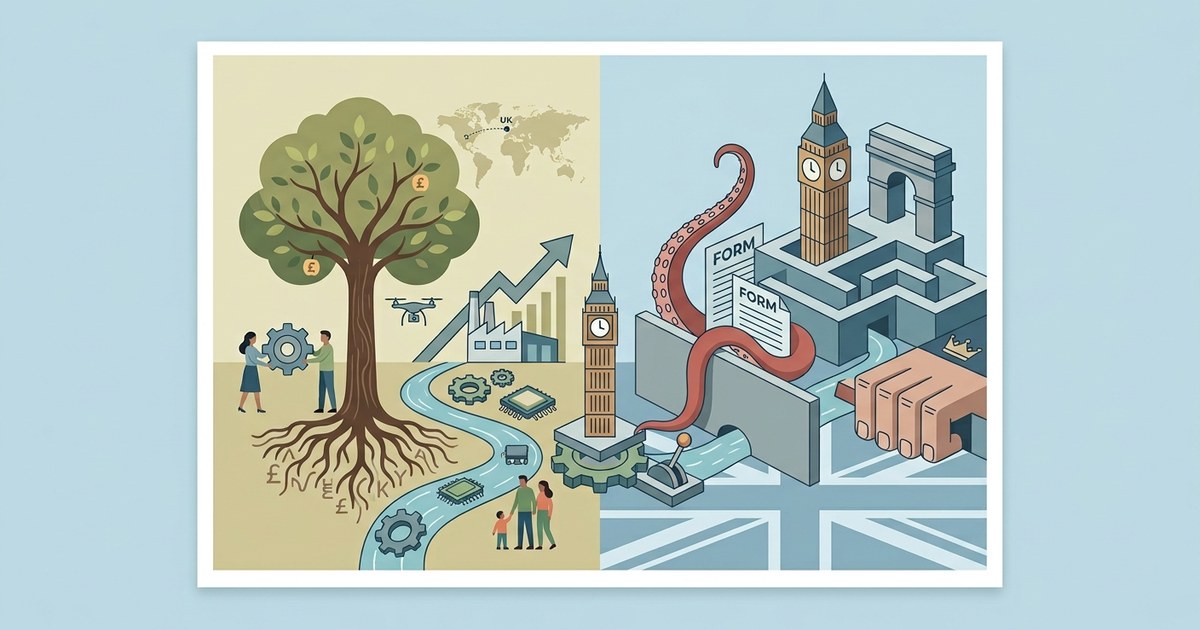
Motion: the UK needs a new attitude to work
Debated: 6 July 2026, Ye Olde Cock Tavern, Fleet Street
Format: main debate, proposer and opposer, 13 floor speeches
‘The UK needs a new attitude to work.’ The chair read the motion to a room of about twenty, framing it against the productivity crisis and the million young people not in education, employment or training. A show of hands before the speeches gave the proposition an early lead of 10 to 3. What followed was less an argument about whether British working life is in trouble than about what kind of trouble it is, and whether a new attitude to work is the cure or the misdiagnosis.
The proposer’s case for a new attitude to work
Ross Hunter proposed the motion and Helena Wardle opposed it.
The comparison that framed a new attitude to work
The proposer opened with two decades of numbers. Real wages in this country, they claimed, have risen by about 4.5 per cent since 2008, while American incomes over the same eighteen years rose roughly three times as fast from an already higher base. They set that beside the count of young people not in education, employment or training, now above a million.
Having arrived from the United States twenty-one years ago, the proposer ruled the American model out. Losing a job there means losing health cover, which hands employers a power over staff they called bonkers. The NHS removes that fear. The point of the comparison was narrower: some American habits, particularly the spread of technology through ordinary firms, could be adopted without giving up anything Britain values.
Culture, investment and class
Three arguments followed. On culture, they noted that a national sporting fixture can flatten a working week here in a way it would not elsewhere, and that a disdain for technical work and for talking about money carries a cost. On investment, they cited Britain’s standing in international comparisons, putting British investment at roughly half the level of other G7 countries and the country as having coasted too long on Victorian infrastructure.
The third was offered as a taboo. Where a marginalised group was exploited a century ago, the proposer argued, resistance made sense, but a hangover of that attitude now persists in a workforce that no longer needs it. Cynicism about who has the connections, they said, is a reason for action rather than a reason to disengage. The motion asked only for a change of attitude, not a change of hours.
The opposer on a new attitude to work: recover the old one
Not a new attitude to work but an older one
The opposer took the motion in the other direction and argued the country needs to recover an attitude it has lost. She began by heckling the proposer on purpose, then explained why: conformity is the thing under defence, and a debate is a poor place to practise it. Nobody knows what the future of work looks like, and humans have thrived without knowing before.
Her case rested on childhood. She questioned one member from the floor about cycling long distances as a young man, unsupervised play and the absence of any fear of failure, then asked whether a modern childhood looks the same. She took the answer to be the root of the problem. Independence, curiosity, adventure, making your own decisions and challenging authority are learned young or not at all.
Work as adult school
Work, on her account, has become adult school: standardised tests, tick-box recruitment and a reluctance to say that a boss is wrong. Childhood jobs, the paper rounds and the waitressing, taught transferable skills that recruitment systems no longer look for. She described arriving from South Africa with a handful of CVs, walking into every shop on a high street and being offered work by a florist on the strength of willingness alone, and traced her own career to a chance conversation behind a counter.
Remote working removes the thing that made this possible, she argued: watching people who know what they are doing, and overhearing them. Her firm recently hired someone into a developer role who cannot yet code, on the basis that she understood the problem and had held nine or ten jobs already. The ask she left with the room was not policy but obligation. Mentor the young, because they are no longer learning at work the way the room did.
Voices from the floor on a new attitude to work
Blame, and where a new attitude to work should be aimed
The first floor speaker objected to what they heard as blame directed at working people, and challenged the idea that this is a British problem at all. Quiet quitting, they noted, appears across the West and most intensely in Japan. American growth, they claimed, looks less exceptional once capital flows and the tech sector are stripped out, and the investment gap is a choice about austerity rather than a national temperament.
A later speaker made the same move from a different angle. Attitudes are rational and incentive-driven, they argued, so what has changed is circumstance, not character. Working from home leaves juniors unwatched and unmentored, and they offered the example of a graduate who sat for forty-five minutes watching a query that should have taken three, simply because nobody was sitting beside them.
The sceptics: what would a new attitude to work actually change?
Two speakers declined to be moved. One, who had worked in management development at a corporation employing thirty thousand people, pointed out that the motion proposes nothing: it says only that things ought to be different. They added that they had once asked the Treasury and major consultancies what causes economic growth and received no answer, and that the research on the 1930s depression suggests you do not get out of one. They intended to abstain.
Another abstainer attacked the class argument directly. Class is not a British peculiarity, they argued, being present across Europe and Asia without producing the same results. They also disputed the account of hiring: graduate recruitment now runs to four or five anonymised stages, so networking gets a young person little more than the address of an application portal.
Money, mobility and comparisons abroad
A speaker who had spent thirty years in the United States and fifteen here, having grown up in a Chinese household, agreed that Britain treats money as slightly dirty and wealth as suspect. They asked which areas the country should invest in, and warned that hard work without direction produces nothing.
A speaker who works in a church took a different view. Of 6.9 million people aged 16 to 24 in England, they noted, 5.9 million are doing something, and the remaining million includes carers and others with reasons. Vacancies exist in hospitality and social care. What the country needs, they argued, is not a new attitude to work but a new attitude to meeting people’s needs, and a redistribution of wealth to match. Asked what would then motivate the people creating that wealth, they replied that they would rely on human goodness instead.
Government policy as the real obstacle
Several speakers moved the blame to Westminster. One argued that employers’ national insurance, the minimum wage, business rates and expanded employment rights have together made hiring a young person too risky, and traced the anxiety they see in that age group to school closures during the pandemic and to a failure to prepare for a coronavirus rather than an influenza.
Another asked why a country that taxes alcohol and tobacco to reduce consumption also taxes work, and turned to artificial intelligence: Britain is not winning that race, and the abundance it might create will be housed elsewhere. A third offered the closure of Hammersmith Bridge as the whole argument in miniature. Approved in 1824 and finished in 1827 for £82,000, about £7.6 million today; shut since 2019, and now quoted at seven years and £300 million to repair.
A new attitude to work, or a model breaking down?
One speaker agreed with the opposer about childhood and observation while rejecting the idea that government caused it. What is breaking down, they argued, is a technological and social model barely two centuries old. Before the industrial revolution most people were born into a trade and worked to the rhythm of the seasons. The factory system created the clock, the interview and the freedom to leave one employer for another, and artificial intelligence is now unsettling all three.
Another speaker tried to reconcile the two openers, arguing they had more in common than either admitted. Jobs became about ticking boxes and avoiding risk, they said, and the productivity problem sits in the long tail of small firms with poor incentives and poor management rather than at the top. Young people see wider opportunity through their phones, and the gap between that and a box-ticking job keeps widening.
What a new attitude to work asks of the young
A speaker in the age group under discussion pushed back on the charge of fragility. Graduate schemes are two-year fixed contracts, they argued, and companies take on more graduates than they have permanent roles for, so the disloyalty runs in both directions. Offices reward showing your face, speaking first and booking the meeting rather than its output. Quiet quitting, on this account, is a response to being used for groundwork and dropped, and cutting entry-level roles to artificial intelligence removes the middle managers of five years’ time.
The chair closed the floor on schooling and confidence: homework in private schools long before state schools, classes of twelve against classes of thirty-five, and the difference that makes to whether a child speaks up. They objected to the rhetoric around welfare and mental health, and traced the rest to manufacturing decline, to Brexit and to a Saturday job that now requires an application, an interview and a four-hour contract at Christmas.
Closing arguments: the opposer
The opposer revealed that she had been due to propose the motion until earlier that day, and had planned the opposite case on the train. Productivity is not efficiency, she argued, and a £300 million bridge is not a problem money will solve.
She agreed that artificial intelligence will destroy jobs, and predicted that anyone who does not embrace it within five years will be unemployable, but insisted the more important question is transferable skills. Junior roles are dying, and a chief executive who refuses to hire junior engineers has forgotten where senior ones come from. We have forgotten how to fail, she said, and children have not.
Closing arguments on a new attitude to work: the proposer
The proposer conceded that neither opener had mentioned artificial intelligence, which he called bonkers given that both work in it. He took the graduate-scheme argument from the floor as the strongest thing said all evening, and turned it into his own: those schemes are the best jobs available to people of that age, and if managers are not mentoring or stretching them, that is the work culture in miniature.
He rejected the idea that he was blaming working people, noting that those at the top can afford their own idleness, and argued that a century of bailing the country out has left it in a funk it needs to shake off.
The final vote on a new attitude to work
The motion carried, 11 votes to 7, with 2 abstentions. The room had gone in 10 to 3 in favour, so the margin narrowed even as the proposition’s raw total rose. Both abstentions were declared in advance by speakers who said the motion proposed nothing concrete to change. The room agreed that something in British working life has gone wrong; it did not agree on whether the fault lies with attitudes, with government or with a model of work that is simply running out.
Why the new attitude to work motion carried
A motion this broad usually loses, because a room can always find a reason to say that the words commit nobody to anything. This one won because the proposition did not have to hold its opening ground. By the second half of the floor the question had quietly changed from whether British workers try hard enough into whether British institutions still work, and almost every speaker who answered that second question answered no. In his closing the proposer adopted the strongest version of that reframing, and the motion proved wide enough to accommodate it.
The proposition’s case: comparison, investment and class
The opening speech was built on three legs of unequal strength. The economic comparison was the sturdiest, partly because it pre-empted the obvious objection by ruling out the American model on its own terms. Conceding the NHS point early cost nothing and bought a hearing for everything after it.
The investment argument went almost unchallenged all evening, which is worth noting because it was the most concrete thing said. Nobody disputed that British investment lags the G7. What speakers disputed was the cause, and the answer they preferred was austerity rather than temperament.
The class argument was the gamble, and it drew the sharpest replies. Two speakers pointed out that class exists across Europe and Asia without the same consequences, which is a hard rebuttal to answer. The proposer had invited exactly that response, and inviting it took some of the sting out, but the leg did not hold weight.
What the numbers did, more than persuade, was set the terms. Once the chair had framed the motion against the productivity crisis and the NEET figure, every speaker who followed had to say something about young people and something about output. Anyone wanting to argue that British working life is fine had no obvious ground left to stand on.
The opposition’s case: childhood, observation and obligation
The opposition’s strongest move was structural rather than rhetorical. Refusing to defend the status quo and arguing instead for recovering an older attitude meant she never had to claim that British working life is fine. It also created her one real vulnerability, which the floor spotted within the hour: a motion asking for a new attitude is satisfied by any change of attitude, and recovering a lost one qualifies.
Two speakers said so explicitly, and one of them voted with the proposition on that ground alone. The opposition case was strongest where it was least like a rebuttal. The observation about remote work removing the chance to watch competent people at close range was picked up and extended by two later speakers, and nobody argued against it.
Her second difficulty was that the case was addressed to the room rather than to the motion. Asking twenty people to go away and mentor somebody is a call to action, and it landed. It is also, on any reading, a change of attitude, which is exactly what the motion asked for.
The ebb and flow of the floor debate
Thirteen speakers took the floor and the centre of gravity moved twice. It began close to the opposition, drifted through a long middle passage about government and technology in which the motion itself was barely mentioned, and settled at the end on employers and the young. Two speakers announced abstentions along the way and neither was talked out of it.
Battleground one: was a new attitude to work an accusation?
The first two floor speeches treated the motion as a charge against working people and defended them. This was the opposition’s best stretch of the evening, and the proposer’s decision to answer it explicitly in his closing suggests he thought so too. What blunted it was that the defence conceded the premise. Once a speaker argues that quiet quitting is a rational response to bad incentives, they have agreed that something needs to change, and the motion does not specify who has to change it.
Battleground two: government, technology, or something older
The middle of the evening belonged to speakers who located the problem outside the workforce entirely: in tax and employment law, in the handling of the pandemic, in the cost and speed of building anything, and in the arrival of artificial intelligence. The bridge example did a lot of work here. It converted an abstract complaint about attitudes into a number, a date and a piece of infrastructure that people in the room drive past.
These speeches read as opposition to the government rather than opposition to the motion, and several of them ended in the proposition lobby. The speaker who argued that an entire model of work is breaking down offered the deepest version of the same thought, and reached the same destination by a longer road.
It is worth noticing what nobody said. No speaker defended British management as it stands, and no speaker argued that productivity here is fine. A motion that needs only agreement that something must change collects those speakers by default, whatever they believe the something to be.
Battleground three: what a new attitude to work asks of the young
Late in the evening the floor produced the decisive speeches. The account of graduate schemes as two-year contracts that end in a drop reframed the evening’s central complaint as a description of employers rather than employees, and it came from someone speaking about their own position. The chair’s speech on class sizes, confidence and welfare rhetoric extended it downwards into schooling.
Neither speech was a rebuttal of the opposition. Both were compatible with everything she had said about childhood and mentoring, which is why the opposition could not convert them. They were, however, precise about what ought to change, and the motion only ever asked for that.
Closing arguments on a new attitude to work, and what drove the result
The two closings pulled in the same direction more than either intended. The opposer spent hers on junior roles disappearing, on the need to embrace artificial intelligence and on mentoring; the proposer spent his on graduate schemes, on managers who do not stretch the people they hire, and on artificial intelligence. A listener arriving at that moment would have struggled to say which was proposing.
That convergence explains the numbers better than any single speech. Seven people voted against a motion whose opponent had just agreed that work must change; they were voting against the word ‘new’, or against blaming attitudes, or against a motion that named no remedy. The two abstentions came from the two speakers who had said from the floor that the motion proposed nothing, and they held that line to the end.
The proposer also did something the opposition did not, which was to take an argument from the floor and make it the centre of his reply. Adopting the graduate-scheme case put the strongest thing said that evening on the proposition’s side of the ledger, and it left the opposition’s own best material, about mentoring and about watching competent people work, sounding like agreement.
Conclusion
The pre-vote margin was wider than the final one, which is the reverse of what the raw totals suggest and the more interesting figure. Late arrivals and a break account for some of it, and in a house of twenty a few votes are noise.
What is not noise is the direction of the argument: the room grew less willing to talk about attitudes and more willing to talk about institutions as the evening went on, and voted for the motion anyway. A country can decide it needs to work differently long before it can agree on who is working wrongly.
Full transcript of the new attitude to work debate
Read the full transcript
The motion, and the show of hands before the speeches
Good evening, everyone. The motion is: the UK needs a new attitude to work. It is more in reference to NEETs and the productivity crisis. What I would like to know is how people feel about the motion. How many are for the motion? Ten. And who is against the motion? Three. Thank you. Would the proposer like to start, please.
The proposer opens: two lost decades
Good evening, everyone. It is a very important topic and I am sure we will have a wide-ranging debate. I am interested that all of you have come out tonight, because it was a big night last night. How many of you were watching the football? Three. I think there are some other Sylvans who probably did watch the football and may not have made it out tonight. Far be it from me to take anything away from the national sport, but let us get into the subject and think about what our attitude to work is in this country.
I came to the UK almost twenty-one years ago, and the scary thing that has happened is this. Since 2008, a couple of years after I arrived, real wages in this country have gone up by 4.5 per cent. Everyone on average can buy 4.5 per cent more than they could in 2008. I am not saying that buying things is the most important thing in life. People in the UK increasingly value earning a lot of money less, and I think that is a good thing. Trying to earn stupid amounts of money leads to people like Elon Musk.
At the same time, we are struggling. The United States over that period went up three times as fast. Their incomes went up by 14 per cent over the same eighteen years, and at that time they were already far wealthier than we were. When I came to the UK in 2005 the salaries in dollar terms were the same. The pound was two dollars, then in the crisis it went to 1.3, and it reverted to roughly what it was before. The UK has always been not as wealthy as the US in recent times, which is fine.
I am American. Tonight is about the UK, not about America. I am going to use the US as a contrast and draw comparisons between the two. I am not trying to say the American model is the right model. It is not the right model for the UK. But we have to look outside and ask whether we have the right model here, and what the best model for us is. If we sit in our own echo chamber that is not necessarily the right thing to do, and the Sylvans is all about busting up echo chambers.
The other sobering statistic, as the chair alluded to, is that we have over a million NEETs, not in education, employment or training. Those are young people. A million people. We have had two lost decades for the economy, and we have a million people who could be lost for themselves, lost for the economy and lost for everyone. Imagine being one of those people. People who come out of school or out of university and do not start working have their whole lives affected by it. It changes their entire life prospects. So we have won the football, fantastic. But are we winning? We have some real challenges here.
I had a choice. If I had stayed in the US, over those twenty years I would have worked quite a bit harder, probably 20 or 30 per cent harder, more hours, harder driving, and I would have earned a shitload more money. I am glad I am here. I could not work in the US any more. It is too insane. It is bonkers. Bosses have huge amounts of power over their staff. You lose your job, you lose your health care, and that gives them excess power. Imagine that. You do not want to get sacked because you could lose your health care. We would never face that here, and it is a much better way of running an economy.
At the same time, the productivity they have there is far higher. They work harder. They use technology much more, and technology use is much more widely spread across US companies than it is here. Some of those things we could adopt here without changing the culture. We can keep the NHS and adopt some of them, and we would all be better off. We could possibly even work the same amount and still be a lot better off. It is not about working more hours.
The context, and how other countries organise work
So that is the context. Sorry to start with a downer, but it is tough out there. People feel it. I know so many people who are struggling. Then I look at my children, and they have a different attitude to work from the one I would have had at their age. I am a foreigner and I cannot fully understand British culture, but I observe a lot. Some things I can see clear as day. Others are more subtle and harder for me to understand. When I hear my children say “I can’t be bothered”, that is an attitude you would not get in the US. That phrase does not exist there. You have people who might say something similar, but the idea that you could possibly say that, nobody would.
Even in France or Germany it is different. Germans do not necessarily work long hours, but they have a totally different attitude to work. In Germany the lower-paid staff work shorter hours and the highest-paid people work the longest hours by far. When I was working in Germany, the partners in consulting firms and law firms worked twenty-four hours a day. They are paid the most and they feel it is only fair that they do the most work. Their mid-level and base-level staff have the shortest hours and the full benefits.
I am not saying that is the right model for us either. The point is that different countries set work up differently, and the question is whether we have the right one for us. France shuts down in August. Their productivity is not especially high, but they probably work fairly efficiently because they do not work that much, and they are about as rich as we are. There might be something we could learn from the French as well, and the food culture is excellent.
Culture, and the cost of a national shrug
I want to talk about three areas, and the third is a massive taboo. I am already breaking taboos here and I am going to break another one.
Culture. I have touched on it already. In a lot of countries, take the Super Bowl in the US, it is on a Sunday evening and there are plenty of people who get drunk and are probably hungover at work the next day. I will tell you, they at least pretend that they are twice as efficient on the Monday morning. They are not turning up late. They get in early and double the amount of work they do that morning just to prove that they are still working.
Shutting down work, taking a bank holiday for sport, would never happen here. I am not saying we should not keep football culture, but there is a cost to it, and the question is whether we have the balance right. I am sure people are going to hate that argument, but I am putting it out there because we need to kick it around. Pun intended.
In the UK there can be a disdain for technical things, for technology, for money, for talking about money. Not valuing high earnings, I like that. But if we disdain all of it we are going to fall behind, and we will not be focusing on the things that could help everyone. So there is part of the culture that we need to think about.
My second point is investment. We have the lowest investment of any G7 country by miles. Our investment levels are something like half of the other G7 countries. Italy is a G7 country and our investment is way below Italy’s, and the Italian economy is really weak. We have infrastructure from Victorian times. It was amazing infrastructure then and it is still all right now. If we get the wrong kind of leaves or the wrong kind of snow we have a problem, but most of the time it works, and that is actually good. Leveraging old infrastructure is a high-return thing. The problem is that it is not quite good enough. We have coasted on it too long.
It is not just infrastructure. Investment applies inside work too. I have a small team of ten people, and we have a new tool we could use. In order to start using it we have to do work. We have to set ourselves back a little to get to the point where everything we do afterwards is much easier. It is very difficult to convince people to do that.
To get ahead you have to invest. Everyone who comes out of school or university builds skills, builds networks, pounds the pavement, spends ten thousand hours on some skill. Everyone does it to an extent, but there is an aversion to it here and people struggle to get there. In the US you would say: this is a better solution, we have to do this much work to get there, let us do it tomorrow. It is a can-do attitude. We have it in some places here, but it is not pervasive.
The class system, and a taboo
Now I am going to turn everyone off. Please, we are in the Sylvans, keep an open mind. It is a taboo subject and I have almost never heard it mentioned here, which I cannot believe. The class system. Railing against the establishment, fine, but the class system is slightly different. One member talks about it all the time. Nobody else ever does.
I do not fully understand it. There is a book called Watching the English, by an anthropologist called Kate Fox, which is brilliant for foreigners. It is a how-to guide for English people, written by an anthropologist who studies the English, and it is a fun read. She talks about class throughout. I cannot understand it, but I do feel something, and people should come up and shoot this down. I am very happy to be proved wrong.
If I were part of a marginalised group that was completely exploited by capitalists or upper-class people a hundred years ago, would I have wanted to rebel? Would I have wanted to work less, and damn the man, or whatever the phrase is here? Yes, I can completely understand that. I think there is a hangover still. I think part of that attitude is still pervading the workforce, and that is a waste. There is no need for it any more. Jettison it. Get rid of it. If I am wrong, shoot me down, and I look forward to hearing it.
Then there is the cynicism. These people all have connections, I do not have the same opportunities. People have differing levels of opportunity. It would be amazing to have equality of opportunity. That is not a reason for cynicism. It is a reason for action. Do more, invest more in your own career, work harder, study more, whatever it is, get on with it.
I have been making the argument that the attitude to work needs to change. We need to work smarter. In some cases we need to work harder, not necessarily overall, and at certain times. That is really working smarter. We work harder for a bit and we can actually work less afterwards. We also need to invest, and that takes a different attitude, a different view of what the future is. You may disagree with 95 per cent of what I said. The motion says we need a new attitude. If any of these points make you think a bit of a change of attitude would make a difference, vote for the motion. Thank you.
The opposer replies: recover the old attitude
Hopefully my argument will help make sense of this. So you have a choice: popcorn or audience.
I do not think we need a new attitude to work. I think we need to recover an old attitude to work, and I am serious about that. I am going to be extremely poorly behaved deliberately, and that is going to annoy the President greatly, and I am sorry that you bear the consequence of my misbehaviour. I am going to continue.
I want to talk about what we are actually debating. We are talking about changing the way we work, changing our attitudes to work. I think that is wrong. Why are we continuously trying to put human nature in one box and say everyone looks the same, everyone thinks the same, everyone conforms to rule, everyone listens to presidents? Obviously I will not. That is my point, and I want to tell you why.
We have absolutely no idea what is going to happen in the future. We never did. We never have. We have always thrived as humans. The problem with how we try to control things is that we get some data, we are told things are changing, we are told we need a different attitude, and then we are unwilling to reverse when we have stuffed it up. Some things just never change and we are not prepared to admit it. I love change. Anyone who knows me knows I am the first to encourage anything new. In this case I am going to argue that we do not need something new. We need to go back to the old, and I am going to paint the picture with some audience participation.
I would like you to imagine the person next to you, the person in front of you, as a child. Let us look at one of our members. He is my prime example. Imagine him as a child. Let me tell you a story a lot of you may not have heard. This man got on a bicycle and travelled a very long way when he was young. He told us the story in a debate and it is funny. So please tell me, what did you learn on your travels that you could translate into work? Am I allowed to ask the audience questions? I am. Were you scared of failing while you were doing that? Did you worry about any of that?
“No. I had no fear. No fear of failure. It never entered my mind.”
What do you think drove you?
“I was determined to get where I wanted to get to.”
Tell me about your childhood. Did your parents supervise you all the time while you played?
“No.”
Did you have free time when you could explore and cause mischief without your parents ever finding out, and you knowing that?
“Yes.”
So, modern childhood. Do you think that looks the same?
“Probably not. No.”
No. We kill people’s human nature, which is detrimental for their work, because we are trying to box people into behaving. I am deliberately misbehaving because I think it is important. I am not talking about crime and that kind of nonsense. I am talking about learning independence, following your curiosity, having a sense of adventure, learning to make your own decisions, learning to challenge authority. Would anyone challenge their boss right now? No, because you would probably get sacked. I would. I do not have a boss, by the way. But how many people have the comfort to go to their boss and say you are wrong, and here is why? Look at our politicians. Do we actually revolt against them?
Work as adult school
The key point is that we forget we have boxed the whole system into one neat, tiny thing of conformity, which is damaging for us as adults in work. I see work as adult school. Let me tell you why. You all have to do a standardised test. We have a tick-box recruitment system, and if you do not tick the boxes and do not have all the skill sets, you will not get the job.
Has anyone thought about how many of us had jobs as children? What kind of jobs? Paper rounds. Lawnmowing. Waitressing. All of those little jobs we did, sharing homework, all of those are transferable skills that we use in the adult world, in adult school, in work. But we box children in. I have seen it, and I am not blaming parents. Please understand that. We are all adults with influence. The news has an influence, because parents are terrified their children are going to get killed. Teachers, anyone who touches a child’s life, has an influence on it.
This is shaping the young humans coming into employment today, because they do not learn independence, they do not learn that they have their own voice, they do not learn that they can challenge the people they think are in charge, because we do not allow them to. The problem that creates in society is massive, because now we put them into work and say, well done, guess what, we are a remote world.
So how did you learn, and how did you fall into your career? Think about it. I can tell you my story. I came over from South Africa completely clueless, thinking it was stupidly easy to get a job in the UK. I walked up and down a high street with twenty CVs in my hand, went into every single shop and asked them, do you have a job for me? The florist asked me, can you do flower arranging? I said no, you can teach me. That was because I climbed trees, I was outside, I was allowed to be totally independent as a child.
I also grew up in a world where I saw people in authority treat people like total shit, and I was told that is the way it is. I got kicked out of Sunday school because the man who tried to teach us to listen was really cruel to a black person, and I said to him, sorry, but you are trying to teach us about kindness, and I saw what you did. I grew up in that country and it taught me a lot. I do not trust authority, I never will, and I think it is the best thing I learned.
We do not allow children to learn things like that, because we cage them into little boxes to control them. That is the worst thing we can do to young people. And now we have a remote world where we do not get to observe other people at work. That is damaging.
I fell into my career because I worked in a building society, and the financial adviser wanted me to refer clients to him from the counter. He told me about his job. I turned round and said, how do I get to do what you do? This is not about me. One of you did the same. You walked into a shop, saw an advert, and asked if you could do the job. That is my point.
Transferable skills, connections and mentoring
We are saying this is AI, this is that. Yes, and, to the proposer’s credit, there is a non-profit that exists precisely because if you do not have connections you do not move up. Let me tell you now, if I had not networked my backside off in the last five years I would not be where I am. That is natural in some circles, because you get people who have a friend of a friend who has this and that. Imagine you come from nothing and you have no connections. That class system is a real issue, and I am very happy to say that an organisation exists to solve it.
But we do not allow children and young people to learn these skills any more, because we box them in. Mischief or naughtiness is bad, obviously not. I do not think we should teach people to conform in the way that we do. I think it is damaging for society, because ultimately we need people to learn that failure is okay. We need to show them failure is okay, because we stuffed up. We created all these systems of education that are utter rubbish, and then modelled work on that. I am not saying cause chaos at work. Please understand what I am saying. We do not help young people understand that they have transferable skills.
Let me give you an example. We have just hired someone in my business into a developer role and she cannot code. What she does have is an exceptional understanding of the problem, and she had nine or ten jobs before this one. She is not that old. That is the kind of person I look for, because I know they are flexible, adaptable, willing to learn and curious. We beat that out of young people, and I think that is the biggest mistake we have made.
We can blame whatever we like, but we have a million young people who are going to struggle, and all I can ask of you today is to be their mentor, because they are not learning at work the way we did. They cannot watch the leaders walk around and have conversations, and eavesdrop. I did. I bet you did too. Mentor the young people who need you, because we have seriously undervalued how valuable experience is, and they have almost no chance of getting it now. That is all I need.
The floor: is the motion a charge against working people?
Good evening, everyone. I am going to vote for the opposition, and I will reflect on some of the points the proposer made. My main objection is blaming working people for the lack of productivity, and the proposer also brought class into it, so blaming working-class people. Our lack of productivity is a very complex issue, and I think it is unbalanced to put it on working people.
“Do you really think that is what was said?”
I am just reflecting. I made some notes. I am not attacking anyone. He made a lot of points and I am going to try to address them. It is also not a UK phenomenon. We have quiet quitting, which we see across the West, and allegedly it is most intense in Japan. We see it in the US as well. There was a survey of Gen X in the US, and their expectation is that by thirty they will all be earning seven hundred thousand or more, and at the same time they want balance. My point is that this is not a UK attitude. It is an attitude across the West.
The USA is not a good example, because it has the benefit of the dollar being the world’s reserve currency, and that results in capital flows into the US that inflate the economy. Risk anywhere in the world means capital flight into the US, and that goes into buying treasuries and the stock market. The Financial Times ran some numbers last year, and they said that if you strip out capital flows and things like the tech industry, their growth rates are similar to European growth rates. With tech it is more complex, because it is pulling in capital, but is it actually making any money? The data tells us it will be decades before we see revenue.
There is also a difference between Wall Street and Main Street, between what the stock market says and what people feel. If you are in the US, people are also feeling impoverished. Compare with Europe: Germany is in a mess, France is in a mess, and the German car industry is being taken over by the Chinese. If we look at productivity overall it started to decline around 1971, and you can use that as a marker, because that is when the US came off the gold standard. China is the most productive country in the world. That relates to what productivity is: we are not selling enough, and we import more than we sell.
The proposer said we do not like to talk about money, but in Holland, for example, it is the same thing. It is not a UK thing. He also said we have insufficient investment levels, which is true, but that is because of the Conservatives pushing austerity, as opposed to Labour, which wants to invest. It comes down to political decision making. Those are the reasons I am tending towards the opposition. I refuse to blame working people, because it is much bigger than that.
What would a new attitude actually change?
Madam Chairman, I have come on this side but I do not really know where we are going at all. It is very difficult to see what you are going to change in the management and development of people and their jobs, because that has not actually been proposed. All we are saying is that it ought to be different. I doubt we can make a decision on this unless we know what you want to aim for. The topic is also so large that we have covered virtually none of it.
I have mentioned in these rooms that I had a job not very far from here, working in the largest corporation in its business, employing thirty thousand people. I worked in a management development department where we were looking at exactly these issues. How do you manage people? How do you motivate them? Hygiene factors. It is a topic you could take a degree in, and I do not think we have covered any of it here tonight.
The proposer has reeled off a list of the statistics. I have been looking at them recently as well, and they are more or less right. As always, the United States is leaps and bounds ahead. It is interesting that he has worked over there and does not want to stay there. I have heard other people say the same thing. Maybe the pressure is just too much.
The other problem with this motion is how you relate our poor economic performance to how you create and manage people in their jobs. That has not been touched on. The same corporation I worked for went out and talked to the senior people in the country about longer-term economics, and I asked people in the Treasury and even major consultants what causes economic growth. I got no answer. They did not know. So we have not got the economic growth going, but we have no idea what causes it.
I have taken an interest in this subject over many years and I have published what I consider are the factors, and none of them has been mentioned here tonight. So along with everybody else, we as a group have no idea how you get economic growth going. We are getting some growth. It is not that we have not got any, but from 2006 to 2026 that is twenty years of poor growth, and I have said in these rooms several times that I believe we are in a depression.
The people still studying the 1930s depression conclude that once you get into a depression you cannot get out of it. It is partly the investment problem. If you are a firm and you see no growth, there is no sense investing whatever resources you have in enlarging your capacity to produce more goods and services. You are just not going to do it. That is why, once you get into that state, you cannot get out of it.
The answer from the people studying the 1930s is that it was the Second World War. Britain declaring war on Germany caused America to arm us. America did not come in and fight for a long time, but they armed us straight away, and building up the United States armaments industry was enough to push the United States out of depression. I cannot see any war of that kind on the horizon, only conflicts, so we are stuck with that one as well. I do not know where we are, ladies and gentlemen, and I will probably abstain. We will see what other people say.
Money, culture and comparisons abroad
I still do not know where I am in terms of the final vote, but I think I am leaning towards the proposition. This is a very complex issue and it is difficult to debate it out within an hour, so I will focus on a couple of things. First, the attitude of UK people towards money, and then culture.
Some background, because that is how I make my observations. I have been living in this country for fifteen years now, and this is the second time I have lived in London. The first time was two years, about twenty years ago. I spent more than thirty years in the US, but I was not born there. I came from a Chinese background, so I had Chinese culture. My parents worked under Chinese work conditions. So you see where I am coming from: an Asian background, then living, studying and working in America for thirty years, and then coming to the UK for fifteen.
I am glad the proposer said America is not the model to follow, and he did not say he was against the working class, so I did not get that at all. What I see in this country is that people do not like money a lot. They do not like to talk about it. It is like a dirty thing. This is just my personal opinion and I could be wrong. In America we could invest, and at one point I was a retail investor. Here, being a retail investor was seen as, what are you doing, this does not sound good. If you are rich there could be something wrong with you, and your money probably came from a dirty way. That is just my impression.
On investment, I wish the proposer would tell me which areas we should invest in. He did not mention that. Education? Military? Technology? I would like to hear that at the end.
On culture, I came from an Asian background, and when I first moved to America I thought Americans were very lazy. You have heard of the tiger mother. You have heard how they want their children to be one of three professions: doctors, lawyers and engineers. I studied engineering, following my parents’ advice. We worked so much harder. Things have changed, definitely. When I worked in the US I pretty much worked from seven in the morning until eleven at night, and I was only a senior project manager, not at C level. At that time a mobile phone was a rare thing, but I was given one so they could text me and call me any time they wanted until eleven at night.
I agree with the proposer that we need to work smarter, but also harder when you are working smarter. Working hard is not enough. You can work hard and go through the motions without producing anything. I also do not like to hear productivity gains conflated with cash flow. Let me finish with the opposition. The opposition said we need to go back to the old attitude, but what she described was not the old attitude. It is a different attitude. It sounds new to me.
Class, globalisation and the hiring process
Good evening. I abstained at the beginning because I felt the question was quite broad, and I will abstain again, for various reasons.
First, for the proposition. One of the things mentioned was class. However, class is not just a UK thing. I would argue that class is really related to money, and it is present throughout Europe and in Asia. In India it is probably one of the best-known cases, and yet we are not seeing the same productivity or growth issues we are seeing in the UK. So I do not feel that is significant enough a factor to explain it. In France, anybody who has been there or been raised there will know that class is a massive issue, to the point where people describe themselves as proletariat. If we are talking about class in the more traditional sense of a monarchy or an aristocracy, again, that is a very common European concept. It is not special to the UK.
The second reason is that I feel neither side really addressed the issue of NEETs, which was part of the opening statement, and neither addressed globalisation. The workforce today is not the same workforce as it was thirty years ago. People today are competing for the same jobs and there are a lot more of them.
On the lack of uptake of technology, one place we can see that is not true is in hiring. Most people today who apply for a job, especially young graduates, will not get one through networking. You have to go through a three, four or sometimes five-stage process, especially at a top company. I changed jobs recently. I joined a big company three years ago and it was a full-stage process that took six months. I have applied for jobs pretty constantly over the last fifteen years and the hiring process has got more and more complex and more and more anonymised. So who you are does not really matter, especially at the beginning of a career.
Being a NEET today, the best networking will get you is here is the website to apply to, and hopefully you get through the HR hurdle. So the comments on hiring and networking, to me as somebody who has gone through that process consistently for fifteen years, seem to come from people who have not, and they do not reflect today’s reality.
The third point, and part of the reason I am not voting for the opposition, is that we are in a new world. A lot of things that were true when our parents were young are not the same today. People are competing with other nationalities and other education systems for the same jobs. Because it is a lot more competitive, a lot more people will get left behind. In a previous time, when the world was more insular, you might get by without having to push yourself the way people have to now. So overall I feel that neither proposition nor opposition really answered what to me was the key question.
Hiring risk, the pandemic and government
Mr Chairman. A million young people not in education, employment or training. That is the result of government policies over the last twenty-five years. This government has raised employers’ national insurance, has raised the minimum wage, has raised business rates and has given new employees more rights. That makes it more expensive to employ anybody, which is going to feed through into limitation of growth.
When you hire a young person you are taking a risk. They have come out of university or whatever. They have had some sort of theoretical training, but it is their first job. Maybe they are nothing more than a pair of hands for months. They are not going to be worth what you are paying them until they learn the job properly. And nowadays you are taking a risk. That young person could phone in on the second day with a sickie for anxiety or depression. So firms are not going to employ young people. It is too risky.
The second reason is the way the pandemic was handled. Back in 2005 the World Health Organisation issued two warnings about pandemics. One was for an influenza pandemic and the other was for a SARS pandemic, severe acute respiratory syndrome. The government got the message for the first one. But for some reason the message about the SARS pandemic, despite the fact that it had happened twice, once in Guangdong province in China and once in the Middle East, dropped down the risk register and disappeared off it in 2017. That register is what the government maintains of the risks they should prepare for.
So when we got a SARS pandemic, the regional health authorities had been dismantled during the Brown and Cameron eras. We had some bureaucratic organisation called Public Health England. The way you tackle a SARS pandemic is to test for infection, trace any contacts and isolate. Test, trace, isolate. We had no mechanism to do that. It had all been dismantled. So the government said stay at home, lock down, close the schools. Schoolchildren had no interaction. I can see you shaking your head, but you needn’t. No interaction, at home on their phones and their PCs for two or three years. Of course you get an element of young people nowadays with neuroses, anxiety and depression, and that is entirely down to government policy, or the failure of government to prepare properly for a pandemic that was warned about in 2005.
Also, not a single person in this cabinet has ever run a business. None of them has had to worry about whether we are operating at a loss or just making a profit, whether we have enough staff, too many, the right staff. They have all been employed by the public sector, where the money just flows from the taxpayer. That is the sort of government we have. So frankly the problem we have is self-inflicted, because of who we elect.
Taxing work, and the arrival of artificial intelligence
An interesting and difficult debate, which has swung either side as it has gone. I think the opposer makes a great point about not trusting authority, and why should we here in the UK wait for our government to bring us a solution when they are in fact the problem? Much like the previous speaker said, the government is the root cause of what is going on in the UK at the moment. We tax alcohol, we tax tobacco. Why? Because we want to reduce consumption. Why are we increasing our taxes on work? What is that going to lead to? It is going to lead to less work. That is some of the lower-hanging fruit.
But there is a more philosophical question that lingers that nobody has touched on yet, and that is AI and what is coming. The UK, along with the rest of the world, is going to have to fundamentally have a new attitude to work, because work is going to change. It is coming. It is here. A lot of people in this room will have fear about what is coming with AI, and as a British resident you should have that fear, because we are not winning the AI race. We are going to be on the side where we do not have data centres. Our electricity is too expensive. The best leaders in AI, the models, are offshore. They are in the US. So the abundance that gets created from AI is going to be housed in the US.
But then there is the other side of this philosophical argument. How can you embrace a utopia, an AI-driven society where you do not actually have to do the work you do not want to do, where some machine does it for you, if you cannot divorce your identity from your work and allow a machine to do it on your behalf? You cannot enter that phase of abundance, which potentially is waiting for us. I think it is maybe a couple of years away, and I am not sure the UK will win this race. But it is a question we need to think about. If we do not change our attitude to work, can we ever fully embrace the benefits of what AI can bring us?
Needs, redistribution and human goodness
Fellow Sylvans. I seem to remember a few years ago there was a vacancy, but it was not advertised in the job centre. It was for head of state, and I think that in a crystal shows the conflict in our society. I think it is erroneous to make comparisons between the United States and the UK, because my understanding is that the economies of each individual state matter rather more than the federal level. I remember a politician from California saying we have got a bigger economy than France.
Let me refocus on the NEET business. I bothered to look up the demographic for sixteen to twenty-four year olds for England, and there are 6.9 million young people between those ages. So the majority, 5.9 million, are doing something. Then you have to break down that million people, because each one is an individual with their own life. A high percentage of them are caring for parents who are disabled. Then there is geographical location, the mining areas that were decimated. Dagenham used to employ thousands. There is a change in the technology, but there are vacancies available. They are in hospitality and in social care.
We are full of status. Footballers. I kick a ball, I do not get ten thousand pounds for it. My position was left back in the changing room. But some children do. And it is true that some of the working class do get through. Look at David Hockney. He was working class from Bradford, and when he came to get his diploma at the Royal College he told them to stick it, because he did not take the exam. They gave it to him in the end. He said, look at my work. So there is social mobility, but I am not likely to get the top job. Probably something to do with my religion, I do not know.
I am a worker. I was born in Birmingham. I work one day a week, and I come here, and this is even harder work than running a church, trying to get people to interact and believe what you say and come to some honest conclusion. I do not think we generally need a new attitude to work as such. I think we need a new attitude to providing what people want and need. We need a redistribution of wealth. We need people to have their needs met, whether that is housing or anything else.
“Given your idea about redistribution of wealth, what do you think would motivate the people who are creating most of that wealth to continue to create it?”
I would not rely on them, because I think within humankind there is enough oomph if people are given the opportunities. Self-build, for example, has gone out of fashion, and that could be new. I believe in the essence of human goodness, and I think that will overcome all, even inequality, if given the chance.
Work before and after the industrial revolution
My fellow Sylvans. I have points I agree with the opposer on. Children today do not have the opportunity to experiment when they are playing, to be creative, to learn the skills that ground them for adult life. In particular, all their online activity does not give them the chance to observe people’s behaviour, which we do not realise is such a fundamental skill in almost every job until we lose it.
I have to disagree with one point made earlier about children’s deprivation being caused by government policy. It is much worse than that. What we have here is the breakdown of a very old technological and social model which has shaped our work at least since the nineteenth century. For that reason I am going to say that yes, we do need a new attitude to work, because the very attitudes we take for granted towards work today are historically only recent.
Before the industrial revolution you did not have a factory system. Peasant workers did not look at their watch and say, I have to be at the field at a certain time or the boss will discipline me. They were not doing things in an assembly-line way. Most of us were peasant farmers. We had to work to the rhythm of nature, whether that was growing the crops, tending the animals or waiting for the rainfall. There were other workers we might call knights, who had to wait for their lord and master to tell them who to go out and kill on the battlefield, and there were far more depraved workers we call actors, travelling storytellers, people who had a calling. Acting was not a respectable profession. It was something people travelled round doing. It was a family calling.
Work before the industrial revolution was not something you handed in a CV for. It was not something you turned up at an office for and had a nice interview for, only to get an email saying you had not got the job. Most people were born into their profession. They probably did not like it, but that is the way work happened, because of the technology and the way things worked.
The industrial revolution upset that. It upset our assumptions, and it did create phenomenal amounts of wealth, with assembly-line pins, motor cars, the ability to make modern medicine, and the fact that if you fell out with one factory boss you could stick your middle finger up at him and go and work for another one, whereas they could not do that back when people were tied to their land.
That is a model that has served us from Queen Victoria’s day pretty much until the present, and it is breaking down. New technology is coming. An earlier speaker said AI is coming, which is a new technology we do not know how to incorporate into the workplace. We will probably have to rethink the way we work with AI. It will probably turn out for the better, because we will actually have to put the old human intelligence to the test.
I am prepared to say that NEETs have the right idea in the modern world, because young people do not have the opportunities their parents and grandparents had. A lot of them feel the system hates them. The property market is messed up because they cannot get a property. It is expensive to start a family. If you can afford to have children they are a blessing, but so many people in relationships cannot afford to. And when you have the labyrinth that is modern HR policy and workplace politics, and workplaces that make it look like they are doing something and take you to training where you do not learn anything, why would you not want to be a NEET and drop out of the system?
I am not going to say what I do for a living, but I would like to say that I am, for all intents and purposes, a NEET, except for the fact that I have a job in London’s art scene. I love my job. I have done it for nearly two decades and growth has not been great. But it is not so much a job as a craft. My craft, my calling, my way of life. It is not something I have had to turn up to an interview for in nearly twenty years. The future of work is not going to be like that, and we do need to rethink our attitudes to work. Work is changing, but the future is bright.
Working from home, and pointless jobs
I am in the opposition camp. Two strands run through my argument: working from home, and bullshit jobs. Let us start from the premise. What attitude do we want people to have? To stimulate the economy, more growth, to pay the state’s liabilities somehow, and also moral, I suppose. Sanity is the ability to love and the ability to work. It is good to work. I am not going to challenge you on those things.
On working from home. My argument is that we do not need a new attitude to work. The attitude is not wrong. It is not as if in a generation we were all hardy work clubs and we have all started to hate it. Our circumstances have changed over recent years, and the big one is working from home. Everyone’s attitude to work is rational and incentive driven, and everyone starts out maybe taking the piss and being a bit lazy, like young people. I was like that. People I mentored in jobs were like that as well. They simply need to be watched. They need to be in offices with managers, with people they respect, and in teams, being held accountable for how long their team breaks are. They need to be helped.
I had a situation once, ten years ago, with a junior member of staff. He was new. He was well intentioned. He was nice. He was clever. He was a physics graduate. But he was just looking at an SQL query running for forty-five minutes, doing nothing, and because I was sitting next to him and knew that should not take forty-five minutes, I said, how long have you been watching that? Forty-five minutes. How long does that normally take? Three minutes. Right, let us do something about this. If he had been on his own he would just have watched it. It is not laziness or lack of application. Some young people are just shy. They gain confidence around other people.
I think working from home has been the most pernicious and unchallenged natural development over the past ten years. I am glad companies are slowly reversing out of it, because it makes companies far more badly managed, and it makes it easier for people to fall through the cracks and feel unmotivated and unseen by their managers. That feeds into the bullshit jobs argument. Our economy, especially our service laptop-class economy, has become in many cases absurd and pointless, with so many jobs being pointless, or jobs advertised as theoretically useful not becoming what they should be.
Bullshit jobs comes from David Graeber, a social anthropologist who wrote a book called Bullshit Jobs. There are five of them: the goon, the flunky, the duct taper, the box ticker and the taskmaster. I am a mixture of a duct taper and a flunky. A duct taper is someone who does shadow IT work when they are a data analyst. A flunky constructs a job out of whole departments’ worth of mismanagement, so far from what the job purports to be that it is papering over cracks, and is hired for the vanity of a senior manager who is evaluated on how many direct reports he has. Data analysts often fall into that camp.
I think I have a great attitude to work and a great attitude to life. I got up at a quarter to seven, did the gym, did my day’s work, came to this. Tomorrow I am going to do more gym, do my day of work, and go and do something else. I want to live life to the full. But sometimes even I can feel cynical about doing work that is fundamentally absurd, and I consider myself to have a good attitude.
We have known this throughout the twentieth century. Solzhenitsyn wrote about the gulags, and that the worst form of punishment for an inmate was to make convicts move buckets from one side of the camp to the other all day long, because the pointlessness of the work would demoralise them more than the physical deprivations in the camp. Pointless work is fundamentally demoralising for people, and we essentially need to redynamise our economy through better taxes, so that real jobs and real businesses can grow and there can be creative destruction to get people doing meaningful work again. That is circumstance, not fundamental attitude.
The cost of building anything
I am going to stand with the proposition. The UK does need a new attitude to work. It was quite interesting that the opposer opened by saying we do not need a new attitude to work because we just need the old attitude to work, which in fact would be a new attitude to work. So, if I am being difficult.
There has been a lot of discussion about where we are, where we have been and where we might be going. I think the story I am about to tell you epitomises what has happened to this country over the last two hundred years. Does anyone live near Hammersmith Bridge? Hammersmith Bridge has been shut since 2019, for safety concerns. Now they are saying to us, seven years later, that it is going to cost three hundred million pounds to repair it so that cars and buses can go back over it. It has taken them seven years to tell us that.
So I had a look back. In 1824 work was approved for the building of Hammersmith Bridge, and it cost eighty-two thousand pounds, which in today’s money is 7.6 million. They approved it in 1824, the work began in 1825, and it was completed in 1827. In three years they built the bridge and it cost 7.6 million pounds. We spring forward two hundred years and we have now decided that it is going to take us seven years to repair something that should really have been done five years ago, and it is going to cost us three hundred million.
“Is the three hundred million pounds mostly materials?”
It is absolutely not materials, and that is my point. It is people sitting in a room saying, what is the environmental impact of this, for three years. When you look at infrastructure projects in this country, and you look at things like HS2 and the money that we waste, make a decision, build the thing, and stop having meetings about it. Unless we have a different attitude to work, we are finished.
An earlier speaker made a great point about attitude. Her parents wanted the best for her. They forced her to do things. She probably did not like it when she was a child, but they said this is the best thing for you to do. Today we have a society which says, listen, you just sit there and you do not want to come out of your bedroom. What has happened to grit and determination in this world? Unless we do something about it quickly, we are screwed.
Boxes, incentives and badly managed firms
Good evening. I will continue on the previous speakers, in an attempt to reconcile opposition and proposition a little, on the topic of responsibility. I think both openers have much more in common than they are trying to present today.
The opposition talked a lot about how we stop teaching our children curiosity and independence, and how work became like a school for adults where you just tick boxes. I think this is part of the problem of responsibility, and of all these people just sitting in rooms. Jobs became about ticking boxes, pushing papers, not taking risk, not experimenting with the job. If you do your job well and follow the rules and do what you are expected to do, you are going to do great and get promoted. That is not how an ambitious country and ambitious companies should run, and there is evidence about this.
One of the underrated parts of the productivity issue in the UK is how badly mismanaged the tail of smaller companies is, while the top companies have good productivity. If you look at how an additional worker influences those companies, for small companies there is a really bad correlation, as the Office for National Statistics would say, and a McKinsey report highlighted the areas: bad incentives, bad promotions and bad management, in the sense that you are told what to do.
That is what the opposer is talking about, and the proposer is talking about symptoms of it when he talks about the disdain, or the unwillingness to try new tools and new tactics. If something works, if something is doing fine, I am not going to risk it to experiment. I am just going to stay and do my thing and that is going to work and I am going to be fine. The same goes for investment. People are just not taking risks in this country as much as they should if we want it to succeed.
I think this whole culture of putting our jobs in little boxes is what partially drives the NEET crisis, because the new generation see the world through their phones, they see the opportunities through the phone, and they have a higher bar for what interests them and what makes them feel fulfilled.
There can be a discussion about whether some of that is overblown, but when we create little boxes which are boring and just push paper, and we have young people with very different expectations from the previous generation, this divergence becomes bigger and bigger. As long as we do not accept this, and do not understand that these boxes, this culture, this attitude is what is wrong, we are not going to solve this issue. It starts in school and goes into our work, and it is about attitude. Both of the speakers are talking to the same point, and I hope we will be able to fix it.
Graduate schemes and what employers offer the young
I wanted to build on the idea about young people’s attitudes to work. It was mentioned earlier that you would not hire a young person because on day two they are going to call in sick with anxiety or depression. I think that in itself sums up that companies nowadays are not investing in young people.
Generally, when people come out of university or out of their A levels they are offered graduate jobs. Those are fixed-term two-year contracts, after which the company can drop the graduate. They generally take on too many graduates and do not have enough permanent roles for them at the end. You have the same thing outside the graduate world, where people are given fixed internships at lower rates of pay lasting six months to a year, and the company drops them at the end.
The problem is that young people, as a result, do not have loyalty or any incentive to commit to these companies. When they go to work for them, they know the company is already one foot out of the door. So they are not willing to work the extra hours. If they are paid from nine to five and there is extra work on their desk, and they know the likelihood is that they are going to be cut within the next year, why would they stay until nine at night when there is no incentive, because the company does not value them?
This is emphasised by the fact that after COVID people have become less connected to the office. On one hand that is a good thing. Globalisation has kicked in, we are able to work from anywhere, and arguably that should increase productivity, but it has not had that impact. Instead people feel they are able to get away with more, that they are detached from their colleagues and that they are not being held to account. That is particularly true with young people, who need to be managed and taught, and that is not happening when they feel they are not being fully invested in.
On top of this, at work you are valued for showing face, not for the inherent value and productivity you bring. You are valued for speaking first in the meeting. You are valued for putting a meeting in the diary. You are not valued for what comes out of that meeting. You are not valued for thinking, should we even be having a meeting in the first place, or should this be an email? That does not connect to productivity and it does not connect to getting the job done. Working practices are broken, what large companies value is at fault, and we are teaching young people the wrong practices.
Most young people nowadays have two or three career changes. That is very different from my parents or my grandparents, who would stay at the same company. My granny worked for Unilever for twenty years. She is obsessed with that company. Nobody can say a bad word about it at my family dinners. The same will not apply when I am her age. I will probably have had two or three career changes, and I will probably reflect by bad-mouthing the companies I have worked for, by saying they have not given me the promotions I deserve or the valuable work I was capable of doing. I think that means we are engaging in a society where people are not valued and they are not loyal to the work that they do.
We have a problem in my generation with quiet quitting. That is not because my generation is lazy. It is because my generation is not being incentivised, nor are we being given the work we were promised, nor the career development we were promised. We are being used to do the groundwork and then dropped at the end of two years. That is problematic when you are trying to develop people.
Further to that, AI means my generation are being cut. We do not need ground workers any more at my level, because we will get AI to do it, and that fundamentally means that in five years’ time you do not have your middle managers, and then you have fewer options above. That will damage productivity not only now but in the future, because we are not hiring the young people who are going to be able to do that decision-making job.
Schooling, confidence and the rhetoric around welfare
I will go over quickly and try to do it in three minutes. First, to the previous speaker, I think that was the best speech all night. I had semi-written a speech and then deleted it, so technology and AI is not very good. I used to run a comedy club, and one of the things about promoting it these days is that I used AI for it, but a friend said you cannot just use AI, you have to change all the wording, because the algorithm picks it up.
Let me list the things that lead to this subject. Public schools and class do come into this. When you start primary school, at least when I started, we did not get any homework. Now, in the last ten years, they get homework. Private schools have always had homework. And wait for it: you also play with sand at state schools. Private schools do not play with sand. So there is a difference in how children are brought up and in their expectations.
If you go to a school where you are told not to speak up, or you are made to feel that you may not do a good job, you always put yourself in that position. At private schools there are twelve people in a class, and thirty-five in state schools. You get more individual attention. I have done work in private schools, and the confidence of twelve year olds is such that you think, better watch how I say that, because that is not how you would say it in a state school. I am not trying to say that all privately educated children grow up with confidence.
The next thing we have to talk about, and a few people have mentioned it, is mental health. Mental health affects a lot of people, but for young people they do not want to talk about it, because under eighteen they do not want to diagnose you as having mental health problems. Since lockdown it has been a major problem. I really do not like the rhetoric around it, and because it is based around welfare it does get my back up, because I have gone through mental health problems and I have gone through being on welfare, and I have been in positions where people do not think I might be good enough.
There was a job going at a fashion label for a receptionist, and I asked what time it started. It started at one in the afternoon, and I thought that is perfect. I have insomnia, so I do not need to worry. If it were ten o’clock I might not have been able to use my freedom pass. Then I looked at all the other things about why I might not get it. I thought, fashion company, I can come in as an older intern. But I used the fact that I am not really a sustainable person, and I thought even if I got the job I might lose it in two days, because I am bound to let it out that I am not really into sustainable clothing.
There are other things as well. Manufacturing. I think we have to blame governments for this. Margaret Thatcher started it: me, me, me. She wanted to break the unions. We are not a manufacturing country. We are a service and hospitality country. Then we had Brexit, which got rid of half the people who work in hospitality. You go into the big supermarkets and there is no staff there.
If you have a me-me-me society, and NEETs have always been around, sometimes it is just a media thing to make us feel we have to talk about it. Oh, it is the foreigners taking our jobs. Oh, it is these people. That is why we are in this state. We are not in that state. It is a mixture of everything everyone has said. I can remember going to the park and playing hide and seek and feeling free and able to do that, and walking along the high street and asking, have you got a Saturday job, and getting the job.
You go for a Saturday job now and you have to fill in a form, sit down, come back for an interview, and wait for it: if you go to a high street retailer at Christmas to get part-time work, in two weeks they will give you four hours, and they think they have got you on their books. So do you expect a young person to feel obligated to want to work when they think, I want to earn some extra money? I am going to end it there.
The opposer’s closing
I only picked one person, with permission. One of you said something very interesting to me downstairs. I am extremely disruptive today, and let me explain why. Someone said my points were quite similar to the proposer’s. I was supposed to propose this debate until earlier today. So I planned this in forty minutes on the train, knowing full well I might completely stuff it up. Looks like I did, because I think I won two votes.
I am going to stick to my notes for this, because I care enough about this issue to argue both sides. I have no problem with that. I think that is a healthy debate. But I think we are conflating something really important. Productivity does not equal efficiency. Look at the three hundred million example. Do we really think being more productive is the problem we need to solve? I say no. I also do not believe that throwing money at this and talking about economics is the main problem. We always try to fix problems with money. It is not going to work. What I am arguing is that we have fundamental human natures that we have suppressed, and it is damaging.
The reason I think this is important is that I agree with the earlier speaker on AI. AI will absolutely kill jobs, and we will be bored to tears if that happens. The purpose of humans is not to sit on our backsides and do nothing. It has never been the case. We would not exist. The apes would rule the world. Look at what happened to software developers. For anyone who knows AI, you will agree with me: you do not need to know how to write code to develop an app. However, do we see software developers having no jobs?
Anyone who does not embrace AI in the next five years will be unemployable. I am making a strong statement, because I have done multiple things that a lawyer should be able to do, that a CFA should be able to do, that a developer should be able to do, and I had no clue what I was doing. I learned it by using AI extremely well, because I am building an AI business.
The opposer on transferable skills and mentoring
However, I do not think that is the point, which is why I did not take a heavy line on AI today. What is more important is transferable skills. I genuinely believe we need to kill the stupid recruitment tick boxes, because if we carry on like adult school we are all going to be screwed. There is a very good researcher who has done enormous amounts of work on this. The three main things that motivate people are autonomy, mastery and purpose. Eighty per cent of people are not motivated by money. I am not interested in the economic argument. However, I agree strongly with the earlier speaker who runs a business that it does not help that we are taxed so stupidly to employ people. It should not be that expensive to give people opportunities.
The biggest challenge is that junior roles are dying. I have heard a chief executive say they will not hire junior engineers. I said, you are an idiot, because where do you think senior engineers come from? Younger people aged sixteen to twenty are totally screwed, because working life has not adapted. So I want us to go back to understanding that we have a hell of a lot of transferable skills. We have forgotten how to fail. I am quite happy to fail, as you can see.
Look at children learning to walk. Look at children singing in a school play. They are terrible. I do not know how parents tolerate it. Not many of them can sing, but they do not care. They are quite happy to have a go and see what happens. We kill that the minute we become adults, and I think that is stupid. We need to embrace adaptability, flexibility and open-mindedness. If I did this job, what can I learn from it to apply to the next one? Our jobs are not going to look the same. Whatever we had before, this is twenty times faster, if not more.
I am not going to make any predictions. That is why I said we do not know what the future looks like. But one thing I can tell you: I do not hire people in my business unless they use AI, and I test for that. I do not take them through four or five case studies. I am sorry your experience was that, because you can tell whether someone is open-minded much faster than that. We had three hundred applicants for one role, and we are a small start-up. We got through those applicants down to ten with AI, met the right people, and did not waste their time.
I will give you an example of a business we should look at. A large retailer sacked all of its customer service agents and replaced them with AI. Guess what they did? They put all eight and a half thousand people on the shop floor. Stop being scared of this. Help younger people. This is not a money problem. This is a help-young-people problem. Mentor young people. Help them learn from you. Support them. Give them opportunities. That is what I am arguing for.
We are really lucky to have experience, and I feel a strong obligation to help younger people find opportunities, because they do not get them. They listen to social media, and millions of people follow total idiots because they have not been taught to challenge what they hear. That is why I think we should go back to thinking about what we learned as children, when we were not constrained the way modern society constrains us. That is not new thinking to me. That is old thinking. Thank you.
The proposer’s closing
Thank you, Madam Chair, and thank you to the opposer for opposing this. She was warned days ago that she might have to close this. Neither of us had any time to prepare today, but I have been thinking about this topic for a while, so I will say that to be fair.
Amazing debate. It is a big, wide topic. Part of it is woolly and part of it is concrete. The floor speeches, as always, have helped define it. The two of us not mentioning AI is absolutely bonkers. We are both doing AI. The opposer’s job is one hundred per cent AI. Mine, I am doing AI every single day, putting AI in and getting other people to use AI, so the point is very well taken.
One floor speaker hit the nail on the head in a number of ways, and a couple of the speakers right at the end brought it home for me. I want to dig into that example of graduate jobs. Graduate jobs are the best jobs for people in the NEET age group, so we are not talking about all jobs when we talk about graduate programmes, but they are a useful insight into the management and work culture in the UK. Listen to what was described: they came in, they were not given challenging work, they were not mentored very well, the company was not actually invested in them. It was probably a directive. Somebody said we need a graduate programme and we need bright young things walking around.
I have worked with people in UK graduate schemes before. I was at a large bank for a while, and the graduate scheme people there either became the bank, and they were programmed to be bank bots and would never leave, or they got spat out at the very beginning. That bank did look after them, but a lot of firms will not look after them that well. What is happening there? The managers of those graduate schemes are not putting any effort in. If they put effort in and trained them a little and challenged them and gave them a bit of real work, or just gave them an opportunity to do something, some of those graduates would have the incentive to go for it.
In the US you will have some companies where this problem happens too. If you have ever worked in the US, the culture is totally different. Out of a graduate class of ten, you will have eight who are gunning to be the chief executive. If they do not become the chief executive of that company, they will move to a different company and try to be the chief executive of that one. Not all of them will succeed, but some of those people will, through drive and sheer work ethic. Three out of them will work seven in the morning to eleven at night every single day. I am not saying that is going to work here, or that that is how it should be here, but the gulf is vast.
AI is going to completely change everything around work. I agree with some of what the opposer says on that. AI has the potential, if we have this abundance state, for so many people to have the opportunity to do things they wanted to do. Some people will say, I have got my basic needs, I can use AI to build my dreams, and they will take that opportunity. For other people who are succeeding in the rat race it could go the other way. I was an amazing lawyer and I could charge six hundred an hour to write these contracts, and AI is taking my job, and I have completely lost all motivation. So it can have all kinds of different effects.
Do you want to fall into that trap? If you are doing well today, do you want that? If you are struggling now, do you want to embrace a new attitude and new technology and a new tool, and have a better life? You need a new attitude.
The proposer on class, paternalism and the safety net
I also want to touch on paternalism. In the UK, and in Europe in general, the UK is somewhere in between Europe and America on different measures. One speaker said the government has screwed this up, the government has done this and that, governments of different political stripes. I am not saying that taxing work is a good idea. The tax burden is very high. It is too high. Those policies are not helping.
But look farther back, and I will come back to the class point. I am absolutely not blaming working-class people. Upper-class people are being lazy. They can get away with being lazy. Things just come to them. They do not have to do anything. So it is definitely their fault as well. Everyone needs to be in this. Think of what happened. You had the class system getting destroyed by the First World War and the entire economy being wrecked, then you had the Labour Party coming into place, with good reason, and they put in place benefits, they put in place the NHS, amazing things. That is the government righting a wrong, one way of looking at it. It is also the government saving everything.
We heard from one speaker on the right of the political spectrum. We heard from others. All of them saying the government. We need more benefits. Government policies are bad. We need to give people all their needs. That is bailing people out. It is paternalism. Should the government have a safety net? Should the NHS be there? I explained in my opening why having the NHS is really important for work, and that is one of the drivers of the work culture in this country and in Europe relative to the US, which I think is positive. So I am not saying we should not have a safety net, and I am not saying we should not have the NHS.
But I think the history of where we come from has partly put us into a funk, and we need to shake ourselves out of it. Many of you will not agree with a lot of the things I said. If you agree with anything, that we can change our attitude and that it will have a positive impact on our life, on our jobs and on how the country is doing, then we need to change it now. Vote for the motion.
The vote
Thank you to the main speakers, and thank you to everyone for your contributions. Now we are going to find out what your thoughts are. Shall I read the motion again? The UK needs a new attitude to work. Who is for the proposition? Eleven. Who is against? Seven. And who is abstaining? Two. So the motion has won, 11 votes to 7, with 2 abstentions.
Further reading
Download this debate as a PDF: Sylvan detailed debate summary, new attitude to work, July 2026.
Browse our archive of past Sylvan debates, or read about how Sylvan debates work.
Related: the British state and growth debate, the home ownership obsession debate and the individual rights debate.