
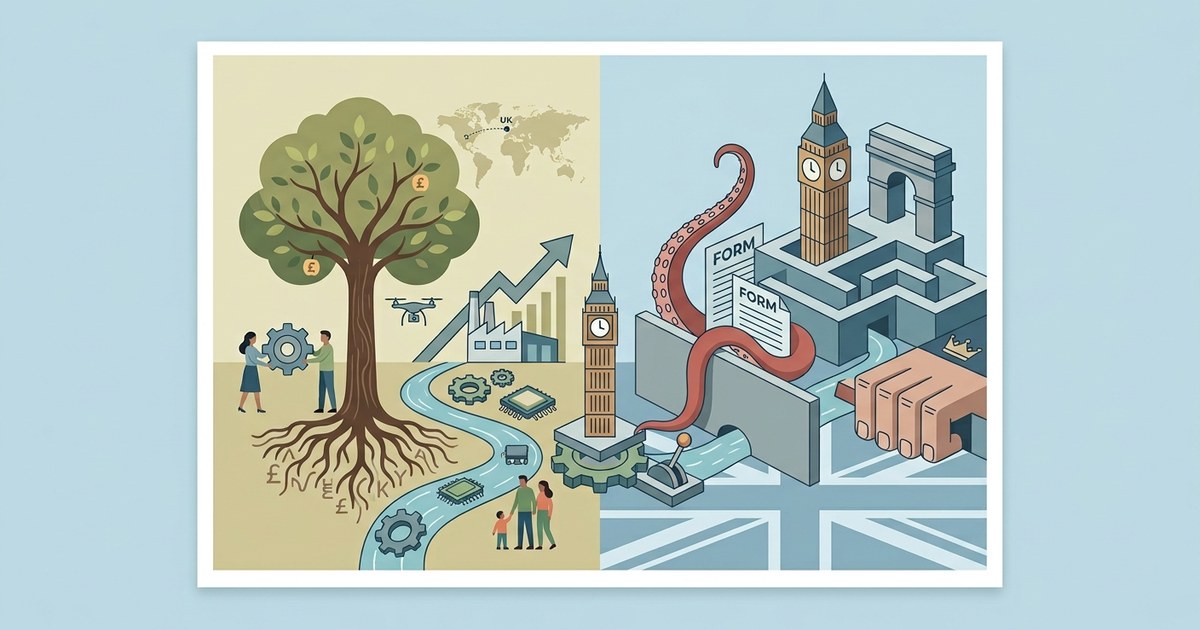
Motion in the British state and growth debate: the British state impedes economic growth
Debated: 15 June 2026, Ye Olde Cock Tavern, Fleet Street
Format: rapid debate, proposer and opposer, floor speeches
The evening’s first motion put the British state and growth in the dock together: the British state impedes economic growth. A show of hands before the speeches gave the proposition 12 votes to 3, with one abstention. The interest was not the result but the range of incompatible reasons found for it.
The proposer on the British state and growth: what the state fails to do
An unusual case from an unusual proposer
The proposer opened by naming the oddity of their own position: a leftist who believes the state should be active in economic development, arguing that this one impedes growth. Then came an offer. If you think taxes are too high, vote for the motion, though Britain’s burden sits below the OECD average. If you think regulation stifles enterprise, vote for the motion, though on the anniversary of Grenfell it is worth saying Britain is among the least regulated countries in several industries.
The British state and growth: housing first
Their own case was about what the state does not do, and housing came first. In the mid-1990s the average London home cost roughly four times the average annual wage. By just after the pandemic that figure had reached nine, and they assumed it is higher now.
Productivity has been flat since the financial crisis, they argued, partly through overdependence on finance and partly through housing. Money paid to a landlord is money not spent elsewhere. Cities generate productivity, and people priced out of them cannot contribute to it.
Ten per cent of new homes
The claim they treated as decisive concerned who buys new housing. Only about 10 per cent of new British homes reach the open market, they said, and in London about 2 per cent. The rest go to institutional investors and overseas buyers. Sales could be restricted to owner-occupiers, and are not.
What Italy does that Britain does not
Infrastructure closed the speech. Rail costs three or four times as much per kilometre here as in Italy, they claimed, and Italy has a national engineering agency that standardises the work whenever a city needs a metro. Britain starts each scheme from nothing and buys in the expertise.
The opposer on the British state and growth: a global system
Everybody has this problem
The opposer’s case was comparative. Every country wants growth and few are getting much: Europe is not growing, the United States less than the headlines suggest, and China is the outlier. On which government was meant, they took both. The Conservative answer was austerity, which cut costs and investment together, and many economists date the weakness to the absence of investment after 2008.
Capital moves and ownership follows
Their central argument was the free movement of capital. It buys the housing stock and it buys the businesses. Numbers of British firms are owned by American private equity, and when a British company approaches viability, global capital arrives and takes it. What results is shareholder capitalism rather than stakeholder capitalism, with the shareholders abroad.
Their remedy looked like the proposer’s: restrictions on who may buy British companies and housing, since the Americans would never let a foreign buyer take a firm they considered a national interest.
The wounds that were self-inflicted
Two concessions closed the speech. Britain has damaged itself, and the 2016 vote to leave the European Union did more of that damage than 2008 did. The country also depends on the United States for energy, defence and finance, so every card transaction runs through an American system. Any government would meet the same constraints.
Voices from the floor on the British state and growth
The entrepreneur’s warning
The first floor speaker had advice for anyone starting a business: do not do it in the formal economy. The state tells you what to pay people and takes a share of it, and small firms can afford neither accountants nor the time to contest a bad assessment. They believe the country is in a depression deeper than that of the 1930s, and that the last one ended in a war they cannot see coming.
The arithmetic of borrowing and net zero
A second speaker read out numbers. Employers’ national insurance and the minimum wage both rose, so hiring costs more and over a million young people are out of work. Borrowing heads towards £3 trillion at 4.7 per cent, the highest rate in the G7, and this year’s interest bill of £111.2 billion is 8.3 per cent of all public spending. Against a welfare bill of £345 billion they set £42 billion of net zero commitments, and called it a failure of priorities.
Whether growth is the point
One speaker questioned the premise. Growth may not be what life is for, and spending on climate now may save money later. A younger generation declining to work until ten at night is choosing a better life rather than failing at the old one. An ageing population presses on the health service, and artificial intelligence is removing the entry-level jobs the young once started in.
Energy, ownership and borders
Another speaker took three positions at once. Britain should use the North Sea, since restricting supply raises the cost of everything that moves. Railways and utilities should return to public ownership, because private priorities are profit rather than service. And open borders are not a left-wing policy: they hold wages down and press on housing.
The net zero exchange
That drew the sharpest exchange of the night. A speaker who works in energy countered that net zero lowers prices, citing hours of free and negative-priced power in Spain and an Italian supplier giving electricity away between noon and four. A speaker working in oil and gas replied that the British version includes an end to North Sea exploration licences, and asked whether that had no effect. The first held their ground: demand does not require those reserves.
The British state and growth: the cost of complying
A further speaker put a figure on regulation from the other side. The state makes decisions and outsources the cost of implementing them. Brexit has probably cost between 2.5 and 4 per cent of GDP, they said, and compliance between 4 and 6 per cent. The tax authority closed its helplines for months, and Britain has the most expensive electricity in the G20, an awkward foundation for an economy said to be saved by artificial intelligence.
A dissent on growth itself
One contributor dismissed the frame. Economics is a work of fiction, they said, and there had been enough hot air in the room to heat several houses. Growth has limits on a planet with finite resources, and the distribution of wealth is a world government question.
They also corrected the unemployment figure. The population aged 16 to 24 is 6.9 million, so a million out of work is a minority, and many of the rest work in charity shops and cafés.
The household and the Ritz
Another speaker reached for the family budget. Essentials first, then whatever is left, and they had never chosen a fortnight at the Ritz because they could not afford it. The country has been doing the equivalent for years, and income tax now covers little more than the welfare bill. Asked to accept that 70 per cent of that bill is pensions, they did, and named the triple lock as part of what everybody will have to pull back on.
The case for doing less
A speaker almost won over by the proposer’s argument that the state should do more said the opposite: it should do far less. Policy here is built on ideology rather than economics, and stamp duty slows movement into housing. Rather than tackle the debt the state will inflate it away, and top marginal rates, council tax and licence fees remove the money that would otherwise reach producers as demand.
Tuvalu and Papua New Guinea
The most direct challenge came late. One speaker took the motion to be about the existence of a state rather than the conduct of this one, and cited the literature holding that institutions drive long-run growth: rule of law, property rights, elections, and a government able to enforce them.
Then they set two Pacific countries against each other. Tuvalu has 10,000 people, a highest point five metres above sea level and no resources. Papua New Guinea has 11 million people, oil, gas, fisheries and vast neighbours. Tuvalu has the higher income per head, and the difference is a credible government.
The state is more than the government
The club’s president took that up. There had been complaint about both recent governments, but the motion says the state, and the courts are the state too. A business dispute here can be settled at law in a semi-reasonable time, which is a condition of doing business at all. They quoted Hobbes on life without government being solitary, poor, nasty, brutish and short, and drew a line at solar generation in a country where it rains while defending wind in Scotland.
The British state and growth: how far should the state reach
The last floor speaker reframed the question as one of degree. South Korea took the other path, betting on a few industries and letting them run, and China is copying it. What results is a handful of families with enough economic weight to hold political sway. At issue is not whether a state should exist but how far into the economy it should reach.
Closing arguments: the opposer on the British state and growth
The opposer replied first and led with comparison. Japan carries debt worth 230 per cent of its output, the United States 120 per cent, and France and Canada more than Britain does. On foreign direct investment, offered as the world’s verdict on an economy, Britain remains a focal point.
History did some work too. British growth was built on empire, on raw materials taken cheaply and goods sold back, and competing fairly is harder. Austerity cut the debt and killed the investment. Our labour market is more flexible than Europe’s, and taxation funds the roads and the legal system without which no business could trade.
Closing arguments: the proposer on the British state and growth
The proposer went straight at the opposition’s central claim. Dependency on global capital is not weather. It is the residue of decisions taken under Thatcher, under Blair and under every government since, to run down industry and build on finance. France, Germany and Sweden made different choices, and Poland is the fastest-growing economy in Europe while being just as integrated.
On the distinction between state and government they conceded the point and turned it: governments make the choices that shape the state, and this one has a large majority and has used it cautiously. Britain has the worst insulated homes in Europe, housing starts have fallen since the pandemic, and management fees can be raised from £2,000 to £6,000 at will. All of it could be legislated against.
Their close was an invitation. Whether you think the state does too much or too little, the motion holds, because the question is not what the state could do but what it has done.
The final vote on the British state and growth
The room voted 13 in favour, 4 against and 2 abstentions, and the motion was carried. Before the speeches the show of hands had been 12, 3 and 1, so every column grew by one and the balance held almost exactly.
The chair noted that the counts did not quite reconcile, most likely because latecomers were present for the second. What the evening produced was not a shift but broad agreement reached from irreconcilable directions.
Why the room linked the British state and growth
The motion was carried 13 to 4, and it was always going to be. Four to one before a word was spoken is not a debate to be won so much as a majority to be kept, and the more useful question is why a room this varied agreed so readily. The answer is that the motion is broad enough to hold two opposite complaints, and the proposer spotted that in his first minute.
The proposition’s case: housing, productivity, procurement
The opening speech did something unusual and effective. It began by handing the audience arguments the speaker did not believe, on tax and on regulation, and inviting them to vote on those instead. That converts every free-market objection in the room into a vote for the motion while conceding nothing.
The case they did make was about omission rather than interference: housing left to institutional buyers, productivity flat since the crisis, infrastructure bought from consultancies rather than built by a standing public capability. Framing the charge as a failure to act made it hard to answer, because the opposition’s best material was all about what the state cannot control.
It was also the only speech of the night that treated the British state and growth as a question of capability rather than of attitude. The Italian engineering agency is a small, concrete example of a thing a state can build and Britain has not, and nobody from the floor engaged with it.
The opposition’s case: capital, dependency, comparison
The opposition’s argument was the more sophisticated of the two and it was structurally doomed. Their claim was that global capital flows explain what looks like British failure, and that any government would meet the same forces.
Two problems followed. Conceding that the remedy is restriction on foreign purchases of housing and firms hands the proposition its case, since a state that could restrict and does not is a state that impedes by omission. And the comparative material, that Japan and France carry more debt and that Britain still attracts investment, argues only that Britain is not unusually bad. The motion never said unusually.
What the opposition needed, and never quite reached, was the claim that the state is not the binding constraint. They gestured at it with the point about global capital, then undercut it by naming Brexit, which is a decision of the British state, as the deeper wound.
The ebb and flow of the floor debate
Twelve floor speakers followed, and they agreed on the verdict while disagreeing about almost everything else. Three battlegrounds opened, and none of them was about the motion. Housing surfaced in five separate contributions, which is a continuation of the evening the club spent on whether an obsession with home ownership leads to poor decisions, and the party-political material picked up where the Greens and Reform debate left off.
First battleground: energy and the price of net zero
The one genuine exchange of the evening was about energy. Two speakers argued that net zero raises costs and that the end of North Sea exploration is an economic decision dressed as an environmental one. Two others, both of whom work in the sector, argued the opposite from operating experience, citing negative wholesale prices in Spain and suppliers giving power away in the middle of the day.
That is the argument this room does well: specific, drawn from work rather than from newspapers, and conducted between people who disagreed without either retreating. It changed no votes, because both sides of it were compatible with the motion. A state that spends £42 billion on the wrong things impedes growth, and so does a state that ends exploration licences without replacing the supply, and so does a state that fails to build the cheap generation its neighbours have. Every version of the energy argument was a version of the motion.
Second battleground: what the state costs to comply with
The most original contribution of the night put a figure on something usually left vague. Compliance may cost British businesses more than leaving the European Union did, on the argument that the state sets rules and outsources the cost of obeying them, and that the growth in employment is in the departments that do the obeying.
It is a contested figure and it went unchallenged, which is worth recording. It also cut across the proposition’s own case, since that speaker wanted less state where the proposer wanted more, and both were voting the same way.
Third battleground: problem or precondition
The only line of attack that could have moved the vote arrived from the floor, late, and from an unexpected direction: that the question is whether a state helps or hinders in general, answered by the institutions literature and by two Pacific countries with opposite endowments and opposite results.
The president reinforced it from the other side, pointing out that the courts, the rule of law and the roads are the state, and that Britain without them would have no economy to slow down. Both speeches were well received and neither dented the result, for a simple reason. The motion does not say the British state prevents growth. It says it impedes growth, and a state can be necessary and obstructive at once.
The argument nobody made
Worth recording is what went missing. Nobody defended the state’s record on its own terms, and nobody argued that current policy is working. Even the opposition’s case was that the failure is not Britain’s fault rather than that there is no failure.
Nor did anyone test the proposer’s central statistic, that only a tenth of new British homes reach the open market. It is a striking figure, it did most of the work in the opening speech, and it passed without a question in a room containing an accountant, two energy professionals and an economist. A motion phrased as blame carries a room that agrees about the diagnosis, and agreement of that kind discourages the checking that a contested claim would attract.
What drove the result in the British state and growth debate
The pre-vote did most of the work, and honesty requires saying so. A room that starts 12 to 3 has decided, and the speeches were arguing about reasons rather than about the verdict. Only one column moved by more than a single vote, and the room was larger at the close than at the opening, so even that movement is more plausibly a matter of arrivals than of persuasion.
What the evening added was range. A self-described leftist proposing, a speaker who wants the railways nationalised, a speaker who wants austerity deepened, a speaker who doubts growth is worth pursuing, and a speaker who thinks the state is the reason there is anything to measure: all but the last voted the same way. The motion is broad enough that doing too much and doing too little both count as agreement, and the proposer’s closing said so out loud rather than hiding it.
Conclusion
The most striking thing about the evening was not the margin. It was the president’s observation that a motion about the economy would not have reached a Sylvans agenda a few years ago, which says more about the mood of the room than the vote does. A club that cannot agree on what the state should be doing can still agree, and did, that it is not doing it.
Full transcript of the British state and growth debate
Read the full transcript
The motion and the opening show of hands
The chair read the motion: the British state impedes economic growth. Plenty to say here, for and against. Could it be the current government? Could it be elements of the British state, the deep state, as they say on X? Is it even the responsibility of the state to engender economic growth, if it is not impeding it? But it is not my opinion and pontifications that count.
The chair then asked the room for an opening position. Twelve declared for the motion, three against, and one abstained.
The opening speech: the British state and growth
My fellow Sylvans, those of you who know me might be shocked that I am arguing for a proposal against the British state, or any state in general. After all, I am a dirty leftist. I should be in favour of the state being active in economic development, and the truth is, I am.
I am not here to convince the people who might argue, and I am sure we will hear this from the floor speakers, that for example taxes are too high, even though actually Britain has a slightly lower tax burden than the average OECD country. But it is fine with me if you believe that, as long as you vote for the motion.
You might also think Britain has too many regulations that stifle business and stifle the market. Well, now that we are on the anniversary of Grenfell, that probably would not have happened in most European countries, because they have better regulation on certain things, and in fact, in many industries, Britain is well known for being one of the least regulated countries. But it is fine with me if you believe that regulation is too stifling for private enterprise. Vote for the motion.
I am going to tell you what the British state also does to stifle growth, or rather what it does not do that stifles growth, and you would be shocked. The first thing, the main thing, actually, is housing. Britain has a housing problem, we all know that. It has been going on since the late 1990s.
I forget exactly what the number is, but around the mid 1990s the average home in London was about four times the average annual wage, and in the country as a whole it was like three. The last time I checked that figure, which must have been just after the pandemic, the number had skyrocketed to like nine in London, so it doubled relative to average income, and it is probably higher now. It is probably 10 or 11, I do not know.
Funnily enough, in our previous Sylvans debate there were some people talking about productivity and why Britain has such low productivity. Really, to understand why Britain is not growing as fast as it could, the answer is that Britain’s productivity has basically stalled since the global financial crisis, for various reasons. One is the overdependence on the finance sector, but another big thing is housing. Housing is one of the major contributors to low productivity.
Why is this? Well, the more housing takes out of your monthly budget, the less you will buy of everything else, so there is less consumption that could be used to stimulate the growth of British businesses, especially small businesses. If half of it goes to a landlord or half of it goes to your mortgage, there is also the issue of cities, because cities like London are super expensive. People are unable to move to these cities, or if they live in one, they live in a situation where they cannot spend. Cities, as we know, are the heart of the productivity of any country on earth.
So why does the government not do anything about the housing crisis? That is the truth. They have not done anything. They allow houses to be sold to Malaysians and Chinese, not Malaysians or Chinese here, Malaysians and Chinese in China and Malaysia. They sell to institutional investors.
There is a recent study that is absolutely mind blowing. Only 10 per cent of all new houses in Britain are sold on the open market. So what you see in Zoopla and all these, that is only 10 per cent, and in London it is just 2 per cent. The government could do something about this. They could prohibit selling these houses to anyone other than an owner occupier, for example, and we would have a functioning housing market. If we had a functioning housing market, people would be able to spend more, there would be more productivity. But the government does not do this.
There is also the issue that sometimes the government just does not do what other countries do very well, and there are a few things that governments can do very well. Everyone complains here that Britain does not build anything. HS2 is a complete disaster, infrastructure is a complete disaster.
We look at the cost per mile or kilometre of rail in this country, and it is like three or four times higher than Italy. Italy is hardly an example of hyper productivity, but what does Italy do? Italy has a national public engineering agency. Any city in Italy that needs a new metro goes to this agency, which does the work, and everything is done in a standardised way, whereas in Britain every new infrastructure programme is going to be done pretty much out of pocket, spending a ton of money on private consultancies and whatever, and so costs skyrocket. So the British state is responsible for Britain’s meagre growth, not just for what it does do, but for what it does not do. I urge you all to vote in favour of the proposal. Thank you.
The opposition on the British state and growth
Good evening, everyone. The opposition’s position is that it is not the British state’s fault. First of all, every country wants economic growth, and we are not in a unique position. It is not as if the rest of Europe, or even the US, is growing. You may think the US is growing faster than us, but if you run some numbers, actually not really. China is the country that is growing the most. So we are all in the same boat. It is not necessarily just the British government.
Then you could ask, the motion says state, but if we bring governments into it, are we saying this government or the last one? The Conservative government had no answer. Their answer was austerity, which basically was cut costs. A lot of economists, and you know the joke, get two economists together and you have three arguments, but a lot of economists say that the lack of investment over the last couple of decades, since 2008, is the reason why our economy is not doing as well as it could. But equally, that applies to other countries. Germany is having a huge problem right now with its car industry, because China has taken over, and it has not invested in its own long term economy. And then the Labour government is trying to invest.
Now let me get to the point I am trying to make. It is not so much the government or the state, it is that we are part of a global community. What we have as part of a global community is the global movement of capital, for example, and that is buying up our housing stock, as the proposition said. That is buying up our businesses. The data says that a vast number of our businesses are owned by US private equity and US corporations, and when we invest in innovation, once our companies become viable or approach viability, then global capital comes in and buys them up. So there is no stakeholder capitalism. It is always shareholder capitalism, and those shareholders are abroad. So it is not the state’s fault. Global capital is free to move.
What do we do about that? Now I am going to start agreeing with the proposition, in a sense: implement regulations. For example, if we wanted to buy Google, the Americans would say no, Google is a US national interest. If we wanted to buy Microsoft, no. So in the same sense, perhaps we should implement some sort of restrictions, not capital controls, but restrictions on the purchase of our companies and of our housing stock. Housing should not be an asset class.
Again, what I am trying to stress is that it is not the state’s fault, that it is part of this system of global capital movement. Of course, we have also shot ourselves in the foot. The proposition says that our decline started in 2008. Another argument is that it really declined in 2016, when we voted for Brexit. We have not really done ourselves any favours. So it is not the state’s fault. It is our own fault. It is the media’s fault, for buying into some of that narrative.
And of course, if we look at our dependence, we have outsourced everything. We are dependent on the US for energy. We are dependent on the US for our defence, and we are trying to pivot towards Europe. We are dependent on the US for finance. Every time you swipe your Visa card or your Mastercard, that transaction goes to the US financial system. So the point is, it is not the British state that is at fault. Whichever government came in, they would be facing these problems. We do not live in 1870, where we were a nation state. We are a country that is part of a global community, with capital flows and labour flows. So it is not the state’s fault. It is being part of a global system.
From the floor: stay out of the formal economy
Mr Chairman, ladies and gentlemen, I agree with most of what has been said today on this topic, and it is pretty damning, isn’t it? I will add some more damning to it. I have experience of trying to be an entrepreneur, and anyone who wants my advice, I would say stop, and do not try and do it in the formal economy. Do it in the underground economy.
If you do it in the formal economy, the government wants to tell you how to do each item, what to pay your people. You cannot pay them what you want to, or employ them how you want to. The cost may make you deduct from the wages you want to pay your people and pay it to the government, and that is a huge amount of money if you actually work it out and you are trying to start a business.
In my experience, the authorities will take advantage of you and try and load you with taxation that is completely illegal. They know you cannot afford accountants, and you have not got the time to wrestle, to go to this hearing and that hearing. Do not do it in the formal economy. Of course, you then run the risk that the authorities will find out what you are doing, and you will probably not know the ropes and how to do it that way, in which case you are running a risk.
I think these are symptoms that can explain, as I have said in these rooms, that we are in a depression at the moment, worse than the 1930s. The researchers are still doing work on the 1930s depression, surprisingly, and the conclusion is that once you get into one, you cannot get out of it again. I have said how that works in previous meetings, so I will not go over it again.
There has been hardly any growth in the British economy since 2006. You get no booms, and without the booms you do not get businesses putting investment back in to expand. We are stuck. The 1930s depression is thought to have been ended by the Second World War. I do not see a decent war on the horizon. I think we are stuck where we are, and I have no way of suggesting how we get out of it, so I will support the motion.
The British state and growth: borrowing, welfare and net zero
Mr Chairman, the state has presided over a huge surge in unemployment, the collapse in business confidence, and the jump in the amount that the government has to pay to borrow money. When this government came in, they increased the taxes on businesses, putting up employers’ national insurance contributions, and they also put up the minimum wage, so it costs more to hire somebody to do a job. We have over a million young people unemployed, because it is too costly to hire them when you do not know whether they can do the job, or even if they will turn up on time. So unemployment is rising, business confidence is at rock bottom, and investment is falling.
Then you have borrowing. Borrowing is going upwards towards 3 trillion pounds. That is a three with 12 zeros after it, and we are paying the highest percentage in the G7, that is 4.7 per cent. That borrowing this year will come to 111.2 billion pounds. That is what we are paying in interest only. That is 8.3 per cent of total public expenditure in interest only, which is ridiculous. In fact, one could say that the Chancellor is as friendly to business as Brutus was to Julius Caesar. You all know what happened there.
There is a feeling about defence. We had the Defence Secretary resign, we had the Minister for the Armed Forces resign, and two others all resigned, because they asked for 17 billion for defence and were only offered 13 and a half. Well, consider the welfare bill: 345 billion pounds a year, 345 billion for welfare alone. It is very difficult to cut the welfare bill. But what about net zero?
Of course, we will have howls of protest from the climate emergency people, but if you consider that defence needs 17 billion, we have earmarked 13.2 billion for heat pumps, that is the government bribing you to put in heat pumps. Carbon capture, which has never worked, storing carbon under the North Sea, 9.4 billion. That has never worked and probably never will, and what is more, it will simply make energy generation less efficient and therefore more expensive.
Overseas climate help, 11.6 billion. God knows what that is, but it is 11.6 billion. And Great British Energy, which does not produce any energy, 8.3 billion. Now I ask you, that is 42 billion earmarked for net zero projects which will not do anything for the climate. So that is the state for you. It is a question of choices and priorities, and our state has got its choices and its priorities wrong.
From the floor: is economic growth what life is about
I do not always actually believe what I argue, but I wanted to argue a different point of view and perspective. What I wanted to say is: is economic growth what life is all about? It might not be net zero. The fact that this gentleman is arguing about it, we might not even have a life if we do not invest now, and it might actually save a lot of money in the long term. The investments we make now might keep this planet, keep us alive afterwards.
Also, the new generation now, they do not just want to stay at work till nine o’clock and have children that they give birth to and parent but are not actually there for. Now they can focus on more than working till 10 o’clock so that people like Elon Musk can get all the money for themselves. They are actually thinking about themselves and their lives, and there are millions more of them who are having a much better quality of life now.
There is also an ageing population, which I am sure you will understand. There is so much demand now on the resources required by the NHS, and I think that is better use for those resources than just a few chief executives getting richer. And with AI, the entry level jobs for the younger generation are disappearing, and this is real. If it is a matter of priorities, this is our future. We should perhaps be using this money to support that youth and that generation.
I do think that perhaps we do need to look at technology in the future. If anywhere, we do need economic growth. Maybe if we had done projects over the years and they were not the most efficient, we now have an opportunity to look at the most efficient ways of spending our resources. And the final thing I want to make is, maybe if we cannot grow, we need to be looking at allies and other countries that are growing, and it might help us unite with the rest of the world.
From the floor: energy, ownership and borders
I am going to use the state and the government interchangeably here. There are certain things that can be done to improve the economy. It is quite a broad topic, but I have narrowed it down to three components.
Number one, with regard to energy, I think we need to be more self sufficient in terms of producing our own energy, and less dependent on other countries. I think particularly we should make more use of the North Sea oil reserves in order to fuel more economic growth. You cannot ban fossil fuels, and I think you need to get rid of this net zero, because it is actually affecting the economy negatively. If you have less supply of oil and gas and electricity, you are going to increase the cost, not just of the energy bills, but of general living as well, because you need fuel to run factories and to send food to the supermarkets. Some of the net zero policies are quite extreme. I think a minister said he wants to ban things like underfloor heating and towel rails, which I think is quite fanatical.
The second thing is that the railways and the utilities should come back into public ownership, because if they are actually in private hands, the priority is profit. You can increase the fares of the railways, but the service can decline, because the problem is with the profits. If you renationalise the railways and the utilities, the surplus will go to other services that are also nationalised and in state control, so you do not actually have to increase the taxes in order to renationalise. I do not think we need to spend more money on defence, but I do not think we should be spending more money on welfare either.
The other thing that is quite important is immigration. I think immigration is a good thing, but we need to take care of the open border immigration. Open borders is not a left wing policy.
If you look at what Bernie Sanders said in 2015, he said it is a right wing policy. Open border immigration drives down wages and increases profits for big corporations, but because you are reducing the wages, it increases unemployment, so people are less likely to do menial jobs. That means you have to have more tax money going towards welfare, which means less tax money going towards health and school and education and infrastructure and crime and all the other stuff that we need. It puts more strain on public services, which increases privatisation, and it puts more strain on housing, so it increases house prices. So I think that is something else that really needs to be taken into consideration.
From the floor: net zero and the price of energy
I have not changed my mind yet. Maybe I do not have the experience of the British state deeply enough that I can come up with an idea, but the main reason I want to intervene is because a couple of people raised the topic of net zero and sustainability. I just want to earmark something. Net zero does not bring a higher cost of energy. It actually should put it down. I work on this on a daily basis.
When you look at energy prices in Spain or in Europe, in countries where the energy demand is very much met with renewable energy, there are periods during the day where energy is free. In some cases in Spain, some of the promoters are finding that during peak days energy has a negative cost. This means the energy providers are paying the consumer to use energy. My parents back home in Italy get an email saying that if you use the energy between 12pm and 4pm, the energy we give you is free. So net zero is not the issue. It is not what impedes the growth of the United Kingdom. I do not know what is impeding growth in the British state. I just wanted to make this point. I do not believe that is the driver.
A question from the floor: net zero in the UK sense does not just talk about the net zero initiatives, it is also things like the banning of licences in the North Sea. I work in oil and gas, which is why I know it. Do you think that impact is minimal on the economy? There are to be no exploration licences in the North Sea from the UK side, and the overarching process is that there will be no more UK side exploration.
The reply: what I think is, when I look at Hormuz being completely shut down, prices barely touched 100 dollars in the worst of the crisis. So what I think is that our economy is already extremely efficient. I would assume the British economy is pretty efficient anyway. We do not simply need that much. I do not see that demand for oil and gas being so high that you need that much reserve. That was my point. I do not want to leverage it towards ESG and net zero, but that was my point.
The British state and growth: the cost of complying
The British state has for a long time hindered growth in this country by imposing costs on every one of us and every business consistently. They have outsourced compliance with all sorts of rules as a cost onto businesses, so businesses in this country spend an enormous amount on that.
I think many people in this room think that Brexit was not a great success. It is fair to say economists have three opinions, as ever, but the chair will say it has probably cost us 2.5 to 4 per cent of GDP. Compliance has cost us, some economists’ opinions, four to six per cent, so potentially twice as much as Brexit, which everyone regards as a disaster, and that is a growing cost. We have talked about employment. Guess where there is actually greater employment: HR and compliance.
What the British state has done is make decisions and expect someone else to pay for them. So when we talk about taxation, let us include the six per cent for complying with these rules. Net zero also has compliance costs, and that continual outsourcing of implementation, top down. We were talking earlier about societal change. Well, that is what they are doing, putting in the rules: here are the rules, you have got to do it this way, and you have got to report on it. So companies have these crazy policies where you can only employ certain people to keep the balance right. Corporations are sinking huge amounts of their turnover into that, and that is one reason why people are not investing here now, because there is that hidden cost.
The point of the state outsourcing and imposing costs on everyone else is not just about businesses and corporations. Every one of you has been subject to this. The bonus of efficiency from digital technology has actually been used to impose the onus on you to comply with them. HMRC even shut down their helplines last year, for I think eight months, saying you do it, you do the work for us. That is a cost on all of us, on our time. And finally, I will say that we also have the most expensive electricity in the G20. The Chancellor, being the economics guru, has told us that AI will be the saviour of our economy, but it is powered by electricity, so I am not sure that is going to work.
From the floor: economics as a work of fiction
Chair, Sylvans, I am noted for my profound knowledge of economics, but when I was listening to some of the commentators, I thought we were having a line from the BBC. There used to be a programme called Listen with Mother. Or if you are not into the BBC, you could look at the Brothers Grimm, or even the Mad Hatter’s Tea Party, because these are works of fiction, and by and large, so is economics. As regards energy, I have heard enough hot air tonight to probably generate many houses, and there is a lot of hot air in the Houses of Parliament as well.
But what values have we got? It is not about the growth. I really do think it is about time that was put to bed. Growth has got its limitations because of the finite resources of the earth, and it is one planet. A lot of these issues are world government issues: migration, immigration, fair distribution of wealth, and all this sort of stuff. Until we move to a world that understands that, these sort of little England type things, the British establishment, of course they are all right on their own patch. They own a large percentage of the land.
I wanted to correct one or two things. I took the trouble to find out what the population of 16 to 24 year olds was, and the population is 6.9 million. There is only a million in need, so the majority of young people between 16 and 24 are doing something. You need to look into the individual circumstances of those million people, and how they find out those statistics. I know quite a few 16 to 24 year olds who work in charity shops or work in a cafe.
Now I do not know whether they come into the statistics, so you can tell around the statistics all you like, but it comes back to what kind of society do we want. Do we want a more equitable society? A large percentage of the land is controlled by five per cent of the population. We know who most of them are, and they would not give you the time of day half the time, but they give their friends free accommodation, of course.
From the floor: the household and the Ritz
Well, I am with the proposition, because I think we are very close to being completely buggered, as they say. We are in such a mess. And why are we in a mess? I think about my own household and think about money coming in, and I think, what am I going to spend this money on? I have got to spend a certain amount of it on essentials. I do not have a mortgage any more, but once upon a time I used to have a mortgage, so I had to pay that. And I have got to feed the kids. So there is some essential expenditure that I have to deal with, and then there is whatever is left over. I have this discretionary amount, and I can think, hey, I will go on holiday.
But I decided, when I was managing my household, that I was not going to go and stay at the Ritz for a couple of weeks every year, because I cannot afford it. Over the years this country has metaphorically been staying at the Ritz. We have been spending a load of money, like 3 trillion pounds, and it is going up and up and up, and we are in a situation now where income tax is just purely paying for the welfare state. How the hell have we ended up in this situation?
I think the problem is that we have very poor politicians. I know some people will not like this, but I have always said that I would try and make politics far more attractive to more capable individuals, because the UK is technically a company, and we need the best people managing that company. The opposer mentioned capital, and capital will go where it gets the best return, and we have not created the environment to attract that capital. Over many years, particularly probably in the last 20 or 25 years, we have created a situation where it is more attractive for some people not to work. It is not those people’s fault, by the way. It is because of the way that it has been set up.
A question from the floor: will you accept that 70 per cent of the welfare bill is pensions? Yes, I will accept that. And there is another thing. For the first time in a long time we have a Labour government in power, and their principles say look after those who are less capable of looking after themselves than others, which I agree with. But it is foolish to think that we can pay for everything blindly, like the triple lock. Everybody has got to pull back. Everybody has got to pull back. We are screwed anyway.
The British state and growth: the case for doing far less
What an interesting debate. The proposer almost had me flummoxed by taking the position that the government should be doing more, when in fact they should be doing far less. I think that on the whole, the state is impeding growth in this country. I think they have got a far ranging suite of policies that are based on ideologies and not necessarily on economics. If they were economics, we already know that there would be so many arguments that we would not be able to do anything.
I think there is one tax that everybody, including all economists, agree on, and that is stamp duty. You want to buy a house, you have got to give a stake to the government. Why should they take tax off you buying a house? Why should they slow down people’s access to housing? We have already heard that housing is one of the biggest costs that limits our ability to enjoy our consumption. The state is enjoying our consumption by funding what it desires to fund. It is buying votes, it pushes into a welfare state.
There should be more austerity, because the only way you are going to get out of this right now is to actually tackle that debt bill. But wait, the state has a solution, and it is not the solution that is going to work for all of us. They are going to inflate it away. They are going to print more money, and guess what, there goes your real growth. That is what we should be thinking about: real growth. I have heard all about growth, but our nominal growth probably does not look so bad, because the government is the keeper of the inflation statistic. So should you believe it? Is the basket truly reflective of your living cost? Can you feel your purchasing power increasing right now, or is it decreasing?
It is the state’s prerogative to direct what they want from tax revenues. They believe that they should collect money from you as an individual, and that their allocation and their budgeting priority is your budgeting priority, because you, the individual living here as a citizen, are not smart enough to manage your own finances, so government should do it on your behalf. That is why they take most of your money in taxes. The marginal tax rate at the top brackets is insane. You add council tax on to that, you add all the friction licences on to that. They are taking all of your money. You could be spending that on consumption, which would be fuelling economic growth. Producers would see a bigger market.
A question from the floor: it is consumption, but who owns the land in this country? That is why the housing is in crisis, because the Qataris and the feudal system own the majority of the land. The reply: but do not worry, the state will take it back when you die.
From the floor: Tuvalu and Papua New Guinea
Hello, everyone. Over the last couple of decades a body of evidence has emerged. I interpreted this motion less as being about the current state and more just about whether the existence of the state impedes, or in my view does not impede, economic growth.
Over the last couple of decades a body of evidence has emerged that the biggest driver of long term sustainable economic growth is institutions, so things like rule of law, property rights, free and fair elections, and a strong and stable government or state that can enforce these things.
An example of how this works in practice is in the South Pacific, which is where I am from. We have got two countries, Tuvalu and Papua New Guinea. Tuvalu is a tiny country, about 10,000 people. The highest mountain in the country is five metres above sea level, and it is slowly decreasing. You have seen the picture of the guy with the water up to his waist. Nothing grows. They have got coconuts and breadfruit, which is a tasteless, starchy thing that you do not want to eat. No natural resources or anything. They just eat mutton flaps and corned beef from Australia.
Papua New Guinea is a country of 11 million people. It is huge. It borders some of the biggest economies in the world, Indonesia, Singapore, all of those. It is abundant in natural resources: oil and gas, agriculture, fisheries, all that stuff. And yet, which one do you think has the highest GDP per capita? It is not Papua New Guinea, it is Tuvalu. And what is the reason behind that? Papua New Guinea lacks a strong and credible government. So in this situation, which country would you rather be in? Would you rather be in the one that has the state, or the one that essentially lacks a state?
From the floor: the courts are the state too
Thank you, Mr Chairman, and thank you to the previous speaker as well, because that is exactly one of the points that I was going to make. We have had a lot of whingeing tonight about the current government. We have also had whingeing about the previous Conservative government. The motion is the state. The government of the day is part of the state. Previous governments are part of the state as well. There are many different features of that.
The previous speaker mentioned the rule of law. The courts and the judicial system are part of the state. The fact that we have the rule of law, that if you have a business dispute you can have it settled within a semi reasonable period of time in the courts of law in the UK, is part of the state setup that we have here.
By the way, the fact that motions about the economy are getting voted in at Sylvans is to me a significant indication that we have got a big problem, because no one in Sylvans a few years ago cared about the economy whatsoever. This would never have been voted in. We are talking about it tonight. It is very important.
There was an economist called Thomas Hobbes, very famous, and I am slightly paraphrasing. He said man in a state of nature, life would be solitary, poor, nasty, brutish and short. What he is saying, his insight at that time was, without a government you will have anarchy, and everyone will be poor. If you do not have an organised state. Tuvalu has a more organised state than Papua New Guinea. I think there are more complex factors, probably, that led to that, many different factors that led to that outcome. Having an organised state is critical.
Thomas Hobbes was looking at the tragedy of the commons. You had a little village, and there was a village green that was a common, and people would graze sheep on it, but they rotated them. If you did not rotate them and take them off at different times, the land would be completely useless, and everyone would be hungry. So having an organised government is critically important. Infrastructure, the trains would not run, roads would devolve very quickly. We would not have roads. So it is not just an island state in the South Pacific.
We have to look at the British situation itself. Could the government be doing much better? Absolutely. Could the last government have done much better? Absolutely. But we have to look at this in the round as well, and that is what the motion says: the state. I do want to pick up on a couple of the proposer’s points, and I wish I had been debating him, because it is always fun, and he is brilliant. Some of the productivity drains that he mentioned are very true, but the lack of investment is one of the biggest ones. We do not invest enough in this country, and sometimes the investments we make are bad.
A lot of the net zero stuff is good for the environment. It is not good for the economy. I disagree with one previous speaker on one priority, though. Investing in wind power, I think, is a smart investment for the UK to make. Another speaker was talking about solar power in southern Europe. It is a great investment for southern Europe. They have cheaper energy, and they will have cheaper energy as a result. We have great wind. Investing in solar in the UK is madness, because it rains, but investing in wind in Scotland is very valuable. So we have to make smart investments, and the governments have not been doing that perfectly. Take away the government, though, and it is chaos.
The British state and growth: how far should the state reach
Thank you, Chairman. Just to touch on the last point that was made on governance and government. I would probably say that the British government is fairly involved in how it makes its policies. It makes policies on virtually everything. But I am sure everyone here knows the South Korean example, the chaebol houses. South Korea in about 50 years went from a very impoverished nation to not, and it did that in a way that in some ways China is trying to replicate, by basically betting on a few key industries and kind of letting them run amok, which is why now some people joke that a single company is the de facto South Korean government.
So the point I am trying to make here is that in some ways I am not necessarily questioning the concept of a state, but questioning the concept of the involvement of the state. If you compare a British state, which is really involved with the economy, to one that decided not to do that, take the South Korean example, you may now be in a situation where a few individuals are incredibly wealthy and very powerful, and the families have a lot of sway politically in the country because they are so economically important.
That is not something you probably have on the same scale in the UK. So based on that, I would probably say that maybe the British state could be better. I am not quite sure which side of the fence I would have fallen on, but that is just one of the points I wanted to make.
The chair draws the threads together
Some really interesting speeches, and many angles taken up here. Is the government over regulating? Is the government investing in the wrong areas? Is it the government versus the state? Are they the same thing? Is it our own expectations and values that are at fault here? I would add: is the state and the government actually the proxy of the British people’s wishes, levels of information, education, bravery and preferences, and what role does the media have in that?
I would remind everyone that the motion is that the British state impedes economic growth. There may be other factors impeding economic growth more, yes, that is true, but the British state can also impede economic growth even if other people and other factors are in play as well.
Closing for the opposition on the British state and growth
Thank you, everybody. Great speeches. The opposition’s position is that it is not the fault of the British economy, it is that we are part of a globalised system. Debt has been mentioned, and the narrative has been that we are doing so much worse than all the other countries. Actually we are doing quite well relative to the other developed countries. Japan has a 230 per cent debt to GDP ratio. Italy, we will not talk about them. The United States has a 120 per cent debt to GDP ratio. France has more debt than we do, Canada does. We have only got 100 per cent debt. We are doing pretty well, really.
Also, when we look at foreign direct investment, this is the globe’s confidence in our economy. Traditionally we have been one of the biggest beneficiaries of foreign direct investment, and that continues to be the case. There is some data that questions that, and that is to do with capital owned by foreign corporations and foreign entities being pulled out, but overall, globally, we still are a focal point for investment.
History has something to do with this. We have grown historically as part of being the British Empire. We are used to high levels of growth, but as we now are part of a global economy, we have to manufacture goods and sell them, and we have to do it on an even keel, on a fair basis, not like the beginning of the early industrial revolutions, where we nicked everybody’s resources and used those as raw materials and then sold goods. That was an unfair advantage. When we have to do it fairly, we have to compete with other countries, and we are not doing that badly. Everybody has the same problem. Everybody is thinking, what can we sell China? Even the Germans are thinking that.
The points that have been made are okay. Should the government do this? Should the government do that? Is the government making the right or wrong decisions? All governments are trying their best to grow. The Conservative government chose austerity, because we wanted to cut down on debt, but the disbenefit is that there is no investment, and so we need investment, which is going to lead to more growth, which is what the Labour government is trying to do.
The deregulation aspect of it the opposition disagrees with. Labour, it is actually quite flexible. It is really easy to start a business, and they have now moved into a contracting model, where previously you had to employ someone full time and now you can employ people on short term contracts, so it is actually quite a flexible labour market, certainly compared to the Europeans.
There have been complaints about taxation, but taxation is needed to fund investment, and the point has been made that good governance leads to growth, and you need taxation to be able to fund good governance. The only reason a business can start up and sell goods is because there are roads that exist that allow goods to be transported all across the country, a legal system, and so on. All of this governance allows it to happen. Everybody is dealing with all of this. It is not just us. It is not the British government.
Whichever government you have in place, and I am using whichever government as a synonym for state, it is being part of a global system. I personally think, the opposition thinks, that global capital flows have positives, but they also have negatives, in that they buy up our housing stock and buy up our businesses. So it is not the British state. All states are having this problem, especially Western states, which have traditionally benefited from colonialism. The US is an exception, because it is a hegemon at the moment, and it is predicted that as its hegemonic position declines, so too will its economic development. So it is not the state. All states are trying to grow. All states are having these problems. It is being part of a global system. That is the opposition’s case. Thank you.
Closing for the proposition on the British state and growth
Let us start by challenging some of the points that my opponent made. I think the state is responsible for Britain’s dependency on outsourcing, on global capital and on the US. These things do not happen naturally. I do not think capitalism is a natural economic system, or especially that free market capitalism is an organic system that just comes out of nowhere. These are all policy choices that governments took to create a state that suffers from these dependencies.
These were deliberate policy choices taken under Thatcher, taken under Blair, taken under every other government since, and they have affected the way that the British state is shaped today. They chose to destroy industry and focus on finance. That made us much more dependent on global capital than if that decision had not been taken. So this is a specific weakness, I would say, of the British state. It is not every country that has gone through the same process that Britain has. France and Germany and Sweden did not make all those same choices. Poland is the fastest growing economy in Europe, and they are integrated into the global system just as much as Britain is. So I do not think that is an excuse.
On the issue of differentiating the state and government, I agree that there is a difference, but governments make the policy choices that craft the state. So you can say that the state exists because governments made those choices, and Labour has had the chance. In two years it is impossible to fully transform the state, but they have had the power to do so. They have an overwhelming majority.
Why is Labour so unambitious relative to what Thatcher did when she came to power? She came to power with an intention of changing the British state from its roots, and you do not see any of this under the current Prime Minister at all. He has had his huge majority, and he has Brexit to benefit from, because now there are not all these rules and regulations from Brussels, if that is what you think was the problem beforehand. So it really does not matter if you are a Labour or a Tory supporter. They have all let you down.
Some other issues that people mentioned. Climate. I agree, net zero is not the issue. If you want to feel that it is, vote for the proposition. I am okay with that. But the government also has not done enough on climate. They seem terrified of appearing like tree hugging climate hippies. Insulation, for example, is a huge issue. Britain has the worst insulated homes in Europe. Partly that is because it also has the oldest homes in Europe, but where are the investments to help people insulate their homes? More heating costs equal less money to spend on other things.
As with everything with houses, the money that your home sucks out of you is lost productivity, and that is less growth. Housing again: new housing starts in the UK have fallen since Covid. There is no chance whatsoever, on the current trend, that they are going to hit the 1.5 million new houses promised in five years. There is Britain’s medieval land ownership, where leaseholders can get fleeced because the landowner can raise the rent of the land, or where a property manager could raise your annual property management fee from 2,000 quid to 6,000 quid for no reason whatsoever, and all of this can be legislated against. All of this is money that you are losing because the government does not intervene.
So again, if you think the government is doing too much, or if it is doing too little, it does not matter. The proposition is a valid point. As you can tell, I am clearly arguing something that might not be natural to me, because I am a left winger, and I probably agree with my opponent on almost everything else. I saw one speaker being shocked that I volunteered to argue for this position, but remember, this is not mutually exclusive to believing that the state can do more. If the state can do more, I agree with it. The state can drive economic growth, but it has not. The fact that it has not does not mean that the proposition is invalid.
The question that we are debating is very clear. It is about whether it has driven growth, not whether it can. That is a whole different debate, and again, it is not exclusive to whether you think the government should be doing less, or if you think it should be doing more. The most successful economies on this planet are the ones that get this mix right, the correct mix of where the government intervenes, where it invests, and where it does not, where it leaves it to the market, where it leaves it to other forces. I simply do not think that Britain has the right mix, and because I think that, I think you should vote for the proposition.
The vote
The chair put the motion again: the British state impedes economic growth. Hands up if for. Thirteen. Against, please. Four. And abstainers. Two. So the motion carries: 13 for, four against, two abstentions.
Further reading
Download this debate as a PDF: Sylvan detailed summary, British state and growth, June 2026.
Browse past Sylvan debates, or read how Sylvan debates work.