
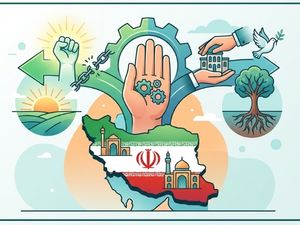
On 16 March 2026, the Sylvans gathered to tackle a highly contentious geopolitical issue: Iran regime change. The room buzzed with anticipation as the speakers prepared to debate a provocative motion, which read: ‘This house welcomes attempts for regime change in Iran.’ What followed was a passionate clash of morals, history and international strategy.
The proposer: a geopolitical necessity for Iran regime change
The proposer opened the debate with a starkly pragmatic argument. They bypassed moral idealism and focused entirely on power politics. They argued that the United States acts as a growing empire and must defend its interests. Furthermore, they highlighted Iran’s stubborn resistance to American hegemony. The proposer pointed out that Iran actively pursues a nuclear programme and backs anti-Western proxies like Hezbollah.
Consequently, they linked this regional tension to a much larger threat. The proposer suggested that American leadership is aggressively changing regimes to prepare for a future clash with China. They freely admitted that this strategy sounds abhorrent to liberal Western ears. However, they stressed that the West must make difficult choices in a dangerous world. They concluded that neutralising a key Chinese ally is necessary to protect the Western sphere of influence.
The opposer: challenging Western morality on Iran regime change
The opposer fired back immediately. They fiercely dismantled the narrative that the West acts as the ‘good guys’. They listed recent aggressive interventions in Venezuela, Cuba and Gaza to prove their point. Next, they framed the potential attack as an existential crisis for 93 million Iranians.
They reminded the audience of the region’s dark history. They noted that Western powers previously overthrew Iran’s democratically elected Prime Minister, Mossadegh, simply to secure oil. Therefore, the narrative that the US wants to help the Iranian people is ‘for the birds’. The opposer argued the real motives are maintaining global hegemony, protecting the petrodollar and controlling the Strait of Hormuz. They insisted these imperialistic goals directly contradict liberal democratic values.
Voices from the floor: history, religion and realities
The audience eagerly jumped into the fray. One speaker demanded that grassroots movements drive change rather than foreign interference. They highlighted the gross hypocrisy of Western powers who actively repress human rights at home.
Another speaker introduced a fascinating religious and historical angle. They pointed out that recent Israeli strikes coincided with the Jewish holiday of Purim, explained the deep-seated rivalry between Shia Iran and Sunni Saudi Arabia and argued this religious fracture complicates any foreign intervention.
Several speakers debated the brutal practicalities of an invasion. One contributor noted the current regime has killed thousands of innocent people. They suggested that citizens desperately want new leadership. However, they doubted that hurling missiles would achieve anything positive. They argued that true Iran regime change requires boots on the ground.
More audience contributions
A different speaker countered this idea immediately. They warned that the Iranian military easily crushes internal opposition. They firmly stated that a US invasion would inevitably repeat the catastrophic failures of Iraq and Afghanistan.
Another passionate speaker criticised the West’s glaring double standards on nuclear power. They condemned the terrible cruelty to women in Iran but suspected the war drums were merely a political distraction.
One contributor reminded the room of Iran’s unique identity. They emphasised that Iran is the historic Persian Empire. They warned that geopolitical interlinkages with China and Russia could easily escalate a regional conflict into a global war.
Further floor speeches
A younger speaker expressed deep disillusionment with Western moral superiority. They argued that social media exposes fabricated historical narratives. They stated that Western leaders lack the moral reputation to dictate global right and wrong.
Despite the heavy criticism of Western motives, some floor speakers still supported the motion. They clarified that ‘attempts for regime change’ do not strictly mandate military action. One speaker cited the BBC Persian service as a valid, non-military attempt to provide unbiased information to oppressed citizens.
Finally, the debate chair stepped in with a personal perspective. They shared stories of meeting friendly, welcoming Iranian people who deeply despise their authoritarian leaders. They urged the room to support the motion specifically for the sake of the suffering Iranian public.
Closing arguments: the opposer
The opposer returned to deliver their final, forceful summary. They agreed that everyone fundamentally desires a liberal democracy for Iran. However, they warned that Western military intervention historically brings absolute destruction. They cited Iraq, Libya and Syria as grim warnings. They argued the human rights narrative is carefully designed to manufacture public consent. Ultimately, they warned that foreign intervention would balkanise Iran and trigger a global disaster.
Closing arguments: the proposer
The proposer took the floor for the final word. They completely agreed that an internal revolution remains the best possible scenario. They also admitted that past American interventions directly created the current anti-Western theocracy. Nevertheless, they rooted their final plea in harsh geopolitical reality. They maintained that America must relentlessly prepare for a future conflict with China. They argued that the West safely cowers in the shadow of American protection. Therefore, they urged the house to support Iran regime change to secure our global future.
The verdict: the final vote on Iran regime change
The debate showcased a massive divide between ethical idealism and harsh geopolitical pragmatism. The audience weighed the historic suffering of the Iranian people against the dangers of Western imperialism. Following the passionate closing arguments, the room cast their votes.
Ultimately, the motion carried. The house officially welcomes attempts for regime change in Iran.
Further reading
A detailed summary and analysis of the debate can be viewed here.
Please see summaries of earlier Sylvan debates here.
For more information about how our meetings run, see meeting info.