
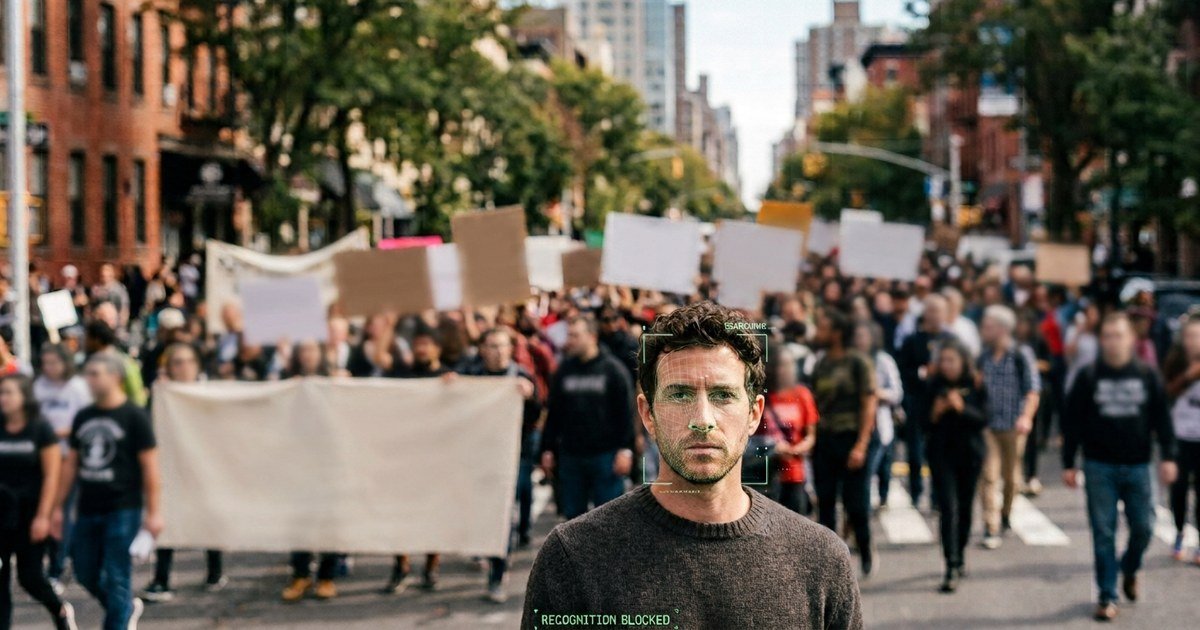
Motion: we should ban facial recognition
Debated: 17 August 2026, Ye Olde Cock Tavern, Fleet Street
Format: rapid debate, opening speeches, floor speeches, closings
Cameras that can put a name to a passing face are already on London’s streets, in its shops and in some of its bars. Straight after an hour on prison numbers, the Sylvans turned to the technology that increasingly decides who gets caught, under the motion that we should ban facial recognition. A show of hands before the speeches put seven in favour and five against.
The proposer in the facial recognition debate: public trust, private power
The proposer began by conceding that the technology will not disappear. Intelligence agencies almost certainly run it on every feed they receive, they suggested, without waiting for legislation. The case rested on a distinction between public and private use. In public hands the technology is acceptable only so far as people can trust the data, the government and the officials making decisions, and those officials come with biases and, sometimes, shareholdings in the companies involved.
Bars, clubs and the right to refuse entry
Private use was the real target. Companies exist to maximise profit and survive competition, the proposer argued, whatever their advertising says. They described a bar in Camden Market that photographs customers at the door, and a well-known venue near Embankment that displays a notice about its cameras. A private venue can refuse anyone without giving a reason. That, the proposer said, is an American way of thinking, and in other countries it would count as discrimination.
The opposer in the facial recognition debate: benefits first, flaws second
The reply named the proposer’s objections (trust, bias, privacy and error) and took them in turn, after first setting out what a ban would cost. A camera that catches a thief is little use if nobody can identify the face. Missing and abducted people could be found in a crowd. Opening a bank account becomes a matter of holding up a phone rather than filling in forms.
Errors as engineering problems
Misidentification, on the opposer’s account, is a technical problem with a technical cure. Early cars needed a man with a flag walking in front of them, they noted, and nobody concluded that horses were better. Bias against people from minorities is known about precisely because the systems can be tested, and testing is how they improve. Nor would anyone treat a match as infallible: an alert claiming that a speaker in the room had stolen cheese in Paris that evening would be dismissed by everyone present.
Line-ups, patrols and bank forms
The alternative, the opposer said, is human recognition, and the classic witness line-up is terrible at it. A camera watching a crime hotspot is more discreet than officers checking papers, and so arguably kinder to privacy. Checking identity by phone also beats posting bank statements and utility bills. The perfect, they concluded, should not be made the enemy of the good.
Voices from the floor in the facial recognition debate: consent, accuracy and trust
A trial outside Angel station
The first floor speaker had walked into a live trial outside Angel Tube station the week before, entirely by chance, on the way to a lunch that never happened. A notice warned that anyone recognised might be arrested. They noticed a cluster of senior officers and a few people surrounded by police, presumably picked out by the cameras, and declared themselves undecided.
Super recognisers, and privacy already spent
The next speaker began with a tangent that had a practical edge. Some people are super recognisers who can pick out a face they have seen once, and police could test witnesses before trusting a line-up. On the motion itself, they argued that the question was one of principle rather than feasibility. Phones and social media already give away far more data, so they asked supporters of a ban to say what it would actually protect.
Blanket surveillance and false positives
The answer came at once. London is the most surveilled city in the world outside China, one speaker claimed, yet crime detection has fallen by 22 per cent. Live recognition treats everyone as guilty until proven innocent and produces false positives, including, they said, a shopper wrongly accused of theft in a supermarket. Smartphone users consent; passers-by do not, and there is no democratic mandate. The speech closed on Benjamin Franklin and liberty traded for security.
The real worry is unchallengeable algorithms
A speaker on the other side called the technology a red herring. The real fear, they argued, is algorithmic decision making with no route of appeal. They compared it to credit scoring in banking: arbitrary, often inaccurate, but open to challenge, with banks under pressure to make challenge easier. The answer was to govern how data is used, and to keep the conveniences, from unlocking a phone to faster passport gates.
Consent that cannot be withdrawn
A supporter of the ban drew a distinction the room kept returning to. Cookies, CVs and documents can be withdrawn from a database. A face captured in the street is far harder to remove, and the camera offers nothing in exchange. They recalled a man in London stopped by police for covering his face near a recognition van, and warned of a uniform, watched and well-behaved society. If crime is falling, they asked, why add more measures?
A tool waiting for the wrong government
A first-time speaker put the case in 30 seconds. In the hands of a nefarious regime the technology would be diabolical, and having already given data away is no reason to give more. Many people would find cameras that recognise them everywhere deeply uncomfortable. That alone, they argued, demands a democratic mandate and active consent.
Exonerating the innocent
An argument the opposition would later build its closing on came next. One speaker saw the technology as a way to deal with petty crime that never reaches the threshold for sending an officer. It could also exonerate: people who cannot afford a KC would have a camera to prove where they were. Asked from the floor why recognition was needed rather than ordinary CCTV, they answered that a validated match settles identity in a way that blurred footage cannot.
Undecided voices and a change of mind
Several speakers held both views at once. One drew a line between CCTV, which most people now accept, and live recognition, which they called creepier, citing the supermarket case and claiming that NHS medical data was already in the hands of Palantir. They credited CCTV with reducing football hooliganism, and suggested carrying a rubber sixth finger so that any match could be blamed on AI. Another asked whether a ban meant forever, or only until the technology works outside laboratory conditions.
The clearest change of mind came late. One speaker said that 10 years ago they would have backed a ban. Now they cited a figure of 1,300 arrests through facial recognition between 2024 and the end of 2025, including rapists and armed robbers, while accepting that some might have been caught anyway. Every move they had made that day was already on camera, they said, and on balance they would not ban it. A final speaker worried less about the technology than about how rarely some governments change, pointing to China.
Closing arguments in the facial recognition debate: the opposer
The opposition’s closing took the floor’s exoneration point and made it the first of two arguments. Would the room rather be judged by an officer who disliked their face, or by software whose training data could be audited? Second, it would make endemic offences such as shoplifting and fare dodging enforceable. A uniformly well-behaved society, if that meant nobody stealing phones, sounded good to the opposer. Parliament sets the law and is the democratic check, they argued, so change the law rather than the tool. Shops should be free to protect their stock, and mistakes would be corrected in court.
Closing arguments in the facial recognition debate: the proposer
The proposer’s closing went back to private use. Only a court, they argued, has the legitimacy to decide that someone is a shoplifter. A shop that bans a person on a camera’s word, or puts their photograph in the window, imposes a penalty without a trial, and in a misidentification everyone agrees that is unjust. Data can be cross-referenced by elimination to identify people without their names, they added, even to infer a genetic condition. In private hands that could price someone out of medical insurance, as in the US.
The final vote in the facial recognition debate
The motion was rejected. At the end six voted for it, seven against, with three abstentions. The opening show of hands had stood at seven for and five against, so the motion went in ahead and came out behind. That is a reversal, though on a margin of one vote in a small room, where a single person arriving or leaving can account for it.
The floor produced at least one public change of mind, and the opposition’s closing was built on an argument first made from the floor. In the end, the house was readier to distrust the people holding the cameras than to take the cameras away.
Why the facial recognition motion failed
Going in, the motion led by seven to five; it came out losing by seven to six, with three abstentions. The reason lies in a gap the proposer opened in the first minute. Their case was really against private use: bars, clubs and shops deciding who may enter. The motion asked for a total ban. The opposition attacked where the motion was widest, on police work and public safety, and the proposition defended where it was narrowest. Most of the floor ended up on the opposition’s ground.
The proposition’s case: trust, profit, legitimacy
The opening speech made an unusual concession for a proposer, accepting that the technology will not go away and that intelligence agencies already use it. Public use, it argued, is acceptable if governments and data can be trusted. That turned the speech’s strongest material, the profit motive and the venue that refuses entry without reasons, into an argument about one kind of user.
The closing sharpened that argument considerably. Only a court has the legitimacy to brand someone a shoplifter. A ban from a shop, or a photograph in its window, is a penalty without a trial. This was the most principled point made for the motion all evening, and nobody answered it directly. Its weakness was scope. It argued that private bodies should not act on a match, which is a narrower claim than banning the match itself.
The private-venue examples were vivid but small. A bar in Camden and a venue near Embankment are an odd basis for banning a tool the police use to find people wanted for armed robbery, and the opposition never needed to engage with them on their own terms. Everyone in the room accepted that a shop banning someone on a false match commits an injustice. That is also an argument for a right of appeal, which is what the speaker from banking proposed.
The data-profiling point at the end, identification by elimination and the inference of genetic conditions, pointed at a larger danger. It arrived in the last minute of the last speech, with no one left to take it further.
The opposition’s case: benefits, improvement, enforcement
The opposer’s opening was the tidiest structure of the night. It listed the proposition’s four objections, set the benefits of the technology against them first, then disposed of each objection in turn. The car with a man and a flag walking in front reframed misidentification as an early-stage problem rather than an inherent one. The line-up comparison did something more useful: it set the technology against the human alternative rather than against perfection.
Its closing made two moves that decided the evening. It adopted the floor’s exoneration argument, which turned the error problem around: if machines misidentify, so do tired police officers, and only the machine can be audited. Then it answered the consent argument with Parliament. The law is democratically made, and the camera only enforces it. That reply did not satisfy everyone, but it gave undecided members a principled reason to vote against a ban while still disliking the technology.
The ebb and flow of the floor in the facial recognition debate
Four battlegrounds opened. The proposition held the first, the opposition took the third, and the other two ended level.
Consent. This was the strongest ground for the ban. Three speakers made it in different registers: a face cannot be withdrawn from a database the way a CV can, passers-by never agreed to be scanned, and a technology that makes skin crawl needs a democratic mandate. The Franklin quotation gave it a slogan. The opposition’s reply, that Parliament makes the law and the camera enforces it, came only in the closing.
Privacy already spent. Two speakers argued that phones, cards and CCTV already record every move, so a ban protects little. The reply from the other side, that smartphone users chose their phones, was a fair point and went unanswered in turn. Neither side moved the other.
Accuracy. The proposition’s floor speakers cited false positives, bias and a drop in performance outside controlled conditions. The opposition answered with improvement over time, then, more effectively, with exoneration. A technology that can wrongly accuse can also clear the wrongly accused, and the poorest benefit most. That converted the motion’s best practical objection into a reason to keep the cameras.
Who holds it. A nefarious regime, a state sharing health data, China’s social scoring: several speakers argued the danger lies in the hands rather than the tool. A speaker from banking turned that into the opposition’s answer, which was to regulate use and preserve challenge. The two sides agreed on the diagnosis and disagreed about whether a ban was the cure.
What the floor added in the facial recognition debate
This was a rapid debate, with both openings made extemporaneously, and the decisive contributions came from the floor. A floor speaker made the exoneration argument, and it became the spine of the opposition’s closing. The most persuasive individual speech against the motion was a change of mind made in public: a member who would have banned the technology 10 years ago and now would not, citing arrests of people wanted for rape and armed robbery.
The room’s working definition of the motion shifted too. Two speakers asked what exactly was being banned: police systems or supermarket systems, for ever or until the technology matures. One asked for the motion to be read again. By the end the house was voting on whether police should lose the tool, which is the version of the question the opposition had chosen to fight on.
What the facial recognition debate left unexamined
Nobody separated live recognition in the street from searching recorded footage after a crime, although one speaker came close by contrasting CCTV with the newer systems. Most of the evening’s fears belonged to the first and most of its benefits to the second. A motion confined to live recognition might have produced a different room.
The evening’s two big numbers never met. One speaker for the motion claimed that crime detection had fallen by 22 per cent in the most surveilled city outside China; a speaker against it cited 1,300 arrests through facial recognition in under two years. Each figure was offered as decisive and neither was tested against the other. The first suggests cameras do little, the second that one particular kind does a great deal, and the gap between them is exactly the distinction between CCTV and recognition that the floor kept circling.
Nor did anyone discuss the rules that already govern the technology’s use. Both sides argued as if the choice lay between a ban and no limits at all, when much of what was said on the floor, about challenge, consent and court decisions, pointed towards regulation rather than either extreme.
What drove the result
Three things, in order of weight. The proposition’s own distinction between public and private left its total ban defending ground it had not argued for. The exoneration argument removed the accuracy objection, or at least balanced it. And the Parliament reply to the consent argument let members who disliked the cameras vote against a ban without feeling they had endorsed them.
The margin was one vote, and in a room this size a single arrival can account for it. Even so, a motion that led going in and lost coming out tells its own story. The house distrusted the people holding the cameras, and still would not take the cameras from the police.
Full transcript of the facial recognition debate
Read the full transcript
The facial recognition motion, and the opening show of hands
We’re going to debate: we should ban facial recognition. Before we start, I would like to get hands. Who supports the motion, we should ban facial recognition? Seven. Who opposes the motion? Five. And who abstains from the motion? Okay.
The proposer: a technology that already exists
We should ban facial recognition. There are many areas where facial recognition is used nowadays, and this is a technology that exists. I do not believe that this technology will cease to exist. I do not have any proof, because I’m not part of MI6 or the CIA, but I am ready to bet at least half of my possessions that they are using facial recognition on any stream feeds that arrive to them, because there is a higher priority of national security. They don’t need to wait for the legislator to put a rule into place. That said, it is already being used.
I think there are two aspects. There is the public use of it, and there is the private use of it, and it is very important to make this distinction. The public use of it doesn’t create any issue if you can trust the integrity of the data centre, of how this information is going to be used, and if it’s not corruptible; and also the integrity of our governments, when the governance changes and the values that drive the society change. There is a whole new debate to assess whether the society is actually following people’s interests or individual interests.
But we can pretty much tell that, because we are human, we are subject to biases. Because the decisions are made by people who are human, and because they have conflicts of interest, they have their shares in private companies, they’re investing in them, there is a case to worry about how those data are being used by the public sphere.
Private venues and the right to turn people away
This is already a concern in the public sphere, but now I’m going to talk about the private sphere. At least in theory, the public sphere is supposed to use anything that we give it, our data, our money, in the interest of the greater good, in order to help people flourish and reach their own excellence. Private companies don’t care about this. What they care about is maximising profit and sustaining their survival in the market and in the competition. Survival comes as a priority for them, before acting well. So you cannot trust that they are doing this for your benefit, even if they try to make you believe it through advertising and marketing.
So you can find facial recognition in clubs, in other private venues where there is not necessarily a huge concern about security. It happened to me in a simple bar in Camden Market: there is a bar in the middle, and they ask for your picture before you enter it. I do think it is because they want to be able to trespass people that they don’t want. There is also a bar next to Embankment, a very famous one, that uses facial recognition. It’s written there, right at the exit, on the right. I’m sure most people know it. I forgot the name of it.
So the problem with private venues using facial recognition is that they have the right to tell you that you’re not welcome there any more, and this is a very liberal way of thinking. More freedom of action given to private entities, which is a very American way of doing this. They can trespass you if they don’t like you, for example. They don’t need a particular justification. But if you go to other countries, this can be seen as a form of discrimination. What is the justification? And who are you, as a private entity, to give a justification that trumps the justice that is normally applied to all of us? I will continue later. Thank you.
The opposer: what a ban would cost
So, the proposal is that we should ban facial recognition technology, and when considering whether we should ban this technology, we should consider what the harms of this technology are. Some of the points made by the proposer were: can we trust these systems? Bias, perhaps; privacy concerns; error. It’s those that I want to go through in my speech.
First off, we really should consider that if we ban this technology, we’re going to lose all the benefits that this technology can bring us. Stopping crime. If you ban this technology, you will not be able to solve that crime where the CCTV camera caught the criminal but we, using our own human faculties, can’t identify them. Perhaps you have some big computer that has the records of where people have been on different evenings. You could find who it was, and you could get back your phone that was nicked on Blackfriars, or whatever crime happened. So they can be useful in that sense.
Likewise, if someone’s missing, if someone’s been abducted, it’s so much easier to find that person in a crowd using facial recognition software. Likewise for private uses: verifying your identity if you want to open a bank account is so much easier if you just do it on your phone with recognition software, rather than having to fill in a form. So we should really consider these benefits when considering banning it.
Facial recognition errors as technical problems
Likewise, we should consider what banning would do, and why we would do it. The proposition raised the notion: can we trust these systems? Could they be corrupted? A lot of these issues are technical problems. For example, if the technology makes mistakes: it is always possible to improve big technologies with time.
This is a novel technology which has only recently been introduced. If the car was introduced right now, and you thought, well, it’s really loud and expensive, and you need a guy with a flag to stand in front of it so people actually know it’s there, why don’t you use horses? You wouldn’t realise that over time the car would get better and solve all these problems. Similarly, facial recognition software will get so much better over time, to make sure that there aren’t any mistakes through misidentification. A lot of the problems that have been thought of with this technology will be solved over time.
Likewise, there’s always the issue of bias causing mistakes, particularly where these systems are less able to identify people from minorities. Similarly, these are technical problems that can be solved. The reason we know that facial recognition software can misidentify minorities more is that we can test it, and once we test it, we can seek to improve it and fix those problems.
We should also acknowledge that, for solving crime specifically, it’s a tool that we use with other tools. We will not treat it as infallible. So, for example, if some Parisian police station said, well, we think this speaker just committed a crime in Paris, nicking some cheese, even if that facial recognition software was really accurate, I think you’d all be able to say: actually, I don’t think it was this speaker who was committing that crime on the 17th of August. So you can use it with other tools, and when you cross-reference with those other tools, you can make sure that silly mistakes like that are caught.
Line-ups, police patrols and bank forms
We should also consider, when banning it, what the alternatives are. Humans are really bad at recognising people. The classic example is the line-up, where a witness comes over and has to choose which person they thought it was. Terrible, really inaccurate. If you have facial recognition software, it won’t be perfect, but we’ll make far fewer mistakes. We should not make the perfect the enemy of the good.
Likewise, you can actually argue that facial recognition is more privacy-sensitive than other ways of identifying people. Having a CCTV camera looking at a particular hotspot for crime is far better than having loads of police goons there checking everyone’s papers to make sure they knew who they were. A camera there is far more discreet, relaxed, and will only flag up when crimes actually happen. Final one: identification for, let’s see, bank forms. If I can’t just use my phone, I have to send in a bank statement from another bank, or a utility bill, and that is losing my privacy in so many ways, which may well be insecure. Having it done on a secure server somewhere in the jurisdiction of this country is both more private and quicker. Thank you.
A live facial recognition trial at a Tube station
Well, I’m not sure what my view is on this topic, but just a week ago I got caught up in a camera recognition exercise quite by chance. I was trying to meet a colleague for lunch, and we had different ideas of where we were meeting, and this distracted both of us, and we never met. This was at Angel, outside the Tube station. There was a notice saying: this is a camera recognition experiment; you don’t have to go through the camera, but if you are recognised, you may be arrested. I don’t actually know whether I went through it or not, because I couldn’t actually see the cameras.
What I did notice was that all the policemen, and there was a whole cloud of policemen there, were of high rank. Police have badges of rank that are the same as the army’s, although there are far fewer ranks in the police than in the army; there are no lance corporals, for example. They all had gold leaves around the peaks of their caps. Anyone of colonel rank will have one band; anyone of general rank will have two. And these all seemed to have two of these gold-leaf bands around their caps. So we had people there, maybe even the Metropolitan Police Commissioner, and this seemed to be an experiment that they were monitoring outside Angel Tube Station, and I got quite intrigued about what was going on.
I did notice that there were a few people being surrounded by eager policemen, presumably the ones the cameras had picked out, and I didn’t stay to see what would happen. But nevertheless, this was going on. Well, at the moment I really don’t know how I’m going to vote. I’ve seen this in operation. I’ll listen to what you all have to say.
Super recognisers, and privacy already given away
Thank you, Mr Chair. Interesting topic, and some interesting points raised. It was interesting that the opposer brought up the piece about line-ups, and I just wanted to mention something slightly tangential to the debate. It turns out that different people have varying levels of ability to recognise faces. There are people who can’t recognise faces at all. There are some people who are super recognisers: if they’ve seen a face before, they can pick it out of a sea of photographs. I hadn’t connected the dots before, but what the police should really be doing is testing witnesses’ ability to recognise faces, and only using in a line-up the ones who reach a certain threshold, because on average it is rubbish, as the opposer says.
But some people might be absolutely brilliant at it, and they could pick out the person, because if they’ve seen that face before they will instantly recognise it. There’s an online test by the University of New South Wales, I believe, that you can take. I took it. I was in the 66th percentile, so a little bit better than average at recognising faces, and I’ve known people to be really high, but other people score really poorly on it. So that is one thing.
Just coming back to the debate: we should ban it. It’s important that the motion is that we should ban it. The proposer did ask whether we can actually ban it. That’s not what this is about. He raised that, and that wasn’t his argument. It might be very hard to ban this technology. That’s not what this debate is about. It’s about the principle: should we ban it?
We have to look at privacy. Privacy was touched upon, but I think we need to expand upon it. Yes, facial recognition affects everyone’s privacy. There’s no question about it. However, we give our privacy away in so many different ways, continuously. Even if facial recognition didn’t exist, or was never used, the amount of data that’s being collected by mobile phones continuously, on location, on everything that you do with them, the amount of data we share over social media, et cetera, it is massive.
So for the people who are in favour of banning it: why? I don’t think I’ve heard that yet. Why do you think we should ban it? For me, the bar is that it would need to significantly enhance our privacy, and I think we give away so much data all the time that privacy is becoming almost a moot concept. Yes, some things can stay private part of the time; some things will only be shared with certain organisations; security in some places is higher than others. But so much is shared all the time.
Where do you draw the line? If you ban this, it’s the tip of the iceberg; there are so many other things that are happening. So, anyway, I’m keen to hear people who are in favour of banning it come up and say: I don’t like it because of this, or this is why we need it from a privacy point of view, or whatever other reason. Thank you.
Blanket surveillance, false positives and consent
So, should we ban facial recognition? I am going to vote yes for this. The thing with facial recognition is that it’s sold as something we need because it’s going to keep us safer. It’s going to keep the streets safer. It’s going to be good for reducing crime. But London is already the most surveilled city in the world outside China. More CCTV cameras per square mile than any other city in the world, unless you’re including Shanghai or Beijing. But despite that, according to the national crime statistics, crime detection has actually decreased by 22 per cent. So what are all these CCTV cameras doing?
I’m sure if you accidentally drive into a congestion zone, as I did once, without actually knowing about it and not paying for it, your number plate will be picked up, and you’ll get a 50-pound fine in the post. So all this sort of surveillance, CCTV, facial recognition: what is the real purpose of it? Is it there to serve the interests of the public, or the state?
And the thing specifically with facial recognition is that it does blanket surveillance on everybody. It assumes that everybody is guilty until they’re proven innocent, and this is actually an invasion of privacy and civil liberties. And the other thing, which has been mentioned before, is mistaken identity, or false positives, which feeds into racial profiling and also gender norms as well. Facial recognition has actually mistaken people’s identity, even in a supermarket, over shoplifting, and they’ve been accused of doing something. Oh, you’ve been shoplifting. You were here the other day. And it’s like, no, it wasn’t me. And people actually get punished because of this. So there are false positive issues.
The other thing is: where is this information going to go? It’s not just the police that are going to have the information from facial recognition. It’s also private companies that are going to be able to obtain it. What are they going to do with this information? Are they going to sell it to other corporations at your expense? Now, I’ve heard it said, obviously: look, if you’ve got your smartphone, you’re basically giving your information to corporations every day. But the thing is, you actually consent to having a smartphone. You don’t consent to having your photo taken for facial recognition, and there’s no democratic mandate for this. Nobody has actually given permission for this. And as it’s the 250th anniversary of the US republic, I thought I’d quote Benjamin Franklin: “Those that give up essential liberty to purchase temporary security deserve neither liberty nor security.” Thank you.
Facial recognition as a proxy for algorithmic decisions
I suspect I might be quite quick. I’m opposing the motion. My main point is that I think facial recognition software is a bit of a red herring, a proxy for what we’re really upset about, which is unchallengeable, algorithm-based decision making, and AI and the robots taking over the world. With facial recognition software we’re all a bit scared: oh, someone will recognise our face, and therefore we won’t be able to go and shop at our local shop again, because they think we’re a shoplifter. One hopes, and we must defend this, that we can challenge that, and we can say to the management: yes, your recognition software might have caught me, but I wasn’t there that time, and I can prove it. If companies use these softwares, which is their choice, without a challenge mechanism, then that’s a serious problem. But it’s not the facial recognition software.
A parallel to that is my industry, banking, credit lending. Banks commission companies to produce credit scores for their customers, and they’re supplied by the credit reference agencies. They’re very algorithmic. They’re very arbitrary. Very hard to challenge. Often inaccurate. But with that, and with other information, and with the relationship that the customer should have with their bank, it’s just part of it. It can be challenged, and it should be challenged, and there’s an impulse to make the challenge easier. Banks are under a lot of pressure to treat their customers fairly. So the technology exists and the data exists, but the emphasis is on how it is used. That’s the most important thing.
And that’s similar to the AI point. If AI gets hold of it, it’s obviously incredibly powerful for AI as well. But that’s an argument for limiting AI, and making sure that the human race doesn’t become the second most intelligent race on planet Earth, which is a different matter. And I’d also bolt on, with my remaining time, all of the benefits of it, logistically: things like logging into your phone with your face, and getting through passport security much quicker than waiting in the line at Gatwick. That’s all I’ve got. Thank you.
Consent, removal and a uniform society
Thank you for having me. I do believe that facial recognition should be banned. As we have mentioned, we don’t give consent to it. We have all been forced into it. We can give consent for our data to be used on our phones, online, as with any website: you can choose to accept cookies or not. You can go to a website and ask for your data to be removed. When you apply for a job, your CV is on a database, and you can decide to have it removed. If you have given official documents to any business, you can ask for them to be removed. You can ask for your face to be removed from the database of facial recognition, but if any other place has it, it’s a much harder task.
If we go into a business and we have a service, if we are using a phone and we need to give consent, we are using that as a service. Facial recognition doesn’t give anything back. They do say that it can increase security, but we have also mentioned how it can be misleading, in the sense that it can pick up the wrong people. But also, I think that generally what this creates is one more measure of surveillance by the state, which can be abused. It can also be abused by corporations and private companies, as has been mentioned as well. And I’m especially against it because I believe it will create a very uniform, well-behaved society, in which anything you do is being watched. So I do worry about that loss of freedom.
I have just a couple more notes here. I remember a case, maybe two or three years ago, where there was a police van with facial recognition on the streets in London, and a gentleman covered his face while he was going past the van. The police stopped him and asked him why he was covering his face, and this was justified as suspicious behaviour. And all he said was: I do not consent to this; I don’t want my face to be scanned. But that was enough for the police to have suspicion over him. So this is my biggest concern when it comes to facial recognition.
And we were talking about prisons just now, and we mentioned that criminality has gone down over the last few decades. So why do we really need more measures, if we are already heading on a path where criminality is decreasing?
A diabolical tool for the wrong regime
This will be quick. It’s my first time, so I’m going to give it about 30 seconds. Look, I think the main concern here is not necessarily what would happen with facial recognition right now. For me, it’s that in the hands of a potential nefarious regime, this would be an absolutely diabolical tool. And I completely take your point that we have already given the data over, and it may be a lost cause. But I don’t see that as an argument to give any more at all. The genie may be out of the bottle, but I don’t think that’s a reason to give them more, and any potential obstacle in future seems like a good one.
A second point, which maybe hasn’t been covered so much, is that for many, many people it would simply make our skin crawl to know that cameras everywhere are recognising us and can see us. It’s not a logical thing, but I do think that it probably means it requires a democratic mandate. The fact that so many people would be so deeply uncomfortable with technology like this probably means that we do need permission. We need active consent, and so that’s why I’d be in favour of backing it. Thanks.
Petty crime, exoneration and a question from the floor
I’m not in favour of the ban on facial recognition. There is the practical aspect, as many have pointed out, that the genie is out of the bottle. Once you have a technology out there in the world, you need to figure out how you’re going to manage it, and maybe take a closer look at how we can make it work. I see it as an efficiency-enhancing tool, in one sense. As one person already pointed out, you are able to increase the capacity of the police force to address crimes.
It dovetails very nicely with the previous topic, actually. A lot of the crime we’re seeing, which is affecting us, is petty crime: people stealing our phones, or people shoplifting in Tesco. The problem is that these crimes don’t reach a threshold where you have to send a police officer in a car to go and address them. Facial recognition is a useful proxy for that. You have proof that this person was there at this time, and everything can be quite clearly established.
And we talked about false positives, but it can also be used as a tool to exonerate a lot of people. The poorest people cannot afford a QC, sorry, a KC now, and a fancy lawyer. They don’t need to, because the camera will clearly state that this person was here at this time. And last but not least, I think we’re being very pessimistic about human nature. I think on some level we all crave privacy, including the people who own these technologies, and somewhere I think we will come to some kind of consensus, some kind of equilibrium, on how we’re going to use this technology. Thank you.
So you were talking about shoplifting, for example. I’m not against having cameras in a business, or in your house, to protect your property. But I would like to hear from you: why do you think facial recognition specifically is necessary on surveillance cameras?
It’s about legal process. Let’s say there’s a small camera there, and all it can show is a person who’s been moving in that space. That’s it. That person could presumably argue that their face was obscured, or the camera was flawed. It is very hard to specifically state that person X was in that store at that time. By contrast, if you have validated facial recognition technology, which provides a stamp that says specifically this person was here at this time, then it becomes easier for the legal process to work.
Torn between CCTV’s record and its creepiness
Thank you. I’m usually pretty opinionated and already have an idea of what I’m going to argue, but this one is tricky. I agreed with a lot of what the proposer said, and also a lot of what the opposer said. Fundamentally, almost everyone who has stood up here and said something, I’ve agreed with in some way. So I’m just going to add some points that I’ve been debating with myself.
One thing is that there might be a distinction here between just CCTV and facial recognition. Having a camera there, whatever: if there’s a crime committed, a month later the police will look and investigate. I think most people are now kind of used to this in most of our cities. Facial recognition is a bit creepier, because there was this case in a supermarket, which someone mentioned, of some guy who literally went to buy stuff, and the security people came up to him and told him he had shoplifted a week before. That was all because his face was processed the moment he was in the store, and confused with someone else’s, and that is obviously problematic. I think we don’t want to live in a society where that level of intrusion is everywhere.
And I would say it’s different if the government does it or if the private sector does it. If it’s the private sector, well, we don’t know what safeguards they’re using. We don’t know where this information is being kept, where it’s being sold, et cetera. Granted, some of these critiques also apply to the government. I mean, your medical data is now in the hands of Palantir, so the state can also sell this data or use it for nefarious purposes. And obviously, as this technology expands, it’s not just going to be in Britain; it’s going to be in other countries where the democratic checks and balances and the rule of law are not as strong as here, and it can definitely be abused there. So I absolutely sympathise with everyone here who has raised concerns about the state having this technology and abusing it.
On the other hand, I do think it has worked. At least the CCTV stuff has worked, in some cases. Hooliganism, I won’t say it was eradicated, but it was definitely reduced significantly from the 90s and 2000s because of CCTV. Serial killers: you never hear about them any more, because CCTV kind of eradicated them as well. So in the end, if you really just want to protect yourself from these things, just buy a rubber sixth finger, so that if you’re caught, you can say it was AI. Trust me, they sell these things, and AI always adds an extra finger or an extra limb. So just go prepared with an extra prosthetic.
Convenience, real-world accuracy and a ban for now
Just quickly, a couple of things. Lovely, very interesting points tonight. Like my friend over here said, it’s easy to agree with a lot of what everybody has gone over. The main point I wanted to bring up is that a lot of the arguments for it seem to be about the convenience of using it, and how it will make our lives easier, facial recognition for your phone and all this, that and the other. And I just question whether that will actually benefit anybody in the long run. We’re getting a bit lazier, I guess. And I think maybe we’re not giving as much credit to our police force and our investigators and what they have actually done.
We’ve lived without facial recognition, and, like we said in the last debate, crime’s down, and everyone’s in prison now. So I don’t know how useful it is to really have that as an extra level.
And I also think we’re talking about an idealised world where facial recognition works fully and is very, very successful. In controlled environments it is successful, but when we actually put it into real-world use, it drops significantly, and that’s when we have a lot of these issues of people being misrecognised. So, if the argument is whether we should ban it, is it banning completely, forever? I’m not sure that was made clear. Or is it just banning it at least for now, while we can’t fully control or fully trust the results that we’re getting from it? I think that’s what I wanted to say.
Just curious. I could have asked before, but there probably wasn’t enough time. What about a shop that stops someone from coming in who has literally shoplifted very recently? How do you feel about that? Shop owners are losing loads of money to shoplifters.
Yes, I mean, they have a right to stop somebody if they come in and they recognise that they’ve been shoplifting over and over again. But that’s been happening as well: they recognise people, and they have their pictures up in the shop, which I actually quite like, to be honest with you. So there are loads of ways of doing this already, and I just wonder whether facial recognition is the appropriate level of invasion of privacy that we need for a crime like shoplifting. Thank you.
A change of mind on facial recognition
I’m a little bit confused myself now, because I think some very good points have been made on both sides. What does the motion actually say? Can you read it out again?
We should ban facial recognition.
Yes. Because I’d rather taken it to mean the sophisticated facial recognition that the Metropolitan Police and others use in order to catch criminals, not necessarily the thing in the supermarket, which is, to me, not the same level of facial recognition technology. So I don’t know what the right and wrong of that is.
If you’d asked me 10 years ago, I’d have said yes, we should ban it. It’s an infringement on civil liberties. I don’t know whether I trust it to differentiate properly between people. Will it discriminate against black and brown people versus white people? All that kind of thing. I would have been very mistrustful of it. However, there are two reasons now why I think it shouldn’t be banned. One is the police. At some point between 2024 and the end of 2025, I can’t remember exactly when, 1,300 people were arrested as a result of facial recognition technology, including rapists, people wanted for GBH, armed robbery, all this kind of thing.
Now, of course, that is very good evidence that facial recognition technology works, in terms of the police being able to say: ah, that’s him, we’ve been looking for him for two years, and we’ve got him. And if they go on to get convicted, and many of them have, that’s also good evidence that it’s working, and it’s working for society, because we want these criminals off the street. What we don’t know is whether they would have been caught at some point anyway. But if this is a tool that the police can use, and it results in that kind of thing, I now think I’m maybe slightly more in favour of it.
And given that every move I’ve made today can personally be proved: I went into a supermarket, I got on the Tube, I bought something in a shop. It’s all on camera. It’s all on CCTV. It’s all on my phone, and it’s all on my credit cards or whatever. So I think we’ve given up on our privacy in so many ways. And so, yes, on balance, I would not ban it now.
Progress, and how often governments change
I stay in the middle. You’ll understand later why. My feeling is that the question is not yes or no. We can’t stop progress. You can’t stop science. And we need to worry about another main problem: how often our government changes. Because they prepare the rules and the state strategy for us, and not for themselves. We can’t stop technology. We can’t say no. We can’t say yes. It’s progress. It goes by itself, whatever you do. We just need to worry about how often we change government. For example, China. They already use this thing. They don’t change their government often, and they try to create a social system with levels of social behaviour, and then you can’t work in a state job or something else. You understand? This is the main idea from my side.
Closing for the opposition: enforcement and the democratic check
Many excellent points. To summarise: why should we have facial recognition technology? We focused on crime, and I will continue that with this closing speech. First, it will make for more accurate enforcement of the law. There was a fantastic point made earlier in the floor speeches: it will help exonerate the innocent. No longer will it be some policeman who probably woke up on the wrong side of the bed and just doesn’t really like your face, and thinks you’re the criminal he wants to bang up. What would you rather have: that person being the one who puts you in prison, or a piece of software with billions of parameters, which can have its training data verified and audited, and its output likewise verified, to ensure that it is the most accurate piece of software that we can possibly manage? I’d much prefer the latter.
Secondly, we need it because it makes it far easier to enforce laws that are so far really quite hard to enforce. Shoplifting is endemic. Not paying fares on TfL: also endemic. With this technology, we’ll be able to ensure that if you commit those crimes, you will be found, and you will be punished. Now, there was the notion that this will lead to a uniformly well-behaved society. Won’t that be awful? If by that we mean that we uniformly will not be nicking each other’s phones, then yes, I prefer that society. Thank you very much.
Likewise, the notion that this deprives you of your liberty. No, this is a tool to enforce the law. That law is controlled and set by Parliament, and so this, crucially, is the democratic check. If you don’t want a law being enforced, then vote someone into Parliament as your representative to change that law, but don’t change the tool used to enforce that law in the first place.
There was this notion of consent, which kind of reminded me of the sovereign individual, or the freeman of the land. If you’re a supermarket, and you’re just really tired of people nicking from your shop, I think it should be the right of business owners to say: no, we’re going to put this software in our shop to make sure that if you nick something, you will be caught. And likewise, I think we as a society can say: we will put it in public as well, to make sure that if you commit these crimes, the law will be enforced. If you want to change those laws, that can be done. But the enforcement of those laws, I think, cannot be contested in itself.
There was a lot of mention of mistakes. As I mentioned, this software will be far more accurate than human fallibility. And likewise, if there are mistakes, which there inevitably will be, these can be corrected through our jury system and our usual systems of enforcing the law. For those reasons, a ban would be making the perfect the enemy of the good, and depriving ourselves of a useful tool to enforce the law. Thank you.
Closing for the proposition: who has the right to ban
So I do have a lot to say, and thank you very much for your contributions. I have talked about the difference between public and private. I talked enough about the public; I would like to elaborate on the private. As I said, they do not work in our interests, and facial recognition is only present to trespass people. There could be other uses for it that I’m not aware of, but this is mainly what it is designed to do.
Now, it is not for individuals or businesses to ban someone, and I’m going to demonstrate this to you. It is not theirs. It is the legitimacy of the state’s justice to do it, to ensure the right of individuals to access a service; they shouldn’t be discriminated against on any basis. This is not a people’s mandate, as you said earlier, and this is an arbitrary decision, and I’ll tell you why. If you have this misrecognition example, as we talked about in the supermarket, and the people are trespassed, we all agree that this is an injustice, right? But why? Because they haven’t shoplifted. But who decides? It is not the individual. It is not the business. Who is the entity that has the legitimacy to decide whether they are shoplifters or not? It is the state’s justice.
And it is exactly the same when you are telling an actual shoplifter that they will be trespassed. You cannot do it if you don’t have a court decision on it. Otherwise, who gives the legitimacy of the action? Nobody. We can decide to do it in collaboration with the justice service, having an agreed list of people who cannot access a service. But this is not the business’s private decision to make, and this is because of discrimination. If you’re banned from a shop, it is a prejudice against you. You have to go to another street; it is a cost for you. Your photo being displayed in the window is also a prejudice. It is not made with a court. People recognise you. It is an injustice done to you.
Also, a very important point, and I will not have the time to say everything, but this is really important: we need to be more jealous of our data. They did an experiment about five years ago where they were able to recognise someone specifically without their name.
If I give my information to a lot of people, and I give my National Insurance number, you can pretty much cross-reference everything and build a whole profile of someone based on this National Insurance number. It’s pretty straightforward, right? It’s an objective attribute. But this is actually possible to do by elimination. I can cross-reference many databases, and I’ll be able to tell that you have a specific genetic condition, maybe if you did a DNA test. And this is really my point here: these data can be used against us if you let private interests dictate the decision. Good luck with having medical insurance in the US if you are recognised as being high risk. Thank you.
The vote
Now let’s vote again. To remind you, before the debate we had seven for the motion and five against the motion. Who is now for the motion? Who is against the motion? And who is abstaining? If I’m not wrong, we get six for the motion, seven against the motion and three abstaining. So the motion is rejected.
Further reading
Download this debate as a PDF: Sylvan detailed summary, facial recognition debate, August 2026. Browse our archive of past Sylvan debates, or read how Sylvan debates work. Related: digital IDs and civil liberties, the policing debate, and social media accountability.