
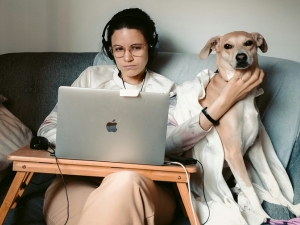
Over the past five years, working from home has shifted from a fringe perk to a mainstream model — and now, to a subject of growing debate. Once celebrated for its flexibility and efficiency, remote work is being re-evaluated. Is this model sustainable? And more importantly, is it good for our careers, our economy, and our society?
That was the central question explored by the Sylvans in a rapid debate on the motion:
Working from home has had its day.
The discussion was robust, passionate, and — like the topic itself — far from one-sided.
💼 You can’t build a career from your kitchen table
The debate opened with a powerful case in support of the motion. The proposer, a businesswoman managing two companies — one office-based and one fully remote — offered a front-row view of remote work’s benefits and its blind spots.
Yes, she acknowledged, working from home improved accessibility, helped employees with childcare responsibilities, and encouraged healthier lifestyles. But those wins come with a cost.
“The impact on young people’s careers is significant,” she said. “When you work remotely, you lose those organic opportunities to learn — those moments in the hallway, the coffee machine chats, the quick, ‘Can I pick your brain?’ conversations that shape your growth.”
She spoke of how, early in her own career, a casual chat with a senior leader opened her eyes to a career path she hadn’t even considered. “You can’t replicate that on Zoom.”
Her starkest warning? That some companies are now choosing not to hire junior staff at all — instead using AI tools under the supervision of senior employees. Why train someone from scratch when a machine can do the job faster?
But then who becomes the next generation of senior employees?
“If we don’t go back to having shared spaces where people can learn, grow, and show their personalities,” she concluded, “we’re in real trouble.”
🌿 The power of flexibility — and trust — when working from home
Opposing the motion, the next speaker offered a balanced but firm rebuttal: working from home hasn’t had its day — it’s evolved.
He didn’t deny the importance of collaboration, but argued that hybrid working — three days in, two days at home—is the sweet spot. “Going back five days a week? That’s overkill. We’re not trying to revive the 2018 commute.”
He cited productivity research, noting that employees working partially remotely tend to be more efficient. “We’re in a flatlining economy. If anything, we need to let go of outdated assumptions to get out of it.”
As for concerns about junior staff missing out, he shared a personal example: a young man who started work eager to be in the office — but after three months of experience, switched to remote by choice. “The knowledge transfer still happened. It doesn’t require five full days at a desk.”
He also pulled back the curtain on the economic forces behind the return-to-office push.
“Let’s be honest,” he said. “This pressure is coming from real estate investors, private equity firms, and corporations with billions tied up in office property. It’s not about your well-being — it’s about their bottom line.”
💡 Serendipity, Shakespeare, and sandwiches
While some speakers focused on productivity, others went philosophical—and even poetic.
One speaker riffed on Shakespeare: “All the world’s a stage,” he said, “but when everyone’s working from home, the stage is empty.”
He painted a vivid picture of deserted offices, silent streets, and young professionals wearing pajamas at 3 p.m. “Our mental health hasn’t improved,” he argued. “We’ve lost the joy of human interaction—the magic of bumping into someone and having your day change.”
Others offered personal testimony: one man had started a remote business with friends but found the process slow and inefficient. “We’re now restructuring just to fix the problems caused by remote work. If we ever hire staff, they won’t work from home.”
Another participant added a class-conscious angle: “Let’s not forget, working from home is a privilege. The butcher, the baker, the candlestick maker — they don’t get that option. So who is this really for?”
🛠 A question of management
But not everyone agreed that remote work is broken — some saw it as a mirror reflecting flaws in management, not in the model.
“Working from home isn’t the issue,” said one engineer. “The issue is bad leadership. A good manager knows which team members need more check-ins and which ones thrive independently.”
He added a cheeky observation: “Also, if you think working from home is bad, try closing a deal next to a toilet in a shared office. Not glamorous.”
Others agreed. “Remote work exposes weak systems,” said another. “It’s up to leaders to adapt, not employees to suffer.”
🧠 Extroverts vs. introverts — and the value of choice
One speaker framed the debate through personality types.
“Extroverts say, ‘I love the office!’ and assume everyone else does too. But introverts found remote work deeply refreshing,” he said. “We need to acknowledge different preferences — and allow room for both.”
He argued for flexibility and choice. “It’s not about being fully remote or fully in-person. It’s about giving people the autonomy to work in ways that suit their roles and temperaments.”
🧳 The takeaway: working from home is not over, it’s changing
The closing statements drove the message home: working from home isn’t a fad — it’s a framework. And like any tool, its impact depends on how we use it.
“Let’s not throw away everything we’ve learned post-pandemic,” the opposition said. “We don’t need mandatory five-day weeks. We need a model that lets people thrive.”
Even the proposer acknowledged that hybrid work would remain. “But the era of fully remote as the default? That’s over,” she argued. “We need to bring people back together — not for control, but for connection.”
Result: the working from home motion carried
In a razor-thin final vote, the Sylvans concluded through the debate that working from home has had its day.
Please see summaries of earlier Sylvan debates here.
For more information about how our meetings run, see meeting info.