
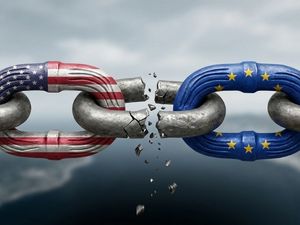
Welcome to another engaging evening with the Sylvans, where members gathered to debate a highly controversial motion. They fiercely discussed the following statement: ‘The US is no longer a European ally.’ This topic directly challenges the current state of the US-Europe alliance. The room buzzed with anticipation. Let us dive into the arguments from the floor.
The proposer’s opening on the US-Europe alliance
The proposer started the evening strongly. They asked the audience to look beyond the current US President. Instead, they highlighted a major global shift. Europe is no longer the centre point of the world. From 1914 to 1989, global dominance meant controlling Europe. Therefore, the US needed a strong western ally to counter Soviet influence.
Today, the world looks completely different. The US must look out for itself. To maintain security, they need total control of the Western Hemisphere. Consequently, American focus is shifting heavily towards East Asia and Africa. The proposer argued this trajectory would continue under any president. Eventually, every leader realises that influence in other regions matters more than Europe. Ultimately, Europe must pull its own weight. The US might remain a friendly buddy, but they are no longer a close European ally.
The opposer’s defence of the US-Europe alliance
The opposer took the stage next. They warned against taking an inaccurate snapshot of today’s politics. Assuming the US-Europe alliance is dead remains a dangerous game. Historically, the relationship always experienced intense ups and downs. For example, the US only entered the Second World War militarily after Pearl Harbour. They also demanded heavy financial payment for Lend Lease supplies. Despite these past tensions, we always assumed the US remained a steadfast ally.
The current administration features a unique individual. This leader relies on extreme leverage and media outrage to govern. However, this one man does not represent the entire American population. The opposer noted the president’s incredibly low approval ratings. Once this unique individual leaves office, they suspect a powerful resurgence in transatlantic allegiances. Therefore, focusing only on the current chaos makes the motion completely false.
Spirited floor speeches on the US-Europe alliance
The debate then opened to the floor. Members eagerly shared their diverse perspectives.
One speaker argued passionately against the motion. They noted that nearly half of America still values these democratic ties. We ignore the threat of losing this friendship at our peril. Another member highlighted deep historical, linguistic and commercial linkages. These bonds do not simply vanish overnight. They argued a true breaking point only happens when values of democracy and free speech completely misalign. We have certainly not reached that point yet.
Conversely, a bold supporter of the motion challenged history. They claimed the US and Europe were never actually true allies. They pointed to the 1823 Monroe Doctrine and heavy Cold War tensions. Furthermore, recent sanctions on Russia actually boosted the US economy. Meanwhile, Europe currently struggles with highly expensive liquefied natural gas. Thus, separate power blocks inherently hold separate interests.
Defending the US-Europe alliance, another attendee pointed directly to NATO. The US still honours the commitment that an attack on one is an attack on all. They actively meddle in Europe because they still care deeply about Russian influence. Another speaker backed this up. They reminded the room of the very real, physical threat from Russia. Europe desperately needs the US to counter this present danger.
Taking a more analytical approach, another speaker examined American imperialism. They argued that European fragmentation continually causes its own weakness. If Europe and the US truly unite, they wield massive positive influence. Sadly, Europe remains too divided.
A fiery proponent of the motion focused heavily on the current US president. They described the leader as a dictator hungry for constant media attention. They passionately stressed to the room, ‘we don’t have Trump Derangement Syndrome; we have Deranged Trump Syndrome.’ Because the president treats allies terribly with sudden tariffs, the US-Europe alliance acts functionally dead.
Taking a pragmatic approach, another speaker distinguished between true allies and strategic partners. An ally always has your back. A strategic partner only helps when it directly benefits them. Because the US now shows ambiguity regarding Article Five, they act merely as a strategic partner. Therefore, they are no longer a dependable ally.
Finally, the chair stepped in to share their thoughts. They compared international alliances to personal friendships. A true friend does not use a hostile, threatening diplomatic approach. The current communication style lacks basic sympathy. Consequently, this harsh tone completely undermines the very idea of a modern alliance.
Closing arguments
Following the floor speeches, the main debaters returned to deliver their final verdicts.
The opposer summarised their strong defence first. They reiterated that taking a snapshot of a single volatile presidency is extremely unwise. They warned against casually dismissing Article Five. Doing so actively risks a catastrophic hot war with Russia. Furthermore, they emphasised that the US and Europe still collaborate deeply on crucial military intelligence. Because we still share core democratic values, the US-Europe alliance proudly endures.
The proposer then closed the evening’s debate. They firmly maintained that the US is no longer a European ally spiritually. While paper treaties currently exist, the underlying reality looks vastly different. They stressed that this geopolitical shift represents a long term trajectory. Regardless of who sits in the Oval Office, American interests have permanently pivoted. They now look towards South America, Africa and Asia. Europe’s time in the spotlight is slowly waning. Consequently, the US now prioritises non European powers for the future.
The final vote
After a spirited and thoroughly engaging evening, the chair called for a vote. The room found itself fiercely divided on the issue. In the end, with the chair casting an abstention to break a tense deadlock, the motion was ultimately opposed. Despite the recent political turbulence, the Sylvans officially decided that the US remains an ally to Europe.
Further reading
A detailed summary and analysis of the debate can be viewed here.
Please see summaries of earlier Sylvan debates here.
For more information about how our meetings run, see meeting info.