
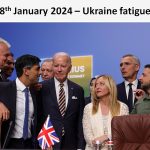
The Sylvan Ukraine fatigue debate considered the following motion:
The West should pursue a stalemate in Ukraine while Putin rules.
The debate took place on Monday 8th January. Stan Billington proposed the motion and Tom Warner opposed it.
The proposition arguing that we should pursue a stalemate in Ukraine
The proposer continued
The opposer continued
Floor speeches from the audience of the Ukraine fatigue debate
Floor speakers brought a range of perspectives. We cannot count on Putin’s death or overthrow, and most Russians are behind him. He represents a deep Russian political tradition. Don’t pursue total victory, push for a settlement. Russia has overcome Western sanctions. The Ukrainians face significant challenges taking military hardware from myriad allies with different standards. They can only sustain about 2,000 artillery shells per day versus Russia’s 10,000. Ukraine needs a large push, but it won’t happen in 2024 and likely the West will betray them ultimately. The West is tired and have no troops on the ground.
Floor speeches continued
However, there is a moral case to avoid a stalemate. Russia clearly acted as an aggressor. Our interests align with stopping Putin, given his destabilising actions such as with elections. Stalemate represents the reality on the ground, yet we need to send the right message by punishing bad actions. In any peace deal we will give up Ukraine. Both sides have completely different perspectives, and war makes finding a universal truth difficult. What if the Second World War had ended with the Nazis still controlling part of Europe? We need to set an example to protect the sovereignty of European countries. Do we have the will to pursue total war?
History tells us that stalemates don’t work – remember Chamberlain’s ‘Peace in Our Time’? We cannot appease Putin. Yet a stalemate is not a ceasefire, you have to fight to maintain the current stalemate. Very difficult to achieve a total victory – we can’t abandon Ukraine to their fate and a stalemate represents a good deterrent.
The opposer’s rebuttal
In rebuttal, the opposer pointed out that winning a war is favourable, but we need a strategy, as stalemate is expensive. Voting for the motion means setting a strategy to contain Russia – not a reasonable prospect. People who should vote for the motion either believe Putin will soon lose power, or have a stake in arms manufacturing. We need to avoid a horrible, costly stalemate, which represents a feeble goal. All others should vote against.
The proposer’s closing speech
In closing, the proposer challenged an axiom of debating circles. The onus rests not only with the proposition to make a positive case. The opposition also must state a position other than refuting the proposition. Tom said we should prop Ukraine up properly, but we have been trying to do it for two years already. Counteroffensives mean tricky warfare, and we’re already pursuing a stalemate. £6 billion a year represents 0.6% of our spending, and a winning counteroffensive would cost much more. Would a loss be superior relative to holding the front line? Many negative regimes have been overcome. Ukrainians don’t want a ceasefire negotiation.
Result: the Ukraine fatigue debate motion did not carry
In the final vote, the Sylvans concluded through the debate that the West should not pursue a stalemate in Ukraine while Putin rules.
See information on other Sylvan debates here.