
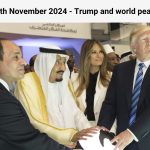
Will Trump support world peace?
The question of whether Trump supports peace has ignited fierce debates globally. Recently, a spirited discussion among seasoned debaters shed light on this contentious topic. The perspectives were as varied as they were thought-provoking, exploring Trump’s unconventional style, his policies, and his legacy. Here’s a recap of the main arguments.
Proponents: Trump’s record suggests pragmatism over conflict
Supporters argued that Trump’s presidency was marked by a lack of major wars—a rare accomplishment in modern U.S. politics. They highlighted the Abraham Accords as a testament to Trump’s ability to foster peace in the Middle East. His unconventional diplomacy, such as crossing the Demilitarized Zone to meet Kim Jong-un, was seen as bold and effective in de-escalating tensions.
Speakers pointed to Trump’s America First approach as a potential stabilizing factor. By focusing on reducing U.S. involvement in foreign conflicts and withdrawing troops from Afghanistan and Syria, Trump appeared to prioritize pragmatism over war. Some noted that his unpredictability might have deterred adversaries like Russia and North Korea from escalating conflicts during his term.
Opponents: a threat to global stability
Critics dismantled the notion that Trump supports peace, focusing on his role in shaping the Ukraine crisis. Several speakers noted that while Trump avoided direct military escalation, his policies often left allies uncertain. His critiques of NATO and a perceived lack of commitment to defending Eastern European allies may have emboldened Russia.
One speaker argued that Trump’s approach to Ukraine, which included a delay in military aid, weakened Ukraine’s ability to deter aggression. They noted that during Trump’s tenure, Russian actions, such as the annexation of Crimea in 2014, preceded a period of tension but no full-scale invasion. This was followed, however, by the major escalation in Ukraine in 2022, under Biden. Proponents of Trump argued that his unpredictability might have made adversaries cautious, while critics suggested his approach failed to provide consistent support to deter conflict.
The divisive factor: Trump’s personality
Both sides agreed that Trump’s personality played a pivotal role in shaping his foreign policy. Proponents admired his business-like approach to negotiations, while opponents criticized his erratic and ego-driven decision-making. Many feared that his disdain for multilateral agreements and global institutions signaled a retreat from the U.S.’s traditional role as a global peacekeeper.
Verdict: mixed outcomes
The debate concluded with a narrow rejection of the motion that Trump supports peace. While his term avoided large-scale conflicts, critics argued that his policies created the conditions for future instability. Proponents maintained that his pragmatism and tough stance could have benefits in specific situations but fell short of ensuring lasting global peace.
The Ukraine question: a key to Trump’s legacy
Ukraine emerged as a central topic in the debate. Critics highlighted Trump’s inconsistent stance, particularly his withholding of military aid, as a significant misstep. Some participants argued this decision undermined Ukraine’s ability to resist Russian pressure. Others noted that his perceived indifference to NATO’s collective defence commitments sent mixed signals to allies in Eastern Europe, potentially emboldening Russia.
Proponents, however, pointed to the absence of a full-scale invasion of Ukraine during Trump’s presidency as evidence of his effectiveness. They argued that his erratic but firm posture might have deterred Russia from escalating beyond the annexation of Crimea. These contrasting views illustrate the complexity of assessing Trump’s approach to peace in Eastern Europe.
Conclusion
The question of whether Trump supports peace remains contentious. While his presidency demonstrated an aversion to new wars, his policies and rhetoric often undermined global alliances and long-term stability. As discussions continue, one thing is clear: Trump’s legacy on world peace—and particularly in Ukraine—will remain a polarising topic for years to come.
Please see summaries of earlier Sylvan debates here.
For more information about how our meetings run, see meeting info.