
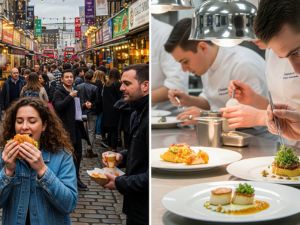
Street food vs professional chefs sets the terms of London’s culinary debate. London’s food scene is a living argument—part revolution, part institution. On one side: the surge of street food, food trucks, pop-ups and market halls serving bold, global flavours from Asia to Mexico. On the other: professional chefs running everything from modest local eateries to Michelin-starred landmarks. A recent Sylvan debate explored which side has done more for London cuisine. The result: a narrow rejection of the motion that street food has done more than professional chefs. But the conversation revealed far more than a scorecard.
The case for street food over professional chefs: food as power, equality and everyday culture
One speaker framed food as a fundamental right and a shared human language. They pointed to global hunger—hundreds of millions undernourished—and argued that the power to nourish and unite sits with people, not just institutions. For them, street food is the movement that puts that principle into practice: accessible, diverse and rooted in the city’s daily life.
London’s streets, they argued, are where the real culinary pulse beats—from chips and caviar to a proper Ruby Murray in the East End. They took aim at political spectacle too, suggesting that extravagant state visits could be replaced by a humble street food tour that feeds the people rather than entertaining elites. In their view, London’s street food is a revolution.
History and culture were part of their case. They invoked familiar stories: the perils of cake for the aristocracy, armies marching on their stomachs and outdoor feeding as an ancient and spiritual act. Economically, they said, tourists and locals often prefer street food’s affordability and variety over expensive dining rooms. And culturally, they credited the streets with seeding fusion cuisine and social conscience—vendors who sometimes share leftovers with those in need, supporting everyone from workers to visitors. To them, the amateurs on the pavement are the ones sustaining London’s food culture more than establishment chefs ever could.
They also addressed media and celebrity culture, describing many MasterChef participants as prima donnas, while acknowledging exceptions like Rachel Khoo and Jamie Oliver.
The case for professional chefs: standards, innovation and community anchors
Another speaker charted the last 10–15 years of London’s street food boom—vibrant, global and irresistible to those who love casual, high-flavour eating. But they pushed back on the idea that street food eclipses restaurants. For them, professional chefs include the full spectrum of caterers, not just Michelin stars, and the relationship is symbiotic: vendors often borrow techniques and flavours from chefs, while restaurants learn from street food’s authenticity and energy.
They noted that street food is not always cheaper, sometimes rivalling restaurant prices, and tends to serve those already able to dine out. Meanwhile, restaurants anchor neighbourhoods, maintain culinary standards and carry innovation forward over years, not months. Many chefs open venues inspired by their roots or by street food, but they institutionalise quality, train teams and develop cuisine in ways that transient concepts can’t always sustain.
This perspective was as much about the experience as the plate. They prefer to sit down with proper utensils, valuing balance and restraint in well-prepared dishes. They recalled landmark restaurants—like the old Khan’s in Westbourne Grove—that helped transform London’s Indian dining scene, and praised the craft of chefs who refine flavours rather than stack them.
Other voices: specialisation, accessibility and a changing city
Other speakers added important nuance.
Street food vendors often specialise in a single dish and aim for excellence. Restaurants cover broader menus and push experimentation. Street food’s visibility—aroma, grills, sizzles—coaxes passers-by to try unfamiliar cuisines. It expands reach and builds curiosity. Restaurants still drive significant innovation, sustaining standards across time.
London’s high streets are changing: more food outlets, fewer traditional shops. Portobello Road emerged repeatedly as a melting pot—Italian, Moroccan, Vietnamese, Japanese, and some Caribbean presence. Soho’s Chinese staples and classic East End curries remain magnets. Ingredient supply and quality have shifted since Brexit and COVID, affecting freshness in kitchens across the spectrum. Personal preferences spanned Caribbean, Chinese, Indian and Turkish to Portuguese; some favoured pub lunches and neighbourhood restaurants, others sought out the best jerk chicken from street stalls around Carnival.
Street food is often a social outing for those with means, skewing younger. Restaurants remain crucial for family dining and community life, offering continuity that trends sometimes lack.
Personal plates, shared city
The debate had as much heart as argument. One speaker described London as a global smorgasbord, from cannelloni to burgers by the American Church on Tottenham Court Road, to Moroccan stalls along Portobello Road. Another emphasised simplicity and quality—well-cooked meals, seasonal menus, and the quiet joy of a sit-down meal. The shared thread: London’s strength is variety, and the city eats best when it eats widely.
What really drives London cuisine: street food vs professional chefs?
Taken together, the discussion paints a realistic picture. In the street food vs professional chefs debate, street food excels at access, diversity and immediacy. It democratises flavour, invites experimentation from the ground up and keeps the city adventurous. Professional chefs, meanwhile, build the infrastructure: training, standards, seasonal sourcing, consistency and long-term cultural stewardship. They amplify ideas that often begin on the street and carry them through restaurants that anchor communities.
The verdict and what it means
The vote narrowly rejected the claim that street food has done more for London cuisine than professional chefs. The outcome matches the conversation: it isn’t a zero-sum game. London thrives because the two feed each other—literally and figuratively. Street food sparks curiosity; restaurants refine and sustain it. Markets and pop-ups keep the city’s palate restless; professional kitchens give those ideas a home.
If you want the best of London, follow both paths. Hunt down that smoky jerk before Carnival and make time for the neighbourhood stalwart that’s been perfecting biryani, ocakbasi or caldo verde for years. In London, the win isn’t street food or professional chefs. The win is the city you taste when both are thriving.
See summaries of earlier Sylvan debates here.
For more information about how our meetings run, see meeting info.