
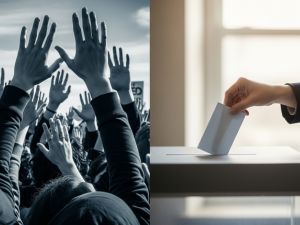
Our chair opened tonight’s debate on protest vs voting.
Opening salvo: framing the protest vs voting debate
The first speaker’s argument unfolded on two levels:
1. Personal impact: one ballot rarely sways policy, but a megaphone can awaken hundreds in real time.
2. Social signal: protest shapes perception. We judge politicians less by records than by reputations forged in the noise of the streets, invoking Keir Starmer’s fluctuating public image.
Evidence? Recent UK strikes by doctors, nurses and barristers that pried open Treasury coffers faster than months of parliamentary questions.
The counter-punch: ballots build the blueprint
The opposition fired back, defining terms with lawyerly precision: a vote occurs in elections or referenda; systemic change means deep, structural shifts. Examples flowed:
Brexit—a single referendum that redrew trade maps overnight.
The rise of the Labour Party a century ago—ballot-box alchemy turning working-class agitation into legislative power.
Post-war welfare reforms—delivered by governments, ratified in elections.
Protest may light the match, the speaker conceded, but constitutional change is the bonfire built by voters.
History takes the mic
Immediately, an attendee invoked the suffragettes: Women won the vote because they did not have one. Their only tool was protest. Another voice cited the anti-apartheid boycotts—global, non-violent pressure that cracked a regime more effectively than any foreign ballot could.
Momentum vs durability in the protest vs voting landscape
A fourth speaker, mixing pragmatism with nostalgia, recalled joining anti-Iraq-War marches 20 years ago. We filled streets yet failed to halt the invasion. Protests record moral outrage; legislation translates it—sometimes. That nuance resonated with fence-sitters: speed versus staying power.
When voting stalls
A data-minded audience member threw shade on American electoral reform. Decades of ballot initiatives against gerrymandering, big-money lobbying and opaque primaries have delivered “frustratingly incremental” gains. Show me the referendum that dismantled Citizens United.
Protest’s double-edged sword
Not all public demonstrations are progressive. A Nigerian attendee warned of rallies demanding hard-line Sharia law; a student recalled Hong Kong’s 2019 street battles that ended in Beijing’s iron grip. Protest can liberate—but also legitimise repression if tactics alienate the middle ground.
The hybrid model emerges
As the night developed, consensus formed around synergy. One speaker offered a three-step ladder:
1. Protest crystallises public sentiment.
2. Parties race to capture that sentiment in manifestos.
3. Elections embed (or neuter) the proposed change for a generation.
Think climate policy: Extinction Rebellion yanked carbon targets onto front pages; subsequent elections forced leaders to codify—or reject—those targets in law. The protest vs voting synergy was suddenly crystal-clear.
The crowd counts
When the chair finally called the vote, his casting vote nudged victory to the protesters.
Key takeaways on protest vs voting
Protest is accelerant: it converts private frustration into public urgency, often faster than any electoral cycle.
Voting is concrete: it chisels that urgency into policy architecture—budgets, treaties, statutes.
The two are symbiotic. Suffragettes marched because they couldn’t vote; they eventually won the right to vote so future generations wouldn’t have to march for the same cause.
Context matters. In stable democracies protests usually influence policy indirectly; in autocracies they may be the only lever—or a lethal risk.
Effectiveness hinges on scale, strategy and narrative. A viral image from one protest can sway millions of future ballots; a single election can nullify months of demonstrations if turnout collapses.
Final reflections on the protest vs voting relay
Protest or voting? It’s less a binary than a relay race. Protest hands the baton to the ballot box, and the ballot box’s outcome decides whether more protest is needed.
Your turn: Will you be queuing at the polling station, designing the next placard—or both? The system changes when enough of us decide it must, and history suggests we rarely choose just one tool.
(If you found this recap useful, feel free to share, join a debate or, well, protest.)
See a detailed summary of the debate, and see summaries of earlier Sylvan debates here.
For more information about how our meetings run, see meeting info.