
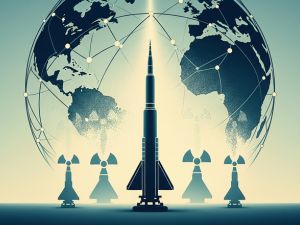
Few subjects in global security provoke the same mix of dread and determination as nuclear proliferation. In a recent public debate the motion—“This house believes the world must stop both Israel and Iran from having nuclear weapons”—sparked a razor-sharp split. The discussion offers a concise snapshot of almost every argument circulating today about Middle Eastern nukes.
Setting the scene: technology, treaties, nuclear proliferation and today’s reality
Uranium enrichment: Natural uranium is 0.7 % U-235. Civilian fuel demands only a few percent enrichment; weapons need ~93 %.
The NPT (in force since 1970) recognises five nuclear-armed states; Israel and North Korea never signed.
The IAEA is tasked with monitoring compliance, but enforcement relies on political will.
Israel keeps a deliberate “opacity” around an estimated 90 warheads. Iran, still under IAEA inspections, has enriched uranium up to 60 %—close enough that, with further processing, a bomb becomes technically feasible. The competing realities feed regional nuclear proliferation anxieties among neighbours.
Why the world “must” halt both programmes of nuclear proliferation
Human security: A single detonation in the region could trigger mass casualties, ecological devastation and possibly a global conflict spiral.
Legal parity: Allowing Israel a free pass while punishing Iran undermines the NPT and fuels resentment.
Regional de-escalation: Pressuring Israel on settlements and nuclear secrecy could reduce existential fear on all sides, making diplomacy with Tehran easier.
Moral imperative: No state should retain weapons whose only purpose is annihilation.
Proposition speakers stressed that “must” signals duty, not convenience. They envision coordinated sanctions, renewed diplomacy and stricter IAEA mandates applied evenly to curb nuclear proliferation.
The opposition: pragmatism, deterrence and the art of the possible
Uninventable technology: Any nation with money, mines and engineers can reach a bomb; the genie is out.
Deterrence logic: Israel’s ambiguous arsenal has—so far—prevented full-scale invasions or genocidal ambitions from neighbours. Removing that umbrella might invite war.
Enforcement limits: Israel’s second-strike triad (submarines, aircraft, land missiles) makes forced disarmament almost impossible without catastrophic conflict.
Precedent anxiety: Ukraine surrendered its stockpile in 1994, only to see security guarantees dissolve. Few states will repeat that lesson.
Opposition voices did not necessarily celebrate Israel’s or Iran’s policies; they argued that, in a hostile neighbourhood, nuclear deterrence is the lesser evil within an environment already shaped by nuclear proliferation dynamics.
Key themes from the floor speakers on nuclear proliferation
Empathy vs. realpolitik
Several contributors urged empathy and universal humanitarianism, rejecting the framing of any people as irredeemable adversaries.
Hypocrisy and double standards
Repeated calls highlighted how U.S. vetoes shield Israel while Iran faces crippling sanctions—an asymmetry many believe feeds Tehran’s ambitions.
Technical sobriety
One participant delivered a concise primer on critical mass, isotope ratios and radiation legacies—reminding everyone that physics, not politics, dictates just how devastating these devices are.
Moral philosophy
A strand of discussion treated nuclear weapons as the ultimate moral failing: investing in extinction while global poverty persists.
Proposition wrap-up: international law exists for a reason
Equalising pressure on both states would cool the arms race, restore NPT credibility and reduce incentives for Saudi Arabia, Egypt or non-state actors to chase bombs of their own.
Opposition wrap-up: “We manage the world we have, not the one we wish for.”
Given Israel’s secure triad and entrenched backing, disarmament efforts are non-starter at best, war trigger at worst. An imperfect balance of terror still beats an unrestrained conventional or nuclear showdown.
Result and reflections
The motion did not carry in a razor-thin vote. The split underscores how hard it is to reconcile moral aspiration with geopolitical constraints.
For advocates of global zero, the path runs through enforceable treaties, credible verification and universal standards. Critics counter that until every state feels genuinely safe, nuclear umbrellas will stay open—especially in regions of historic trauma and mutual distrust where nuclear proliferation fears are acute.
Conclusion
Whether one favours idealistic abolition or cautious containment, the debate’s takeaway is clear: nuclear proliferation in the Middle East is neither a purely technical problem nor a simple morality play. It is an evolving contest of trust, threat perception and power politics.
See a detailed summary of the debate, and see summaries of earlier Sylvan debates here.
For more information about how our meetings run, see meeting info.