
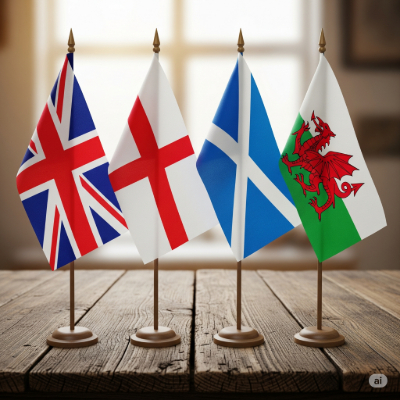
The Sylvans met to explore a single question in depth: “We should fly more national flags to normalise their presence.” The arguments revealed how loaded, contested and important national flags have become, especially in the UK.
The motion in context: reclaiming national flags
The proposer set the stakes plainly: UK national flags especially the St George’s Cross have been co‑opted by the far right. They argued that what should be a symbol of civic pride, belonging, and unity is too often associated with exclusion, racism, and ethno‑nationalism. Many people who love their country avoid displaying national flags for fear of being misread.
Their solution: normalise national flags by flying them more widely, across communities and identities. If many different people, in many different places, fly the St George’s Cross, the Union Jack, the Saltire, the Welsh flag, and the Irish tricolour in good spirit, the stigma fades. Over time, the meaning shifts back to patriotism rather than nationalism. Culture can be rebranded, they suggested; it has been before. The goal is to “take back the flag” from the far right and restore it to the broad, moderate majority.
The opposition case: symbols, power, and national flags
The opposition challenged the premise that flying more national flags leads to healthier civic identity. They questioned the origins and authority of traditional symbols, pointing to patron saints whose histories are complicated and often remote from modern Britain. To them, establishment narratives have long used flags to mask inequality and maintain social control. Flag‑waving can feel like denial when homelessness, child poverty, and global hunger persist.
Rather than doubling down on old symbols, they proposed imagining a new flag for 21st‑century values—diversity, inclusion, social justice—emerging from the grassroots, not imposed from above. For them, real change comes from tackling material injustice; flag‑flying might be harmless, but it doesn’t fix systemic problems.
Themes from the floor: identity, stigma, and who gets to reclaim national flags
Personal experience and principle collided throughout the floor speeches:
Lived experience of racism
One attendee described being told, “We don’t want you here,” by a local political candidate—an encounter that laid bare how national flags can be perceived as caste‑war symbols rather than civic ones. Post‑Brexit, they felt less safe and more exposed to abuse. They also noted the irony and complexity of St George’s origins and the disconnect between chivalric myth and modern nationalism.
Symbols acquire meaning through use
Several contributors stressed that flags mean what people make them mean. If national flags are primarily seen in hostile contexts, they take on that hostility; if they are seen in inclusive, celebratory contexts, they become symbols of pride and unity. The Pride flag was cited as a symbol that began as defiance and now represents equality and diversity—an example some saw as a roadmap for reclaiming national flags.
Reclamation is not simple—or universal
Others argued that reclaiming a symbol typically must be led by those targeted by it. If a flag has been used against a community, members of that community are the ones with standing to decide whether reclamation is possible or desirable. The Lionesses were cited as a powerful, positive image around the St George’s Cross, yet even their use doesn’t instantly neutralise the flag’s complexities for everyone.
Generational shifts
One speaker referenced data showing a decline in national pride among younger Britons and a preference for civic over ethnic nationalism. For them, the narrative around Britishness—and who shapes it—matters as much as the symbols themselves.
International parallels
Multiple attendees highlighted Germany’s experience around the 2006 World Cup, when healthy, positive expressions of national pride became more acceptable without supremacist overtones. Sport emerged repeatedly as a space where national flags often function as unifying rather than exclusionary symbols.
The Welsh question and etiquette
Some noted that Wales is not represented on the Union Jack and that many people don’t know proper flag etiquette. For them, visible gaps in representation undermine the claim that national flags naturally unify.
Patriotism vs weaponised patriotism
Several participants argued that national flags are already ubiquitous, but the real problem is the weaponisation of patriotism for divisive politics. Their prescription: invest in social justice, public services, and fairness; resist privatisation and scapegoating; and build a multiracial, multicultural democracy that people feel proud to belong to.
Free speech boundaries
One attendee supported the right to fly national flags in general, while drawing a clear line against symbols explicitly associated with violence or terror, such as Nazi or ISIS flags. They cautioned that politicians often manipulate patriotic imagery, making the meaning of flags inherently ambiguous.
Summing up the national flags debate
In closing remarks, the opposition returned to the claim that top‑down symbols—however venerable—have long histories entwined with hierarchy. They argued that a new, bottom‑up flag could better express today’s values, but that flags alone will not solve poverty and inequality. They urged a vote against the motion.
The proposer’s summation emphasised that history can be reshaped and that national flags have been reinterpreted before. They framed the decision as a practical test: would flying more national flags reduce stigma and reclaim the symbols for civic patriotism, or would it entrench the far right’s associations? If you believe the former, they said, vote for the motion; if the latter, vote against.
The vote and what shifted
The motion—“We should fly more national flags to normalise their presence”—was not carried. Notably, sentiment shifted during the evening. An initial reading showed a majority in favour; by the end, more participants had moved against.
Key takeaways from the national flag debate
National flags are battlegrounds for meaning. They can unify at moments of celebration, yet they can also feel exclusionary, especially where there is a history of racist appropriation.
Normalisation is not neutral. Flying more national flags might dilute far‑right signalling—or it might embed it. Outcomes likely depend on who flies them, in what contexts, and with what narratives.
Reclamation needs legitimacy. Communities targeted by a symbol’s misuse have a central voice in whether and how reclamation happens.
Symbols follow substance. Many participants insisted that confidence in national identity grows from tangible progress—fairness, public services, equality—supported by inclusive storytelling and representative symbolism.
Plural identities are real. “National” can mean England, Britain, Wales, Scotland, Ireland, Europe, or all of the above. If national flags are to be shared civic symbols, they must find room for that plurality.
Where this leaves the question of flying more flags
If you see national flags as tools that can be reclaimed through broad, diverse, everyday use, you may lean toward more flag‑flying to “normalise” inclusive patriotism. If you worry that increasing visibility entrenches existing stigmas or distracts from real fixes, you’ll likely oppose the push and prefer building civic pride through policy and practice first.
Either way, the debate made one thing clear: national flags are not just fabric. They are stories, and the contest over who tells those stories—and to what ends—will shape how the UK sees itself for years to come.
Please see this detailed summary of the debate for more information.
For earlier Sylvan debates, click here.
For more information about how our meetings run, see meeting info.