
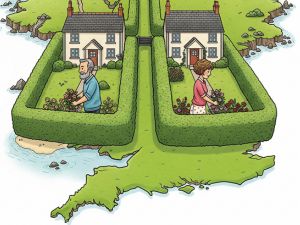
The island of strangers debate considered the following motion:
This house believes we are becoming an island of strangers.
The debate took place on Monday 2nd June. Kal Bashir proposed the motion and Peter Lowe opposed it.
The proposition arguing we are becoming an island of strangers
The proposer defined strangers as unfamiliar people, lacking in relationships – not just literal strangers; in other words, social isolation. Non strangers have shared values and provide mutual support, but strangers feel alienated even when with others. People are becoming less familiar. First, we see a decline in community engagement. Volunteerism has declined, only 17% of adults participate. Council meetings, religious services and sports participation has declined. People don’t know their neighbours, and we see the avenues for connection shrinking.
The proposer, continued
Second, we have the rise of digital isolation, with the average adult spending 6.5 hours on a screen daily. 17-24 year olds prefer messaging to meeting. We have had an increase in remote working, and 1/4 of older adults feel left behind. Loneliness has increased, and family meals halved. People feel more connected to their devices than to each other. Third, we have a decline in trust. Between neighbours, generations and households. Opposing political views have become more polarised. At the same time, people do not have as many friends at work. In public people feel unsafe and avoid conversations with others. Trust erodes, then the willingness to reach out fades. One in five adults has no close friends. Among 18-24 year olds, many feel fundamentally separated from others.
What is the solution to all of this? We can strengthen personal connections. Schedule time with friends and relatives. Even watching TV with your parents provides a shared experience. Find like-minded people through hobbies. We can boost community activities, clubs, causes and public spaces.
The opposition against the island of strangers motion
The opposer began by pointing out that the context of the question centres on immigration, as Sir Keir Starmer just used the ‘island of strangers’ quote in his speech on that subject. I do recognise a degree of alienation in the community. Neighbours may not talk over the fences and immigrants have not integrated. Yet the PM’s warning focused on the impact of net migration to the UK, referencing Enoch Powell’s use of ‘island of strangers’ in his 1968 ‘Rivers of Blood‘ speech on the same topic. We’re not there yet, but it could happen. Starmer also cited the need to celebrate diversity and that without rules we will become strangers – we will go wrong if we don’t control immigration. However, this rhetoric has no real substance or meaning, and represents a dog whistle targeting Labour supporters who could support Nigel Farage’s Reform Party.
The opposer, continued
69 million people can’t know each other personally, though the proposer does not have it wrong about isolation. We had the appalling racist abuse faced by Windrush immigrants, the 1970s saw race riots against Ugandan Asians and Vietnamese boat people. Black footballers faced constant taunting. Britain was a really difficult place in the past. Yet immigrants are dreamers, for jobs, education and experiences. Today we have 16% of people born abroad, including India, Poland and Pakistan as the top three countries of origin. People constantly talk about it as a problem. On the other hand, we have a love affair with immigrants and want them to come. They pay taxes to fund public services, do jobs we won’t do including in the care sector and pay high university fees. 9.3 million British of working age do not work. Thank you to immigrants for all you do.
The island of strangers isn’t real, Starmer simply doesn’t know how to deal with Farage. He should attack Reform in their areas of weakness. Illegal migrants represent a vanishingly small percentage of overall migration: we should not focus on the boats. We have austerity and other problems to deal with.
Floor speeches from the audience of the debate
Up to the Napoleonic wars, we had free and unfree people, with the unfree tied to their manor. People have to work intensely with others, and families have entanglements. I agree with the proposer on the definition of a stranger and the opposer on the context. What causes isolation – is it immigration or another issue? The convenience of working from home, texting rather than calling, online shopping – it now requires relatively more effort to make a connection with people. As a teacher in London I see kids wearing ethnic clothing on diversity days, and they don’t describe themselves as English. Have we as adults put in the effort to teach them to be part of a community? Have we reached out to other groups?
Floor speeches continued
Some studies have shown that diversity leads to isolation and others do not. As an immigrant myself I don’t feel completely left out. However, a language barrier is one of the biggest reasons for isolation. Yet we are all visitors and guests on this planet! In an unequal society we will have isolation. We are an island of strangers, but not because of immigration. The ruling classes use political rhetoric, rage and anger to divide us. Natives feel our home is being trashed and immigrants can leave. We have lost our sense of community and what makes us British. Reform blurs the lines between race and immigration. Immigrant families often have much closer bonds than British ones.
A nation centres on what we have in common and what we see as good, and Britain has the rule of law. Our identity comes from how we describe ourselves, on the emotional, physical and intellectual levels. We should prioritise rational traits we can control to develop our society, including education and critical thinking.
More floor speeches
We should have a national debate on whether to limit immigration. Even Brits socialise over alcohol – while Muslims don’t drink, there are other ways to socialise. Much of this boils down to racism. GB News oppose the boat people but support regime-change wars – one causes the other. We need new ideas and immigration, the world without global learnings would be a small place. Farage has French ancestors. Fear of the unknown leads to isolation.
Swiping on dating apps is dehumanising. Technology could bring people together but needs much more work to do that. Mothers don’t make as much eye contact with their babies because they stare at their phones. Brits love travelling abroad but don’t like immigrants. We live on an island, and have historically actually had less immigration here than in other places (even though it was still significant). We don’t have an effective melting-pot like they do in the US.
The opposer’s rebuttal
Whatever is going wrong, it’s not the fault of immigration. The feeling of isolation affects people more than immigration. We need immigrants to fuel jobs and the economy. Brexit has left people behind – the £350 million for the NHS never came true and the NHS has declined. Social media has driven political polarisation. If this is just immigration, we are not an island of strangers, because it used to be harder to be an immigrant here. Starmer used the mythical Powell quote as a smokescreen. Yes, tech can isolate us, but new communities can also emerge, such as the tens of thousands of Facebook groups. We have millions taking part in padel tennis and park runs, and even Fortnite gaming communities. People record TikTok videos on street corners together.
The proposer’s closing speech
Looking at the motion verbatim, are we an island of strangers? Everyone agrees we have digital-driven isolation. We don’t need to attach immigration to this. Loneliness leads to lower life and economic status, and Starmer wants to replace the cause of this with immigration. If you agree with this substitution, vote for the proposition. Social isolation leads to poorer health and higher demand on public services. We never had a golden age of community, and the link with immigration isn’t strong, you have to twist it around like a pretzel. Starmer tried to appease his base and blame immigrants.
Result: the island of strangers debate motion carried
In the final vote, the Sylvans concluded through the debate that we are becoming an island of strangers.
Please see summaries of earlier Sylvan debates here.
For more information about how our meetings run, see meeting info.