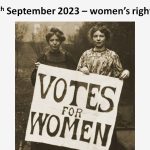
The Sylvan women’s rights debate considered the following motion:
This house believes that women’s rights are being eroded.
The debate took place on Monday 4th September. Victoria Griffiths proposed the motion and Mike Douse opposed it.
The proposition arguing that women’s rights are being eroded
The proposer framed the debate by pointing out that over the past 150-200 years, women’s rights have improved, yet this has reversed. We should interpret the motion as having a global scope. She defined women as adult female humans, and did not address the trans issue in this debate. Every one of us have known and loved a woman – a wife, mother, friend. We need to consider this from the viewpoints of laws, social and other aspects. The Equalities Act and things like shared parental leave have improved things. Yet the US, the most powerful country, elected Trump who undermined women. This sent a message that that’s okay – and there is a drip, drip effect which has a big impact over time. Roe v. Wade overturned.
The proposer continued
In South Africa, rights will only come in in 2030. Spain saw the Rubiales football World Cup kiss, demonstrating male power over women. In the UK, Thatcher had to make her voice deeper and change her clothes – yet this also applied to Theresa May and Liz Truss. The UK government took away equality of work for women. The Duma in Russia took away criminality for domestic abuse. Afghanistan has regressed markedly on women’s rights. You all want the best for the women you love. Economic security features in Maslow’s hierarchy of needs. The subtleties matter, and the current situation is unacceptable.
The opposition against the women’s rights debate motion
The opposer pointed out that he could agree with many of these examples, though many do not comprise ‘rights’. Two types of rights: moral, which are unshakeable and permanent, by virtue of us as human beings; and legal rights. Most examples the proposer cited did not comprise legal rights. The Spanish ‘pig’ kissing the girl did not centre on legal rights. We need to focus on the person’s exercise and perception of the rights, not conditions. We all support women achieving equality.
The opposer continued
I worked in Afghanistan 9 years ago, when women had the right to education. In rural areas they in fact had less access, and now the Taliban has taken the right away. Yet we cannot base progress on legal rights changing. The appalling developments in the US have seen rights taken away. The debate should not hinge on getting a better deal, or a move to equality – we must focus on the nature of rights.
Floor speeches from the audience of the women’s rights debate
A number of speakers cited global examples of the erosion of women’s rights, such as Iran’s morality police. The Taliban want women to be invisible. Religious texts also rail against women’s rights, in particular the Koran. In the US you have pressure from the Religious Right against Roe v. Wade. Women are equal to men but aren’t the same as men, so why should we expect the same from men and women. Women’s reproductive window means some prioritise children over their careers. On the other hand, couples trying to have children at 40 also face lower fertility. Rights versus conditions has a blurred line. Marital rape not legal, but do the police fully enforce it? The pandemic affected frontline workers more, with women overrepresented. The State has the option to protect people, for instance the economic cost of childbearing, yet it hasn’t. Only 1.2% of rapes end in criminalisation, which means effective decriminalisation. The trans situation does lead to safety issues.
Floor speeches continued
What does a genuine right look like relative to a false right. The right to go to school but no access – a false promise. If 49 states allow abortion, it still doesn’t provide full a full right. We need accessible and protected rights. The right to accuse an abuser, but often not pursued. In the UK you need two doctors to agree to have an abortion. Some speakers disagreed with an overall erosion of women’s rights. We can match every example of erosion with others of progress. We have the UK gender pay gap legislation of 2017, the parental bereavement act and the domestic abuse act. Society should allow all to reach their full potential, regardless of gender.
Floor speeches continued
Speakers disagreed on workplace conditions. The last 10 years rights in the workplace have come on leaps and bounds; but many women still cannot be heard at work. A very high percentage of women have faced abuse. Women’s rights are responses to past oppressions, which is not the same as equality. #metoo came into being in 2006 and peaked in 2016, and has declined ever since – few faced prosecution. US Religious Right thinking seems to spread to other countries such as Eastern Europe.
The opposer’s rebuttal
Voting tonight does not put you into a category. We need to relate to the motion. Religion or common and civil law. I’ve worked in Bangladesh since 1966. Things have improved, even with religious influence. Many women have made their way into high positions and professions. The world has much more than the US, thank goodness. We have to distinguish between rights and conditions. 1.2% convictions for rape, but no right to rape. We need to execute the right not to face rape better – we need to fight for this. This debate centres on rights. We’ve had false promises, yet we must decide whether the rights themselves face erosion.
The proposer’s closing speech
The proposer posits that rights reduce via changes in law. Yet if it happens in America, it will happen elsewhere too. A thing in law with no impact isn’t a right, it’s just a thing. Trump said it, people accept it, a thought spreads. It will turn into law, it will oppress women. We need to focus on societal and moral rights.
Result: the women’s rights debate motion carried
In the final vote, the Sylvans concluded through the women’s rights debate that women’s rights are being eroded.
See information on other Sylvan debates here.