
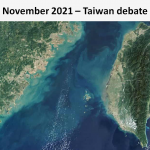
The Sylvan Taiwan debate considered the following motion:
This house believes it would be worth the West fighting a war with China to maintain Taiwan’s independence.
The debate took place on Monday, 1st November.
The proposition supporting a robust response to potential Chinese aggression against Taiwan
The proposer asked for the Chatham House rule to be in place, and his position is not reflective of his own or his employer. China’s belief that Taiwan is part of China underscores the importance of this motion. China has limited patience for the status quo of what they see as a breakaway province. Taiwan will not give up easily, and as a stable democracy has no internal threat. The US has committed itself ‘by law to defend’ the province, and sells it weapons. It has sent military trainers to the island. War would be started by China to take Taiwan by force.
Will the island fall and does it need military support? Taiwan wouldn’t go quietly and will call for aid. Yet China has 25x the military spending and Taiwan would need allies to survive. If you are okay for China to take it, then oppose the motion. What happens if we do nothing? It will be Hong Kong on steroids times 1,000. We will see many deaths and a brutal occupation, and the trampling of democratic rights. If the US does not come to the rescue, its Asian allies will lose faith. It would confirm China’s view of the US as a terminally declining power.
Taiwan is the largest producer of semiconductors used in all our phones and computers. A war would have a major impact. And making the war a Western war, rather than just a US war, will make it more successful. The US needs diplomatic support and a bulwark against it escalating more widely. Without European support, it would embolden Russia to take more territory in Eastern Europe. Without it the war would last longer and have greater costs in lives and economic disruption. Being clear about the West’s response provides the best deterrent. Idling by and doing nothing will lead to disaster on a horrific scale.
The opposition against the motion
The opposer confirmed that everyone supports an independent, democratic Taiwan. Unfortunately, the reality is that it is not worth a war. China’s claim on Taiwan would make any war a dubious cause. And it would continue an outdated Cold War approach. Losses would be massive and the outcome the same. China annexed Taiwan in 1683, but ceded it to Japan in 1895. Then the Allies handed it to the Chinese Nationalists under Chiang Kai-Shek in 1945, and the US protected them. Taiwan had martial law then democracy.
The 1992 ‘Consensus’ declared that China is one nation, but with different interpretations across the Strait. One-third of the Taiwanese people support reunification, including the Kuomintang party of Chiang Kai-Shek. The basis for war rests on at best a doubtful cause, possibly an unjust one. China has traded economic growth for political freedoms, and reduced poverty massively. China’s human rights failings with minorities represent much stronger grounds for military intervention.
The West hasn’t stopped Russia in Crimea or China’s island building. The loss of life in a war could be catastrophic, but the outcome the same. China would inherit a wasteland – not worth the fighting.
Floor speeches from the audience of the Taiwan debate
Floor speakers brought up a wide range of perspectives. Some compared the situation to the appeasement of the 1930s. The West doesn’t have a credible military deterrent – creating that would put us in a position of strength. There is a real risk of dragging the whole region into a destructive conflict. Yet what do you do about a bully – you stand up to them. Compare this to the Cuban Missile Crisis where the US stood firm, and Russia knew they were serious.
One speaker advocated regime change in China and believed China would take Taiwan with the US not doing much about it. Some speakers pointed to Taiwan’s history and that it was never independent.
A war would provide zero economic advantage yet many people will die. Some speakers argued that intervention could lead to fewer deaths. The war could lead to nuclear conflict, yet mutually-assured destruction still exists. The situation will drive global supremacy – would we prefer the US or China? President Xi will not lose face, and Biden does not have the strength to get the support of the US people for a war.
The opposer’s rebuttal in the Taiwan debate
In rebuttal, the opposer argued that Western involvement would lead to greater loss of life, not less. The Chinese have a ‘just cause’ in taking back Taiwan. China is being the bully, but are enforcing their rights with a just cause. If they do invade, should we proceed with a tactical conflict? No, we should make the most forceful trade sanctions. The US Congress won’t support military intervention.
The proposer’s closing speech
In closing, the proposer pointed out that Taiwan enjoys de facto independence at least, with self governance. There will only be a war if China invades first – peaceful coexistence is the status quo. The opposer signs off on an invasion because of a ‘just cause’. Yet he says we should fight vigorously with trade sanctions.
To justify the loss of life, military action would minimise it. The US force would not bomb China but attack the invading military units. Without the US it would not be a 15 minute war but a 15 year war, as Taiwan will fight. Even under occupation 24 million people will resist. Western intervention will prevent the escalation of wars across the world.
Result: in the final vote, the Taiwan debate motion did not carry
The Sylvans concluded through the Taiwan debate in a very close vote that they do not believe it would be worth the West fighting a war with China over Taiwanese independence.
See information on other Sylvan debates here.