
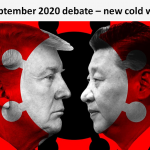
The Sylvan new cold war debate considered the following motion:
This house believes that the deterioration in relations between the West and China will lead to a new ‘cold war’.
The debate took place on Monday, 7th September, with Tony Czarnecki as the proposer and David Kerry as the opposer.
The proposition supporting the view that there is a new cold war
The proposer provided a contextual backdrop for the debate by discussing China’s long-term geopolitical strategy, arguing that they aim to subjugate other countries. Actions taken including the Belt and Road Initiative and state-owned champion firms have been to gain advantage during a second cold war. China’s AI capabilities are as strong if not stronger than those of the US, which could be used for a cyber war. However, he argued that an ‘immature superintelligence’ could actually be a bigger threat to the world than China.
The opposition against the motion
The opposer outlined the original cold war as a definition for the debate. He then clearly argued that the current interactions between China and the West are simply ‘business as usual’ (BAU) capitalism. There are key differences from what Russia aimed to do, which was heavily influence other countries including up to regime change, which China avowedly will not countenance, with the exception of former territories.
He discussed a number of today’s political currents. Trump’s bombastic foreign policy, the likelihood of a no-deal Brexit and the response to Covid across the globe. Cold war theories can easily create fear. But he argued that in reality, a cold war is the BAU of the society the world has become. The West has an opportunity to learn from our history and respond to what China is doing – there doesn’t need to be a cold war.
Floor speeches from the audience of the new cold war debate
Floor speeches as usual examined the topic from a huge variety of angles. The changing of the global top dog frequently leads to armed conflict. A number of speakers shared significant fears as to China’s intentions. The foreign policy approaches of the two sides were likened to chess (the West) and the game of Go (China). This could range from China aiming to bring other countries ‘back’ into its orbit, to encircling and strangling them.
In the old cold war there was much less trade between the two sides, both of which aimed to destroy each other. On the other hand, China’s economy is now symbiotic with the West. However, today the West is far less unanimous as in the past, with the EU conflicted and the UK bouncing like a tennis ball! A significant current pointed out that China is far from capitalistic and centrally directs its actions.
Result: in the final vote, the motion carried
The Sylvans concluded through the new cold war debate that indeed, relations between the West and China will become a new ‘cold war’.
See information on other Sylvan debates here!