
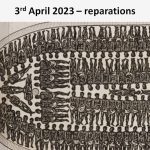
The Sylvan reparations debate considered the following motion:
The West should pay reparations to the descendants of slaves.
The debate took place on Monday, 3rd April. Mohid Malik proposed the motion and Firas Modad opposed it.
The proposition arguing that we should pay reparations
The proposer framed the debate as a normative question, not about practicalities – should the West pay a debt owed due to slavery? In the 20th century the concept of reparations arose, to recognise and compensate for a crime (not just monetarily). This is about international reparations, not for a country to pay its own citizens. This is not about pointing fingers or guilt or self pity – this is about what we inherit. We shouldn’t make the best the enemy of the good by doing nothing. We cannot amend what happened, with millions of Africans taken on slave ships.
The UK had 4,000 slave-owning families at abolition in 1833, and we gave 5% of GDP to compensate them. An injustice, the payment equals £105 billion today. We cannot separate present day riches from today’s poverty – yet we claim the successes, always. The gains from trade based on slavery still drives our prosperity today. Britain operates under a system of modern capitalism. We have ‘Levelling Up’ policies today to support the North – underprivileged groups sometimes need support to flourish.
The opposition against the reparations debate motion
The opposer called slavery a cruel, horrendous crime, yet not an exceptional one. Slavery has endured forever, abolition is the exception. The Vietnamese and Chinese enslaved each other, the Mongols under Ghengis Khan, Turkey capturing Europeans – the list goes on. Why should Europeans pay for slavery? What about the other regions and countries? The Royal Navy lost 1,600 sailors to stop the slave trade. We will talk about the practicalities of reparations. There are 40 million slaves today globally, 30 million in Africa. What about the earlier African slavers who sold their countrymen? How can we distinguish the descendants of slaves and slavers? Western psychology has a Christian legacy, with a longing for original sin. We appease the spirit by finding ourselves guilty. Practicalities make reparations challenging. The UK had to pay slave owners to stop the trade. Our foreign aid represents a form of reparations. Where does this stop?
Floor speakers explored the topic from a wide range of perspectives. The effect of slavery carries on for generations, for example Blacks in the US after the Civil War. Wealth gives opportunity, and Blacks don’t have wealth. No guilt personally for what happened, and we have to talk about the practicalities. Large payments, pricing a life – I can’t imagine it. We can’t pay to get rid of guilt. Yet listen to the defences – Shaggy’s ‘it wasn’t me’, and there’s no right to take my cash. We (Blacks) don’t want cash. The UN defines reparations much more broadly, including four additional categories: non repetition, rehabilitation, truth seeking and memorialisation.
Floor speeches continued
Slavery predated the Transatlantic trade, some groups sit outside the scope of this debate. This looks at the whole argument through white history – racial identity is a social construct. The Netherlands apologised for its role in slavery, and set up a €200 million fund for education. The UK blocked a UN resolution on this due to legal ramifications. The slippery slope argument should not apply, this questions centres on whether we ought to make reparations. With more wealth and power comes responsibility – not a zero-sum game. Not until George Floyd could we discuss race easily. Politicians promise to do things then forget minorities. People fear the cost of large amounts of cash, yet with Jamaica we relieved debt and removed visa restrictions. Critical to restore dignity.
Black Lives Matter and we owe today’s prosperity in part to slavery. The slave owners should pay, coal miners should not have to pay. We need to make an effort. The passage of time does not reduce the moral question of whether we should compensate in some way. How can we identify whom to compensate? We need to start by apologising for it.
The opposer’s rebuttal
In rebuttal, the opposer emphatically stated that we should not pay a single penny! Neither I nor my son did this, six or seven generations later – a form of racial guilt. Structural racism is nonsense, no law has racism embedded in it, all positions are open to all backgrounds. Certain minorities earn more than whites on average. Reports by ‘the woke’ do not have validity. On non-monetary reparations, Tony Blair apologised for slavery. Racism exists, yet I don’t believe the UK has structural racism. This would impose guilt by descent, and many innocent descendants would have to pay.
The proposer’s closing speech
In closing, the proposer pointed out that we can certainly talk about other instances of slavery. ‘We all suck’ – slavery has existed forever. Yet transatlantic slavery went beyond anything else. Societies with slaves differ from slave societies. I take ownership of this problem and accept the good and bad, and the beauty in all of it. We aid Ukraine as well as bailed out the banks, we can find the money. Reparations need broadening. Haiti first abolished slavery in a revolt against the French, and had to pay reparations of £21 billion to France.
Result: the reparations debate motion carried
The Sylvans concluded through the reparations debate that we should pay reparations to the descendants of slaves.
See information on other Sylvan debates here.