
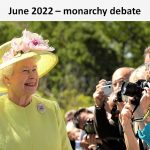
The Sylvan monarchy debate considered the following motion:
After Queen Elizabeth’s long reign of service, the monarchy will remain our best form of government.
The debate took place on Monday, 6th June. Peter Hulme-Cross proposed the motion and Mike Douse opposed it.
The proposition supporting the monarchy
The proposer argued that the monarchy brings out the best in people and inspires them. For instance Princess Diana and HIV patients. The military loves the monarchy. After Diana’s death the people wanted a response from the Queen. In the pandemic she also spoke (‘we will meet again’) – only a monarch can do that. The Queen listens, advises and warns the PM at weekly audiences. The monarchy means no coup d’etat can happen here.
Without a monarchy, we’d need to have an elected president, bringing politics into play. The person would need to be well-known, likely an ex-PM. Does anyone want a President Blair or Cameron? Politics would intervene. Presidents tend to extend their terms in office, such as Putin and Xi. We must be cautious in changing this 1,000 year old-institution. After Cromwell the people wanted the monarchy back. It represents stability, continuity and impartiality. Tourists from across the world love it. Strong links with the Commonwealth of 54 nations, voluntarily belonging to it. It costs £67m per year, or about a cup of tea per person, good value.
The opposition against the monarchy debate motion
The opposer pointed out that the motion centres on the monarchy as a form of government, not tourism. Everyone loved the Platinum Jubilee weekend, yet it could have been a long goodbye to a fading era. Is the monarchy the right way to continue? An unelected, ceremonial monarchy cannot do some things. Elected heads of states can provide an impartial check on the powers of the government, mighty important in a democracy. Such as referring matters to the Supreme Court. The current PM breaks laws and wages war on the civil service, yet we have no voice to check an elected dictatorship. Does the Queen lead Boris to be at his best? The Queen has approved laws protecting her own wealth.
There is no risk of us getting an elected Putin or Xi. Look at Ireland and their wonderful, suitable presidents. EU presidents protect their constitutions. The monarchy does not fully represent the nation, and an unelected Queen must follow her PM. We strive for democracy, yet heredity signifies inequality – we need to free ourselves from a national Stockholm syndrome. We don’t trust heredity in the professions and nor should we in government.
Floor speeches from the audience of the monarchy debate
Floor speakers ranged widely on this topic. A number echoed the point about privilege, with 1% of the population controlling a huge proportion of the wealth. This debate could not happen in Parliament, as MPs have to swear allegiance to the monarch. Changing the head of state would require a new, consciously-developed constitution. Several speakers extolled her public service, moral authority and embodiment of the country, contrasting with dishonest politicians. However there is no guarantee her descendants will be as perfect. The monarchy is more political than we know, represents colonialism and underpins the PM’s patronage (honours) system.
Different models, not just an elected president, could replace the monarchy. The monarchy’s land ownership increases its cost significantly. Past PMs would love the role of elected president. Royal Assent and Royal Prerogatives provide significant power to the PM through the Queen. Yet any new system would have challenges also. The UK populace in general enjoys tremendous privilege living in such stable constitutional democracy. The ‘magical’ monarchy also leads the Anglican church.
The opposer’s rebuttal in the monarchy debate
In rebuttal, the opposer pointed out that there will be an upheaval with Charles becoming king. The Queen cannot do anything if politicians misbehave. While ex-PMs don’t inspire, someone like David Attenborough could represent an excellent candidate for an elected president. I would vote for the Queen as some have mentioned. We’ve had a good constitutional monarchy, but it simply isn’t the best system going forward.
The proposer’s closing speech
In closing, the proposer argued that while Charles might not measure up, he has had greater preparation than any other future monarch. We could have had Edward VIII, Margaret or Andrew, and we can always say this. Yet the office is greater than the occupant, Charles will fit in. We currently suffer from the failures of elected government, with a lower calibre of MPs than in the past. The opposition party must hold the government to account. We exist under a monarchy with an independent judiciary, freedom of speech and property rights. But we must keep the Queen and 1,000 years of continuous history.
Result: in the final vote, the monarchy debate motion did not carry
The Sylvans concluded through the monarchy debate that the UK the monarchy will not remain our best form of government after the long reign of service of Queen Elizabeth.
See information on other Sylvan debates here.