
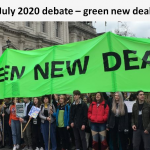
The Sylvan green new deal debate considered the following motion:
This house believes a ‘Green New Deal’ is required to re-start the British economy post the pandemic.
The debate took place on Monday, 6th July 2020. Ewan McGaughey proposed the motion and Ina Negoita opposed it.
The proposition supporting the view that the UK needs a Green New Deal
The proposer cited the impact of the pandemic – leading to high unemployment – and the current climate emergency as key reasons to invest now in a jobs-saving, climate-cooling green new deal. A new deal was defined in reference to the American New Deal of the 1930s. The cost of renewable energy is lower than fossil fuels, and £600 billion of investments announced by the UK government could be used to de-carbonise. Now is the time to do it, when it can be done more cheaply. The world can be a much better place, with less traffic noise, no plastic bags, improved nature and cleaner air.
The opposition against the motion
The opposer strongly argued that the UK does not need to copy an American slogan or ideology, but rather a more ‘moral’ approach. She identified the Green New Deal as a left-wing UK organisation founded in 2008 with a ‘socialist agenda’. She attacked the proposer’s apparent lack of a practical plan to implement green investments, and likened it to a ‘Corbynist fantasy’. Are we prepared to pay more for greener energy and transport? Are we willing to pay more for UK-produced goods? She urged individual, moral action for change to support the climate.
Floor speeches from the audience of the green new deal debate
A number of floor speeches wrestled with the different definitions of a green new deal put forth by the two main speakers, though towards the end of the debate it had settled with a more general definition rather than that of the left-wing Green New Deal organisation. Several speakers extolled the benefits of renewable energy, though also questioned the efficacy of a significant green investment shift. Cliches were attacked and there was a thread of discussion on whether green actions needed to come from the grass roots or from a top-down government push. A number of discussions took place on how green energy can replace today’s fossil fuels. Investment in home insulation was supported, as economists believe it is the highest return-on-investment green spending (a plan for which was announced by the government the next day). Several speakers argued that green investments should not be a matter for left versus right politics but rather a matter for broad support.
Result: in the final vote, the green new deal debate motion passed
The Sylvans concluded through the debate that the UK economy needs a green new deal to re-start post the pandemic.
See information on other Sylvan debates here.