
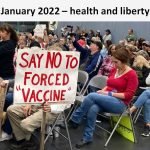
The Sylvan health and liberty debate considered the following motion:
This house believes that public health-related pandemic responses are justified in restricting personal liberties.
The debate took place on Monday, 10th. John Akers proposed the motion and Dr Claire Brash opposed it.
The proposition supporting restrictions on liberty during a pandemic
The proposer contrasted the right to liberty with the alternative of autocracy. Yet liberty has limits – for instance, no drink driving and the requirement for seatbelts. Yet are these restrictions on liberty or simply social rules? Fundamental liberties rest on a society with interconnections between human beings, where wants and desires impinge on those of others. The State alone can resolve these disputes.
In the past, if one succumbed to a disease it would lead to quarantine. The plague era had social distancing and the closure of taverns after 9pm. States have a duty to protect human life, and balance that with liberty. Many face risks due to Covid-19, and we need to protect them. Without liberty we would be at the mercy of tyrannical governments, yet we must work so that as few people are infected as possible.
The opposition against the motion
The opposer faced a tricky argument as a junior doctor. We need to elect a government and interact with others. Yet the current government cannot hold the status quo together, and there is a cost of not associating with others. Having an internal motivation for vaccination versus that being forced by the government is very different. Covid has moved to an endemic phase with the Omicron variant, which means a lower threat level. The flu, another endemic virus, can kill 25,000 per year.
The government has asked us to give up some liberties to secure peace and health. Yet they betrayed the NHS through a lack of PPE, and wasted money on the Test and Trace system. Still they had to put lockdowns in place. From the individual perspective, if they don’t feel safe they can shield voluntarily. Health education could achieve much of the same, whereas people rebel against rules. Refusing the vaccine causes passive harm.
The requirement for healthcare workers to take vaccines has cost the NHS 40,000 care workers. Replacement workers cost £2,500 each to recruit. Covid measures have been fast tracked ahead of addressing other harms. The mental and social health effects of the measures has had a big negative impact. We need to weigh jumping into restrictions hesitantly. Internal motivation trumps paternalistic enforcement!
Floor speeches from the audience of the health and liberty debate
Floor speakers addressed the topic from a variety of angles. Some clearly argued that the current government’s incompetence has no relevance for this debate. A number felt that today’s restrictions strike the right balance between health and liberty. The current Covid situation has improved, making the opposer’s arguments more relevant, yet that wouldn’t have held in March 2020. The Swedish approach would not have worked here. Several speakers pointed out that the government has not led by example.
Covid is a social disease and humans cannot control their behaviour in a way to avoid spreading it. The social and emotional impacts of the restrictions came up frequently. The whole country should not suffer to protect the oldsters! Many speakers supported balanced restrictions necessary to prevent the harm of others. Yet some restrictions have subjective bases, such as mask wearing. Businesses need clarity on rules. A limited number of speakers opposed restrictions on libertarian grounds. Will the government give its new powers back?
The opposer’s rebuttal in the health and liberty debate
In rebuttal, the opposer pointed out that practice and not just principles is important. Government action will protect people, but do they have the capacity to do this effectively? How do we measure the broader well-being including mental health and education impacts? The motion is broad, but the current pandemic is the most relevant. Should we have mandatory public health treatments, and how do we scale back government control? We can’t control freedom of harm from others, yet we can control individual actions. Common sense isn’t universal, but fines do work in the short term. We have the right not to be vaccinated. We should view health as a responsibility and hold ourselves to a higher standard.
The proposer’s closing speech
In closing, the proposer agreed the government has not led by example. Plebs would not have had the same leniency. Lockdowns cause significant damage, yet were presented as a way to save the NHS rather than save lives. Regulation leads people to take restrictions seriously. The motion can come down to a single case – if someone has Covid, should they have their freedoms restricted?
Result: in the final vote, the health and liberty debate motion carried
The Sylvans concluded through the health and liberty debate that restrictions on personal liberties are justified in the face of a pandemic.
See information on other Sylvan debates here.