
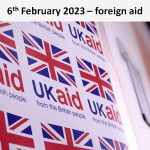
The Sylvan foreign aid debate considered the following motion:
This house believes the UK should further reduce foreign aid.
The debate took place on Monday, 6th February. Elaine McLean proposed the motion and Victoria Griffiths opposed it.
The proposition arguing to further reduce foreign aid
The proposer opened by pointing out that only four countries have given 0.7% of GDP in foreign aid – mainly Scandinavian. Do the donor countries actually benefit from the aid? I support aid in general. The third world depends on aid too much. Aid comprises humanitarian aid, financial aid, as well as military aid. The war in Ukraine – we would send tents if it were about people, not oil. Repatriation isn’t aid, it’s a debt we owe. Natural disasters clearly require aid. Do we provide fish, or teach a person how to fish? Aid comes with significant waste, and often twists the arms of recipient countries politically.
The UK’s economy has slipped to sixth place globally. The current situation means that many people need to use food banks. The cost of living has gone up the most since 1966. Our schools do not have proper funding, people wait to get hospital treatment, workers go on strike. We need infrastructure investment at home as well. If we cut aid, are we still ‘Great’ Britain? A stranger helped me when I needed it. Yet our aid aims to get what we want out of recipient governments. We need aid here, we have significant debts.
The opposition against the foreign aid debate motion
The opposer outlined the key sources of foreign aid, the largest part driven by central government PAYE taxation revenues. Foreign aid isn’t charity, but investment. We need to consider our position in the world – we had a global pandemic, and others need aid more. We would need to cut existing contracts that countries rely on. In the 1970s we gave 0.4% of GNI (gross national income). We do have a cost of living crisis, yet this pint sitting next to me, consumed weekly, represents less than 0.7% of average income. The then Chancellor Sunak cut the aid budget to 0.5% to cope with the overall budget situation. The USA gives only 0.18% of GDP, yet give the largest amount. Going below 0.5%, would that be down to 0.3%?
The opposition continued
Humanitarian assistance makes up 15% of our foreign aid. The bulk goes on preventing refugees from arriving here. We fund the Ukraine war. The Carter Center’s education programme about the guinea worm has reduced infections from 315m to 27m people globally. As a result, these people can now contribute to the world economy. David Cameron sent £300m to the Caribbean for infrastructure (including a prison), and British contractors delivered it. Aid strengthens our security. Ukraine and the threat of Russia, and stabilising governments in Africa. To reduce corruption, we need to put aid in the right places. We still give aid to Pakistan and China, but less – and China will fill any aid vacuum. While this argument is a hard sell to people who are struggling, we will be even more vulnerable if we cut aid. It should be higher than 0.5%, and the cuts have slashed its impact.
Floor speakers discussed the topic from a variety of perspectives. We colonised the world, driving a moral obligation for us to give aid. There could be a variable limit on aid depending on the economy. We need to help our own first, but what about £56bn on the military relative to £11bn of aid? Aid represents a key source of the UK’s soft power, our approach differs from the American one. We get a net gain on aid. Yet one speaker questioned whether giving aid at all is sensible – it’s difficult to work out how to spend it. If we looked at this in the way a merchant bank would do, we could get a return on our aid.
Floor speeches continued
We do spend more now than during the 1970s, and the OECD averages 0.4% – scope to reduce. Aid has two inherent moral hazards: corrupt recipient governments going along with donor conditions, and UK politicians having the ability to grandstand. Our aid should be more about the recipients and less about us. This debate has not centred on the moral imperative – we have few AIDS deaths here, but look at sub-Saharan Africa. We cut £400m from our AIDS aid budget, a big impact. Aid should be left in the hands of individuals rather than the State.
Tremendous opportunities exist to help people, foreign aid is loving. Cataract surgeries in Pakistan costing $50 can make people far more economically active. We should give fish when disasters strike, and teach fishing at other times.
The opposer’s rebuttal
In rebuttal, the opposer shared that personally she does not think we should give aid, yet lots of people suffer. We have a moral obligation and economic reasons. We need to teach fishing, as well as how to sell fish – trade enhances security. No need for arbitrary targets, perhaps we could not have a target, yet then we may not bother. Voters can hold governments to account on aid through elections. Human beings want to help, and the 0.2% cut had a big impact, such as on AIDS. We should help people and be a good country.
The proposer’s closing speech
In closing, the proposer pointed out that she didn’t say we should end aid. The aid needs to benefit the recipients, but too often doesn’t – this should lead to less aid. AIDS, a huge issue. How we give aid matters. The UK raped countries in the past – women and minerals. Yet in Africa some people have yachts.
Result: the foreign aid debate motion did not carry
The Sylvans concluded through the foreign aid debate that we should not cut foreign aid further.
See information on other Sylvan debates here.