
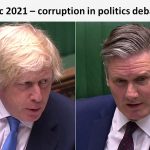
The Sylvan corruption in politics debate considered the following motion:
This house believes that the UK’s political system is morally bankrupt.
The debate took place on Monday, 6th December. David Kerry proposed the motion and Adam Smith opposed it.
The proposition supporting the view that the UK’s system is morally bankrupt
The proposer began by stating that UK citizens increasingly view people in Parliament as corrupt. In defining the terms of the motion, morality means right or wrong behaviour. Morally bankrupt means that a political party moves away from the moral values they claim to follow. Or when someone trades away too many moral values. Yet while the UK Parliament is the mother of all parliaments, there has been a long history of issues. Rotten boroughs, David Lloyd George selling peerages, the list goes on. More recently we’ve seen the Owen Patterson resignation and Jacob Rees-Mogg’s £6m loan to himself. Sir Geoffrey Cox lobbying on behalf of the British Virgin Islands.
The system has allowed for this for donkey’s years. The promotion path for MPs allows for lucrative second jobs, and the honours system. In 2019 Boris Johnson prorogued Parliament and Jacob Rees-Mogg lied to the Queen about it. Boris now says ministers can ignore court decisions. The system is so loose and undefined that it enables all of this to happen. Overall, it falls well short of the moral and ethical standards befitting the mother of all parliaments.
The opposition against the motion
The opposer strongly argued that the system is all run by individuals. There are many parties, with independents serving in the Lords and local councils. Yet several features of the system ensure we’re not morally bankrupt. We can access information about corruption in the media, where the UK ranks 33rd in press freedom. This allows challenge and scrutiny. The opposition can raise it at PM’s Questions, just as Keir Starmer did. Our corruption ranking stands at 11th in the world, alongside Canada, Australia and Hong Kong, and higher than the US.
The Lords includes Lords Spiritual and Law Lords for added perspective. And we can replace the Commons regularly. If Boris is too corrupt, we can vote for another MP or party. Every politician is amoral, as they need to serve their constituents. The Parliamentary Standards Committee goes after vested interests. Our system is better than Africa and China – we have checks and balances.
Floor speeches from the audience of the corruption in politics debate
Floor speakers ranged well beyond the opening speeches. Every organisation has problems, and the public think many MPs are corrupt. Westminster now employs sniffer dogs to root out cocaine use. This issue reflects broader society, and has the potential to lead to uprisings. Actions such as Tories buying peerages for £3m each do not affect governance overall. Other countries have far greater corruption, though difficult to compare with places like Africa.
A few speakers pointed out that a system cannot be morally bankrupt or corrupt, only the individuals within it. However, several others pushed back and argued that the system is made up of the legal framework and individuals within it. Several argued that while the system faces significant issues, it functions effectively. Meritocracy has declined, and unwelcome behaviours can take root strongly over the long term. London’s status as the money laundering capital of the world does not bode well. A few speakers pointed out that elections do not work particularly well in holding politicians to account. Voters stay tribal and continue to back the main parties.
Some defended the UK’s political system as ‘the best in the world’. Select committees scrutinise each decision. Yet the unelected Lords and unwritten constitution leave plenty of room for shenanigans. Of course Boris is morally bankrupt, and the Lib Dems lied about tuition fees.
The opposer’s rebuttal in the corruption in politics debate
In rebuttal, the opposer echoed the positive views of speakers that supported the UK’s political system. A system cannot have values. He cited Plato’s view that democracy inherently leads to corruption. The Queen rules, and her reputation precedes her. Our system comprises a mix of elected and unelected, via the Queen.
The proposer’s closing speech
In closing, the proposer acknowledged that elections do not guarantee moral probity. Yet the system of 5-yearly elections allows politicians to get away with a lot, and does not protect individuals. He wouldn’t rely on a free press forever and a day. We don’t have enough checks and balances. People run the system and it has allowed corruption. You can’t divorce the system from the people within it. It enables manipulation, buying votes and the reward / punishment system, which is there to be abused. A corrupt government won’t take notice of the people, and the system allows them to do this.
Result: in the final vote, the corruption in politics debate motion carried
The Sylvans concluded through the corruption in politics debate in a very close vote that the UK’s political system is morally bankrupt.
See information on other Sylvan debates here.