
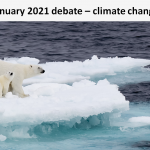
The Sylvan climate change debate considered the following motion:
This house believes that the UK will achieve its new 2030 climate change targets.
The debate took place on Monday, 4th January. Ross Hunter proposed the motion and David Kerry opposed it.
The proposition supporting the view that the UK will achieve its 2030 climate change targets
The proposer set out a positive vision for the UK’s ability to reduce its carbon emissions. The debate is not about the government’s flashy and minimally funded proposal. Rather rather whether or not the country will reduce emissions to the required level. The Sylvans need to take out their crystal balls and predict the future. The UK has already reduced emissions by 43% on 1990 levels. Beyond that, it needs to achieve an additional 25% against that baseline. The proposer set out a scenario that would rely on a 1/3 cut in transport emissions based on electric vehicles, a 1/4 cut in residential from hydrogen, insulation and heat pumps and a 2/3 cut in electricity generation via wind power.
The benefits of electric cars are huge and consumers have already started to take them up. We can manage manufacturing and charging issues. Residential improvements require significant government incentive schemes and for homeowners to take them up. Wind power costs have declined massively, meaning that firms have major economic incentives to invest in them. Excess power will be used to manufacture green hydrogen. Wind power has doubled roughly in the past 5 years, and would only need to double again to 2030.
It is difficult to imagine what technology will be available in ten years’ time. Think back to ten years ago, when smart phones were rare and coal was the UK’s main energy source. Achieving the 2030 targets does not require major government investment or shifts in behaviour for most other than a proportion of homeowners. (Though 2040 and 2050 targets will be much harder to achieve.) The crystal balls need to look beyond the cynicism about today’s government.
The opposition against the motion
The opposer viewed the government’s climate proposals as exciting on paper, but that they will not happen by 2030. Fully one wind turbine per day would need to be erected for 9 years to achieve the targets. The UK cannot currently produce hydrogen. The government will struggle to get new nuclear plants going. What is the impact of producing electric vehicles on workers in gigafactories and miners in developing countries? Public transport needs to be a much bigger part of the equation not cars. Air travel will not be green by 2030.
Greener buildings are required if we are to hit complete decarbonisation by 2050. Heat pumps would need to be installed at a rate of 19k per week. While the UK could become a world leader in a few things, the challenge for achieving net-zero carbon emissions by 2050 is personal behaviour. The easy wins are taken, and decarbonising homes will require significant shifts including behaviour change.
Floor speeches from the audience of the climate change debate
Floor speakers took a variety of positions with wide-ranging perspectives, as usual. Some believed the 2030 targets were in fact too easy, and that the period to 2050 will require the tougher efforts. On the other hand, the easy bit has already been done, which is removing coal, and we have shifted manufacturing emissions to China. SUVs and leafblowers – unnecessary consumerist emissions. Moreover, a number of speakers cited personal responsibility and related behaviour change as the key driver of whether the UK will succeed, with a healthy dose of scepticism. What labour force will install all the changes required for homes? Builders are retiring rapidly and younger people won’t do the work.
Several speakers pointed out the relative immateriality of UK emissions next to the global climate change crisis, though in response speakers raised the question that if we can’t do it, who can? A few speakers shared their scepticism about whether EVs will be practical and taken up by consumers, and the variability of wind power. Others bashed Boris Johnson’s record of overpromising and underdelivering.
Result: in the final vote, the climate change debate motion did not pass
The Sylvans concluded through the climate change debate that the UK will not achieve its new 2030 climate change targets.
See information on other Sylvan debates here.