
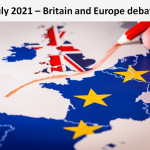
The Sylvan Britain and Europe debate considered the following motion:
This house believes Britain will continue to be a European nation.
The debate took place on Monday, 5th July. Adam Smith proposed the motion and Faiza Javad opposed it.
The proposition supporting the view that Britain will continue to be a European nation
The proposer outlined the strong geographical, cultural and historical roots of Britain in Europe to support the motion. How long have we been attached to Europe? We have a land border, and the Eurotunnel connection. While we have left the EU, we still trade more with them than any other economy. As we speak our nations play in the Euro football tournament. In many ways Britain has been European since the Norman conquest in 1066. Our royal family has strong European roots. The Vikings raided us, the Romans ruled much of Britain. In the Brexit referendum younger and more educated people supported staying in the EU.
The opposition against the motion
The opposer considered social, economic, cultural and political considerations as the key drivers of European-ness. While geographically we are part of the continent of Europe, the UK has been detached from the EU as an ‘awkward partner’. A nation is an individual country with its own social and political structure. If we withdraw from the EU, we don’t want to be a part of it. Identity, sovereignty and English nationalism shaped the Brexit referendum result. While many Brexit supporters thought EU policies would end and it would lead to freer trade, social and cultural issues had a stronger sway. Immigration and taking control of borders. Those with less education had a fear of being left behind.
Floor speeches from the audience of the Britain and Europe debate
Floor speakers shared their views on Britain and Europe in-depth in a wide-ranging discussion. Some Europhiles shared the strong contributions Britain has made to Europe, both as part of the EU as well as in major events such as the Napoleonic and world wars. Several pointed out that Britain is not one nation but a country with several nations within it, though many European nations have this feature. Indeed, several speakers argued that Britain has never been and will never be a European nation. Henry VIII’s break with the Pope was the original Brexit.
We can only judge Brexit 5-10 years post, yet Britain will have a weaker position at the international tables. Boris can blame the short-term impacts of Brexit on Covid. Stepping back from a more global perspective, Britain is culturally more like European nations when placed next to, for instance, Asian cultures. We share cultural aspects with America which imported them from here. However, in the grand scheme of things British culture represents one form of European culture.
The opposer’s rebuttal in the Britain and Europe debate
In rebuttal, the opposer strongly reiterated that through the Brexit referendum, Britain defined ourselves as different. We should make decisions locally, and foreign regulatory bodies should not have sway. Britain never considered itself European, and never will.
The proposer’s closing speech
In closing, the proposer pointed out that actions speak louder than words. While Henry VIII took us out of Rome, the Church of England took much from Martin Luther. While we went to war with European powers, we also had strong alliances. European nations have changed their guise over time, and many sit off the continent (Nordics, eastern states). Britain has helped to define Europe over the ages.
Result: in the final vote, the Britain and Europe debate motion did not carry
The Sylvans concluded through the Britain and Europe debate that Britain will not continue to be a European nation.
See information on other Sylvan debates here.