
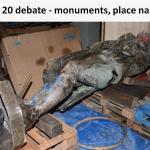
The Sylvan monuments and place names debate considered the following motion:
This house believes that the country’s monuments and place names should be changed to reflect modern British society and not its past.
The debate was held on Monday, 3rd August 2020. It was proposed by Lissi Corfield and opposed by Tony Koutsoumbos.
The proposition supporting changing monuments and place names
The proposer drew us back to much earlier times in Britain, when the statues of the retreating Roman Empire were knocked down. Importantly, this did not destroy history but reflected the political climate of the time. She linked this to an argument that the past should not dictate to the present. Similarly the city of Stalingrad was renamed multiple times and the Jimmy Savile statue was removed in 2011.
The Edward Colston statue in Bristol, now a symbol of the slave trade, was toppled unlawfully, but there is no movement to reinstate the statue, and the action did not have a domino effect on other statues. It will resurface in a museum, where his story will be told in the context of his time. In the end she clearly recommended that robust local democracy should manage the country’s monuments and that new ones can go up, as well as some old ones can come down.
The opposition against changing monuments and place names
The opposer began with a comparison linking the UK’s monuments to other countries’ relics, in particular the Elgin Marbles. Britain’s monuments are its history, and remind us of who we are – how would it feel for the Churchill statue to be in a foreign museum? And on modern British monuments, a number have had a consensus supporting their removal, but what about the disputed ones? In Britain, statues are typically put up by private citizens coming together, with the State approving based on criteria about the quality of the monument itself.
The question is who should approve monuments and who would decide whether they should be taken down? It could be a quango, a mob or public ‘consensus’. A quango would be bureaucratic and inefficient, while consensus could be tricky if people do not agree. He referenced the dictum ‘you don’t know what you’ve got until it’s gone’, citing Greece and Hagia Sophia as examples.
Floor speeches from the audience on a range of topics
Floor speeches shared a wide range of perspectives. Churchill’s record was much discussed, including views that he was a white supremacist and ‘monster’ as well as his strong record in leading the country through the war. Indeed Gandhi and others’ records were similarly scrutinised.
A number of speakers raised the spectre of slippery slopes, and how far the changes should go. The placing of monuments into historical context, either via plaques or putting them into museums, was supported by a number of speakers. The quality of history teaching in the country was strongly questioned.
Result: in the final vote, the motion carried
The Sylvans concluded through the monuments and place name debate that the country’s statues should reflect modern British society and not its past.