
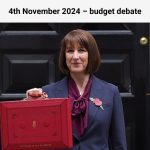
The Sylvan budget debate considered the following motion:
This house believes the budget set the right priorities.
The debate took place on Monday 7th October. Ross Hunter proposed the motion and Robbie Grant opposed it.
The proposition arguing that the budget set the right priorities
The proposer opened by saying it is good to have a debate about the economy, as a trained economist – yet it is known as the dismal science. In any case, we get to talk about pie: whether the budget decisions will grow it and how they redistribute it. The motion includes ‘setting priorities’, which means making choices given constraints. For what or whom does the budget set them? For the whole country, all people. We can tax King Charles at 1 million per cent, but we shouldn’t if it shrinks the overall pie due to lower tourism income. We have poverty in this country, people who aren’t getting medical and social care. Change will lead to winners and losers. Growth is critical, we will be poorer without it and won’t be able to afford the public services we would like.
Our focus today needs to be on the economy and social matters. While the budget has political elements, if the budget centres on politics, we will all lose. Unfortunately, the British economy is very weak. We coast on ancient infrastructure, with vast under investment in general and the lowest in the G7, worse than Italy. The Industrial Revolution and the Empire fuelled economic growth, after which the financial sector led to boom and bust. We had the own goal of Brexit and then the impact of covid and the Ukraine war, exposing our weaknesses in health and energy.
The proposer continued
This led to extremely difficult choices in the budget. Rachel Reeves set the primary objective to deliver growth, which is the right priority but difficult to achieve. She also loosened fiscal rules to boost investment, another necessary step, though limited. Building tunnels to Euston station to avoid HS2 terminating in West London, a small bore investment. Borrowing will increase then trend toward a balanced budget, delivering fiscal stability, also critical. However, the £40 billion tax rise (2% of GDP) will hurt businesses and increase interest rates. While most individuals do not face immediate tax increases, they will face lower wage growth and dearer mortgages. However, there are targeted taxes on the wealthy. Capital gains, carried interest, non doms and inheritance tax.
Labour will spend money to keep the public services from disintegrating. £25 billion in new funding for the NHS will unblock some waiting lists and provide some modernisation – more of a patch than investment for a service on its knees. Education receives a material boost, investing in the future. Social carers get an increased allowance. All of this is a reaction to the Conservatives shrinking state to near breaking point, and keeping social services from disintegrating. However, focusing on growth and investment in a very difficult context set the right priorities.
The opposition against the budget debate motion
The opposer opened by pointing to the ‘upside down’ priorities of the budget. We have awful public finances and a lack of investment, and the Tories didn’t do a good job. They supposedly prioritised workers over the international rich. We need green tech and growth over austerity. However, the small print of this budget sets it against growth. The National insurance increase will hurt wage earners. Government borrowing will crowd out the private sector, with increases in tax on carry and stamp duty along with public sector pay rises, with no commitment to reform. We will have more and more debt, £400 billion next year alone, saddling future generations. Very low growth, downgraded by the OBR, and only token investments. Front loading spending is a mistake that will lead to austerity in later years.
The Institute for Fiscal Studies found a lack of strategy and lower per capita growth. We need to understand the implicit priorities of the budget. Reeves blamed this on the ‘toxic legacy’ of the Tories. Productivity is weak. James Callaghan had the idea for the National Wealth Fund in 1964, and we have Red Ed Miliband (sovereign energy) in the cabinet. Strikes have restarted after inflation-busting pay rises in the past. VAT on private schools will cripple the schools forced to privatise (Anthony Crosland).
The opposer continued
We see history repeating itself with a 1960s and 70s dash for growth with government steering investments. Yet Rachel Reeves sold the budget to the City as having stability, prudence, productivity and investment at its core. Labour have left little wiggle room in their forecasts. The impact will actually fall exclusively on working people and small businesses, and barely affect large corporates.
They have targeted agriculture and business property relief. £1 million is not a big number in farming, individual pieces of equipment can easily be hundreds of thousands. The median farm has £3 million in assets and £16,000 in income. A big proportion of farmers will face the tax, up to 70%. The private equity industry will buy up all the land. The super rich have trusts to shield them. This budget prioritises the FTSE 100 over small enterprises and gold-plated public sector pensions over our own individual direct contributions. A postscript: the military doesn’t get enough with the threat of Russia facing us.
Floor speeches from the audience of the budget debate
Floor speakers attending the budget debate considered the topic from a wide range of viewpoints. Businesses produce the wealth in an economy, and they now face a record tax. Governments can’t invest to produce growth. Should we pour money into the crumbling NHS? We have huge subsidies for farmers. The national debt stands at over 100% of GDP. We can’t send the bailiffs into the NHS, we don’t have a fail safe.
We need a Ming vase strategy – carry it carefully. Yet we have 9 million adults not in work, we need to reform the NHS, we need to hold the government to account. The budget taxes the aspirational middle class. It takes us away from the ownership society. The budget represents typical Labour socialist tax and spend ideology. You can’t tax your way to growth. The UK does not have a good record of borrowing to invest. A flashback to 1976 and Denis Healey – tax the rich with led to an IMF bailout.
Floor speeches continued
We have heard unsubtle arguments about only the private sector creating growth, yet we need intelligent thoughts on other priorities and practical ideas. Public spending does trigger a step change, e.g. with the Asian Tiger economies. Government investment in infrastructure crowds in the private sector. The OBR takes an objectively tough, conservative approach, it could end up better than forecast.
The NHS has major problems and we need to simplify it. Austerity had a worse own-goal impact than Brexit. This budget sustains liberal democracy. The growth myth leads to inequality and helps the top 1%. We don’t want to fall into the German trap of under investment, with terrible infrastructure and bureaucracy. The government manages the economy, and will displease half the country. Private investment failed with Thames Water and the railways. We should have a financial transaction tax to fund public services. The priorities of the budget do not need to be effective for the proposition to win.
The opposer’s rebuttal in the budget debate
The opposer robustly rejected that a growth aspiration is sufficient, no! That is happiness and apple pie. The argument is about the choices and priorities made by this chancellor. I’d like to thank the opposition speakers. We need wealth creation yet we have a huge debt burden. We have a £5.1 trillion pension liability – anyone under 40 will never get a state pension. This budget undermines aspiration. We have 9 million economically inactive.
Let me tackle the arguments of the proposition, which is spend = investment. Spending isn’t an investment, it covers day-to-day items. I want to do it differently, but that burden does not rest on me, yet I have ideas. We should be working on the 9 million economically inactive and we need proper supply-side reform to drive growth. We need security in the face of another potential world war. And we need investment and stability, but those aren’t the priorities. The priorities of this budget are ego, here-today, gone-tomorrow, nonsense economics.
The proposer’s closing speech
The proposer pointed out that the opposer didn’t say that sick people on an NHS waiting list should get a procedure. The NHS is on its knees, and the opposer has not said we should keep the NHS in the shape a relatively wealthy country should have. This budget centres on keeping social services while also having a stable economy and investing for the future to an extent. Is this about agreeing with the priorities they state, rather than them being practical? If they are genuine, and if what they are doing will tend in that direction, we have to take them at face value, but they can’t be pie in the sky.
Think of the people who came up and opposed this motion – some very left wing for not going far enough, and some really right wing calling the budget socialistic and state-driven. We have criticism from the left and the right. No budget can solve everything. The economic backdrop is dire, in order to do these things they had to include the biggest tax increase. Private businesses do create a lot of wealth, yet the government creates the environment for the public sector to flourish. Government investment can crowd in private investment.
The last government slashed investment, and swept problems under the carpet. Public services will break, and we are not the United States without a social safety net. The US has an incredible nexus between government and private business, and businesses have oligopolies, raising costs for consumers. Lobbying drives returns there, by setting the playing field. We simply do not have enough money for Labour to do everything they want. The economic impacts are real, the focus on growth, investment and stability and saving the public services.
Result: the budget debate motion carried
In the final vote, the Sylvans concluded through the debate that the budget set the right priorities.
Please see summaries of earlier Sylvan debates here.
For more information about how our meetings run, see meeting info.